Claire Bennett
Wine Editor13 min read
Tuscany Wine: Chianti, Brunello & Super Tuscans
What Tuscan wine actually is, the difference between Chianti and Brunello, what makes a Super Tuscan, and how much to spend. Plain English.
Tuscany Wine: Chianti, Brunello & Super Tuscans
Walk into any Italian restaurant in any city and you’ll see Chianti on the list. The bottle in the straw basket on the table costs $14. The bottle three lines down on the wine list costs $90.
Both say Chianti. Both come from the same patch of hills in central Italy. So what on earth is going on?
By the end of this page you’ll know:
- The single grape that makes 90% of Tuscany’s serious red wine (and why two villages turned it into the most expensive bottles in Italy)
- The difference between regular Chianti and Chianti Classico (it’s not just marketing)
- How a few rebellious winemakers in the 1970s broke the law, lost their official status, and accidentally created the Super Tuscan category
- The Tuscan dessert wine you dunk biscotti into, and why grown adults get genuinely emotional about it
- The exact price band where Tuscan red wine starts being worth what you pay
What Is Tuscan Wine?
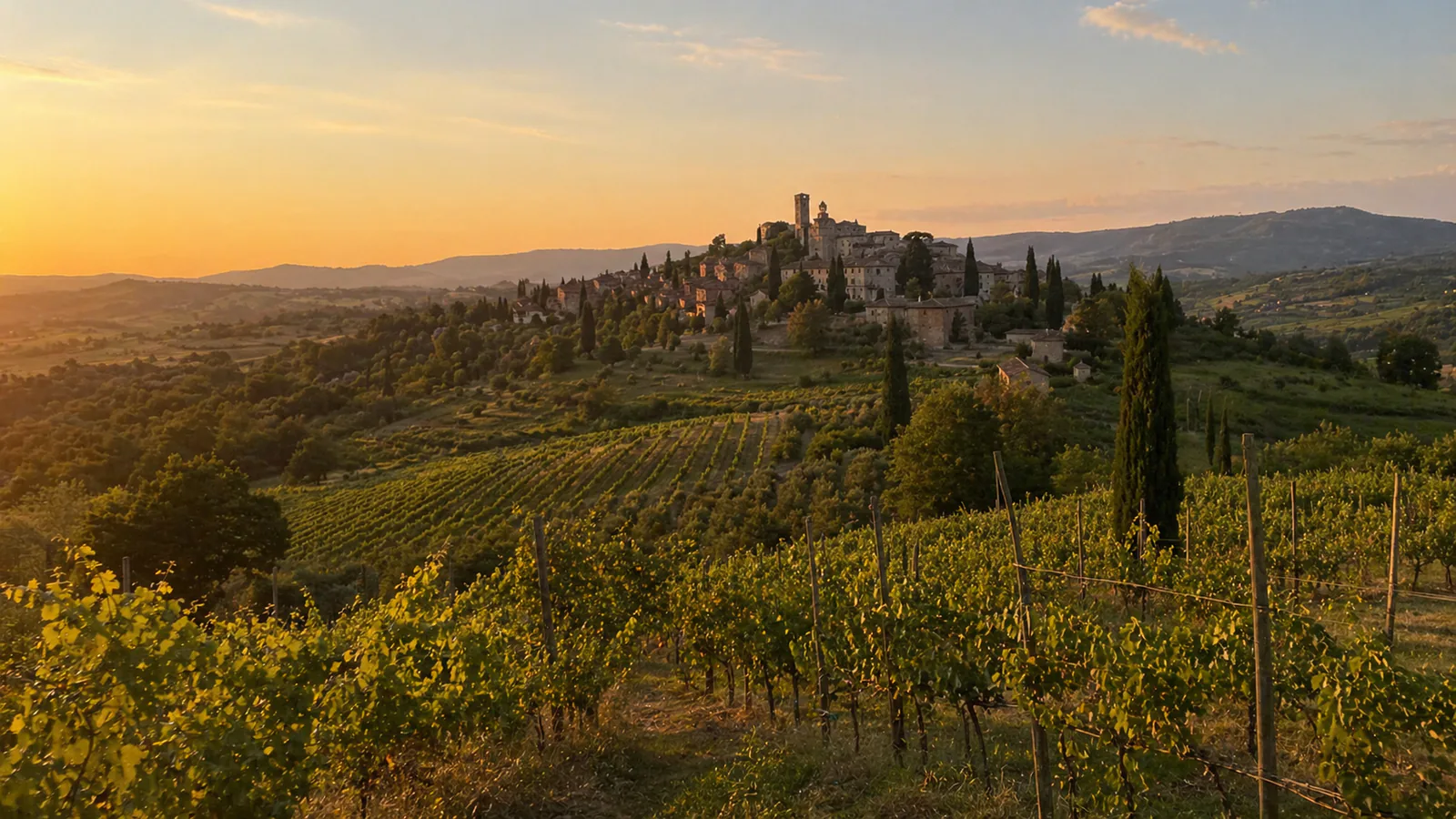
Tuscany sits in central Italy, the bit of the boot that includes Florence, Siena, and Pisa. It’s been making wine since the Etruscans, which means roughly 2,500 years of practice. The region produces a mix of reds, whites, and dessert wines, but its reputation is built almost entirely on red wine, and almost entirely on one grape.
The climate is classic Mediterranean. Warm, dry summers, mild winters, sea breezes off the Tyrrhenian coast, and a spine of hills running down the middle that gives the inland zones cool nights and altitude. Soils swing from the limestone and clay marls of Chianti to the volcanic and galestro shale of Montalcino to the gravel and sand of the coast. Each one stamps a different character on the same grape.
What ties everything together is food. Tuscan wine has been built for the Tuscan table for centuries: bistecca alla fiorentina, ribollita, pici with wild boar ragù, pecorino cheese with chestnut honey. The wines are savoury, bright, and acidic on purpose. They’re meant to cut through fat and meat, not sit on the sofa with you.
If you remember one thing: Tuscany is red wine country, Sangiovese is the grape, and food is the point.
What Grape Makes Tuscan Wine?
Sangiovese is to Tuscany what Pinot Noir is to Burgundy. Roughly two-thirds of all the vineyards in the region are planted with it, and every famous Tuscan red is either pure Sangiovese or has Sangiovese as the backbone.
The grape is a chameleon. In one village it tastes of sour cherry and tomato leaf. Drive an hour and it’s gone deep and brooding, all leather, dried herbs, and tobacco. Somewhere else it’s plummy and ripe. What stays constant is the structure: high acidity, firm tannin, and a savoury, slightly bitter finish that makes you want another bite of food.
A few clones of Sangiovese actually matter. Sangiovese Grosso (also called Brunello) is the bigger-berried version grown in Montalcino. Sangiovese Piccolo is the smaller-berried clone used across most of Chianti. Prugnolo Gentile is the local name in Montepulciano. Same grape family, slightly different expressions, three completely different wines in the glass.
The grape also tells you why Tuscan wine pairs so well with Italian food. The acidity refreshes your palate after every bite of olive oil and fat. The tannin grips meat protein. The savoury, herbal edge mirrors what’s already on the plate.
What Are Tuscany’s Three Famous Sangiovese Wines?
Tuscany’s reputation rests on three Sangiovese-based wines, each from its own zone, each with its own rules and price band.
Chianti and Chianti Classico
Chianti is the wine in the straw basket your parents drank in the 80s. It’s also some of the best-value red wine on the shelf right now, depending on which Chianti you grab.
The confusion comes from geography. There’s “Chianti” (a huge zone covering most of central Tuscany) and “Chianti Classico” (the original, smaller heartland between Florence and Siena, marked by the black rooster on the bottle). Chianti Classico has stricter rules: more Sangiovese in the blend, lower yields, longer aging. The bottles cost more because the wine inside is genuinely better.
Within Chianti Classico there are three quality tiers worth knowing. Annata is the entry level, drinkable young, around $20 to $30. Riserva spends longer in oak and tastes richer and more polished, around $30 to $60. Gran Selezione is the top tier, made from a single estate’s best fruit, often $60 to $120 and built to age.
Generic Chianti without “Classico” on the label can still be excellent, especially from Chianti Rufina, a small zone east of Florence known for elegance and longevity. Avoid the cheapest supermarket Chianti in the basket bottle. It exists for the basket, not the wine.
Brunello di Montalcino
Drive an hour south of Siena and you hit Montalcino, a hilltop town surrounded by vineyards. This is where Sangiovese gets serious. Brunello is 100% Sangiovese Grosso, aged a minimum of five years before release (six for Riserva), and routinely ranked among the greatest red wines in Italy.
The taste is a different planet to basic Chianti. Black cherry, dried rose, leather, espresso, balsamic, tobacco, and a structure that keeps the wine alive for 20 to 40 years in a good vintage. It’s powerful but never blunt. The acidity and tannin keep everything in line.
Prices start around $60 for entry-level bottles and climb past $300 for top producers like Biondi-Santi, Soldera, and Case Basse. The sweet spot for someone trying it for the first time is the $80 to $120 range, which buys you producers like Argiano, Il Poggione, or Altesino: world-class wine without paying the auction premium.
If $60 is too steep, the same zone makes a wine called Rosso di Montalcino. It’s Sangiovese from younger vines or earlier-released barrels, costs $25 to $40, and gives you a real taste of the Brunello character without the multi-year aging tax.
Vino Nobile di Montepulciano
The third corner of the Sangiovese triangle is Montepulciano, an hour east of Montalcino. Vino Nobile is made from at least 70% Sangiovese (locally called Prugnolo Gentile) and aged a minimum of two years before release. It sits stylistically between Chianti and Brunello: more body and structure than Chianti, less power and aging potential than Brunello.
It’s also the most under-priced of the three, often hovering in the $25 to $50 range for serious bottles. Producers like Avignonesi, Boscarelli, and Poliziano make wines that drink well above their price. If you’ve worked through Chianti Classico and want a step up without jumping to Brunello money, this is the move.
A note on naming: do not confuse Vino Nobile di Montepulciano (a Tuscan Sangiovese-based wine) with Montepulciano d’Abruzzo (a completely different grape from a completely different region, four hours south). Same word, two different wines, infinite confusion at the bottle shop.
The Super Tuscans
In the 1970s a few rebellious winemakers on the Tuscan coast got fed up with Italy’s wine laws. The rules said if you wanted a famous regional name on your bottle, you had to follow a fixed recipe: mostly Sangiovese plus a small amount of approved local grapes. Some producers wanted to plant Cabernet Sauvignon, Merlot, and Cabernet Franc. Others wanted to make pure Sangiovese without the mandatory white-grape blending that Chianti rules then required.
So they did it anyway. Their wines couldn’t legally call themselves Chianti or anything else, and got demoted to the lowest legal tier, “Vino da Tavola” (table wine). They sold them at premium prices regardless. Critics tasted them. Critics loved them. The press needed a name and “Super Tuscan” stuck.
The original three are the ones to know. Sassicaia (Cabernet Sauvignon and Cabernet Franc, first vintage 1968) was the wine that proved Bordeaux grapes could thrive on the Tuscan coast. Tignanello (Sangiovese with Cabernet Sauvignon and Cabernet Franc, first vintage 1971) showed that breaking the Chianti recipe could produce something extraordinary. Ornellaia (Bordeaux blend, first vintage 1985) is the third pillar.
The Italian government eventually caught up. In 1992 the IGT Toscana category was created so these wines had a legal home that didn’t punish them for being good. Today “Super Tuscan” isn’t an official term. It’s shorthand for premium Tuscan reds made outside the traditional rules.
Prices run from $40 for entry-level Super Tuscans like Tenuta San Guido’s “Le Difese” or Antinori’s “Tignanello”-adjacent bottlings, to $300+ for the flagships. Good middle ground around $80 to $150 includes wines like Antinori’s Solaia, Ornellaia’s “Le Volte,” and Argiano’s “Solengo.”
Other Sub-Regions Worth Knowing
Beyond the big three Sangiovese zones, Tuscany has a few other corners that produce serious wine.
Bolgheri sits on the Tyrrhenian coast and is the home of the Super Tuscan revolution. The climate is warmer and more maritime than inland Tuscany, and the wines are built around Cabernet Sauvignon, Merlot, and Cabernet Franc. Sassicaia and Ornellaia are both here. Expect $40 to $300 for a serious bottle, with stylistic ripeness closer to Bordeaux’s Left Bank than to Chianti.
Maremma is the broader coastal zone south of Bolgheri. It’s where you find the value end of the Super Tuscan idea: Bordeaux-blend reds and ripe Sangiovese at $20 to $50 from producers like Tua Rita, Le Pupille, and Petra. Worth a spot in any Tuscan exploration.
Carmignano, west of Florence, has been blending Sangiovese with Cabernet Sauvignon legally since 1716, when Grand Duke Cosimo III set the boundaries. It’s effectively a Super Tuscan that pre-dated the Super Tuscans by 250 years. Bottles run $25 to $60 and the style is elegant and savoury.
Whites and Dessert Wines
Tuscany’s reputation is red, but two whites and one dessert wine are worth knowing.
Vernaccia di San Gimignano is the region’s best-known white, made from the Vernaccia grape around the famous tower-stacked town. It’s crisp, lemony, slightly almondy, and has been documented since the 13th century. Decent bottles run $15 to $30 and pair perfectly with seafood pasta or fried calamari.
Vermentino, especially from coastal zones like Bolgheri and Maremma, is the other Tuscan white worth your time. Light, citrusy, with a saline, herbaceous character that suits warm weather and grilled fish. Around $18 to $35 buys you a great example.
Vin Santo is Tuscany’s traditional dessert wine and one of the most distinctive sweet wines on earth. Grapes (usually Trebbiano and Malvasia) are dried on straw mats for months, pressed, then aged for years in tiny barrels in attics where the wine cooks through summer and freezes through winter. The result is amber, nutty, sweet but not cloying, with flavours of caramel, dried apricot, walnut, and orange peel. The classic move is dunking a hard biscotti called cantucci into the glass. Half-bottles run $30 to $80 and a good one will outlive you.
What Tuscan Wine Tastes Like
Across the Sangiovese-based reds, the flavour signature is consistent. Sour cherry, dried tomato leaf, dried herbs (rosemary, thyme, oregano), leather, tobacco, sometimes a balsamic edge. The wines feel high-acid, medium-tannin, and savoury rather than fruity. They almost always taste better with dinner on the table than on their own.
Climb the price ladder and the wine gets more concentrated, more aromatically complex, and longer on the finish. Brunello adds depth, polish, and aging potential. Chianti Classico Riserva and Gran Selezione bring more layers and structure than basic Chianti. Top Super Tuscans add the plush, ripe, oak-influenced character of Bordeaux blends to the savoury Tuscan backbone.
Coastal wines (Bolgheri, Maremma) feel rounder and riper than inland Tuscan reds, because the climate is warmer and the grape mix often leans toward Bordeaux varieties.
What you won’t usually find in Tuscan wine: heavy oak, jammy fruit, sweetness, or low acidity. If a bottle tastes like that, it’s probably been chasing the American export shelf rather than the dinner table.
How Much to Spend
Tuscany has a wine for almost every budget, with quality scaling reasonably with price across most of the spectrum.
$10 to $15. Basic supermarket Chianti, often in a basket bottle. Drinkable at a pizza place, rarely memorable. Skip if you can; spend $5 more.
$18 to $30. The first sweet spot. Real Chianti Classico Annata, basic Vino Nobile, Rosso di Montalcino, coastal Vermentino, decent Vernaccia. This is where Tuscan wine starts being genuinely good and consistently food-friendly.
$30 to $60. Chianti Classico Riserva, serious Vino Nobile di Montepulciano, entry-level Bolgheri, mid-tier Super Tuscans. Wine for a dinner party where you want to impress without overspending.
$60 to $150. Brunello di Montalcino, Chianti Classico Gran Selezione, top Bolgheri, established Super Tuscans like Tignanello. The bottles you open for a real occasion or stash in the cellar for five years.
$150 and up. Cult Brunello producers, flagship Super Tuscans (Sassicaia, Ornellaia, Solaia, Masseto), and rare back-vintage bottles. You’re paying for vineyard reputation, scarcity, and aging potential as much as for what’s in the glass.
The honest upgrade path: jump from $12 supermarket Chianti to a $25 to $30 Chianti Classico from a real producer like Felsina, Fontodi, Castello di Ama, or Isole e Olena. The difference is night and day. Then, when you want to see what Tuscan wine can really do, save up for one $80 Brunello from a vintage like 2016, 2019, or 2020 and open it with a steak.
Frequently Asked Questions
What’s the difference between Chianti and Chianti Classico?
Chianti is a large zone covering most of central Tuscany. Chianti Classico is the smaller original heartland between Florence and Siena, marked by the black rooster (Gallo Nero) on the bottle. Classico has stricter rules: more Sangiovese in the blend, lower vineyard yields, and longer aging. Same grape, related styles, but Chianti Classico is consistently the better wine and worth the extra money.
What’s a Super Tuscan?
A Super Tuscan is a high-quality Tuscan red made outside the traditional regional rules, usually using Cabernet Sauvignon, Merlot, or Cabernet Franc alongside or instead of Sangiovese. The category started in the 1970s when rebel winemakers wanted to plant Bordeaux grapes. The wines now sit in the official IGT Toscana category. Famous examples include Sassicaia, Tignanello, Ornellaia, and Solaia.
Brunello vs Chianti: which is better?
Brunello is more powerful, more concentrated, longer-aging, and significantly more expensive. Chianti (especially Chianti Classico Riserva and Gran Selezione) is more food-friendly, more versatile, and better value for everyday drinking. Brunello is what you open for a celebration. Chianti is what you open with Tuesday’s pasta. They’re both excellent. They’re just not competing for the same job.
Why is Brunello so expensive?
Three reasons. First, the rules require a minimum five-year aging period before release (six for Riserva), which ties up huge amounts of capital and warehouse space. Second, Montalcino is a small zone with limited vineyard area and very high demand globally. Third, the wine itself is genuinely great, with a track record of aging 30+ years from top producers. Supply, time, and quality all push the price up.
What food pairs with Tuscan wine?
Tuscan reds were built for Italian food, so start there. Bistecca alla fiorentina (rare-cooked porterhouse) with Brunello or Chianti Classico Riserva. Pasta with meat ragù wants a mid-weight Chianti. Pizza margherita is happy with basic Chianti. Wild boar, duck, lamb, and aged pecorino all sing with Sangiovese. Avoid pairing Tuscan red with anything sweet or very spicy. The acidity and tannin will fight back.
Can you age Tuscan wine?
It depends on the bottle. Basic Chianti is built to drink within two to three years of release. Chianti Classico Riserva and Gran Selezione can age 8 to 15 years from a good vintage. Top Brunello can comfortably age 20 to 40 years. Super Tuscans vary: Sassicaia and Tignanello easily push past 20, while entry-level Super Tuscans drink best within 5 to 10. Buy based on when you actually plan to open the bottle.
Ready to put a real Tuscan red on the table this week? Start with a Chianti Classico from a producer like Felsina or Fontodi, or step up to a Rosso di Montalcino if you want a taste of Brunello character without the price tag.
See the full Italy wine guide or browse more red wine styles.
Keep Reading
Sangiovese: Italy's Most Important Red Grape
Sangiovese is the soul of Tuscany and the backbone of Chianti and Brunello. Here's what it tastes like, where to find it, and what to eat with it.
Italy Wine Guide: Regions, Grapes, and Where to Start
Italian wine made simple. The 20 regions, the grapes worth knowing, what DOCG means, and how to pick a bottle without overthinking it.
Pasta Wine Pairing: What To Pour With Every Sauce
The best wine with pasta by sauce, from tomato and bolognese to creamy carbonara, pesto, seafood pasta, and baked lasagna.