Claire Bennett
Wine Editor14 min read
Pasta Wine Pairing: What To Pour With Every Sauce
The best wine with pasta by sauce, from tomato and bolognese to creamy carbonara, pesto, seafood pasta, and baked lasagna.
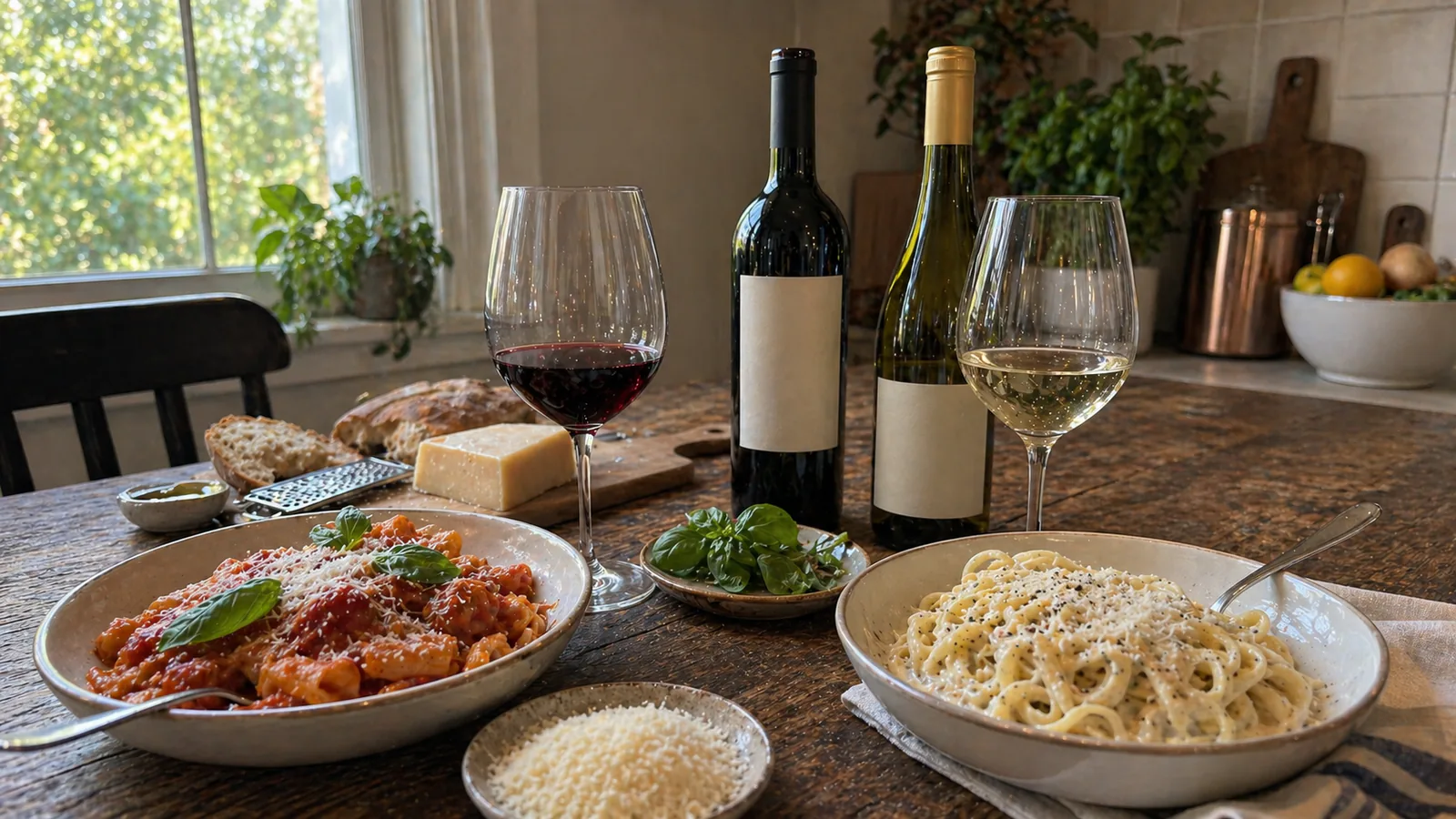
Pasta is the dish where most people freeze in front of the wine rack. You know you want something Italian-ish, you’ve heard “red with pasta” your whole life, and then you remember the pasta on the stove is creamy carbonara and now nothing makes sense. The good news is the rule is shorter than you think. Match the wine to the sauce, ignore the shape, and ninety percent of the work is already done.
By the end of this page you’ll know:
- The single question that decides every pasta wine match in under five seconds
- Why a glass of Chianti turns a bowl of bolognese into a Tuesday-night event, and which Italian red costs less and does the same job
- The white wine that handles cream sauces better than Chardonnay, even though nobody talks about it
- The one bottle you should never pour with carbonara, despite what half the internet keeps repeating
- The two-bottle setup that covers a dinner-party pasta course when you have no idea what your guests are eating
- Why pesto wants a different white than seafood linguine, even though both look “fresh and green” on the plate
What’s the One Rule for Pairing Wine With Pasta?
Pair the wine to the sauce. That’s the whole rule. The pasta itself is a neutral vehicle, so spaghetti, penne, rigatoni, and pappardelle all behave the same way in the glass. What changes the pairing is what’s coating the noodle.
Three quick reads tell you almost everything you need. Is the sauce acidic (tomato, lemon, capers)? Then the wine needs acidity to match. Is the sauce rich (cream, butter, cheese)? Then the wine needs body and freshness. Is the sauce meaty (slow-cooked ragu, sausage, oxtail)? Then the wine needs structure and a little tannin to keep up.
Once you have that read, the bottle picks itself. Acidic sauce plus acidic wine means a Chianti, a Barbera, or a Sauvignon Blanc, depending on whether you want red or white. Rich sauce plus body and freshness means a soft Chardonnay, a Pinot Grigio with real fruit, or a Pinot Noir if you want red. Meaty sauce plus structure means Sangiovese, Zinfandel, or Cabernet Sauvignon when the dish is built around lamb, beef, or game.
What Wine Goes With Tomato-Based Pasta?
Tomato sauce is acidic, savoury, and a little sweet from the slow cook. The wine has to match that acidity or the pairing tastes flat. Reach for medium-bodied reds with bright fruit and food-friendly acidity. Chianti, Sangiovese, Barbera, and Montepulciano d’Abruzzo are the obvious moves because they grew up at the same dinner table as the sauce.
Chianti with marinara is one of the great regional pairings on the planet. The wine’s tart cherry and herbal notes echo the basil and tomato in the sauce, the acidity scrubs the palate between bites, and the tannin is mellow enough to stay friendly with garlic and olive oil. A bottle of Chianti Classico for around twenty dollars handles spaghetti marinara, penne arrabbiata, and tomato-based puttanesca with no fuss.
Barbera is the sleeper. It has even brighter acidity than Chianti, lower tannin, and juicy red-fruit flavor that makes tomato sauce taste rounder. If you find yourself drinking pasta wines often, a good Barbera d’Asti or Barbera d’Alba is one of the smartest twenty-dollar bottles in the shop. Zinfandel is the New World move when the sauce is bigger or has chilli, sausage, or smoke.
If you want white wine with tomato pasta, pick something with real acidity and a little weight. Vermentino, dry Italian Rosato, and a crisp Falanghina all hold up. Pinot Grigio works if it has personality. Bland Pinot Grigio disappears beside marinara and the dish loses its lift.
| Wine | Food |
|---|---|
| Chianti | Spaghetti marinara, pasta puttanesca, baked ziti |
| Sangiovese | Tomato pasta with beef or pork ragu |
| Barbera | Penne arrabbiata, weeknight tomato pasta, sausage marinara |
| Zinfandel | Spicy marinara, sausage and peppers pasta, smoky tomato sauces |
| Vermentino | Cherry tomato pasta, pasta al pomodoro, lemon-tomato dishes |
What Wine Goes With Creamy Pasta and Alfredo?
Cream sauces need wine that brings two things at once. Body, so it doesn’t feel thin beside the sauce. Acidity, so it cuts the richness instead of disappearing into it. Unoaked Chardonnay is the cleanest answer. Chablis, Macon-Villages, and an honest Australian unoaked Chardonnay all work because they have apple-and-citrus flavor with enough freshness to keep alfredo, cacio e pepe, or four-cheese pasta from feeling heavy.
Big oaky Chardonnay with cream pasta is the classic mistake. It tastes correct on paper because both the wine and the sauce feel rich. In the glass it doubles down on butter and vanilla, and three bites in the dish starts to feel like dessert. Keep the oak restrained.
Pinot Grigio with a real backbone, like a good Alto Adige bottling, is the lighter move. It has pear and citrus flavors with enough acidity for cream, plus it disappears nicely behind the cheese. Soave is the regional Italian sleeper here. It is made from Garganega and gets unfairly written off because cheap supermarket bottles are dilute. A real Soave Classico is one of the best creamy pasta wines in the shop for under twenty dollars.
Carbonara is its own animal. Egg, pecorino, guanciale, black pepper, no cream involved despite what every American recipe tells you. The pairing wants something crisp with a little weight. Frascati, Verdicchio, and a steely unoaked Chardonnay all hit the mark. Avoid heavy reds with carbonara. Tannin and salty pork fat together can taste metallic.
What Wine Goes With Pesto and Olive-Oil Pasta?
Pesto is bright, herbal, and slightly fatty from the olive oil and pine nuts. The wine needs the same green energy. Sauvignon Blanc is the obvious pick because the grass-and-citrus profile mirrors basil and lemon almost perfectly. A Sancerre is the polished version. A New Zealand Sauvignon Blanc is the punchy weeknight version. Both turn pesto pasta into a pairing that feels engineered.
Vermentino is the Italian alternative. It has a faint herbal edge, lemony acidity, and a coastal feel that suits Ligurian-style pesto better than anything else. If you ever find yourself in a wine shop with a bowl of pesto on the brain, ask for Vermentino di Sardegna and stop second-guessing.
Aglio e olio, lemon pasta, and other olive-oil based dishes follow the same playbook. Crisp dry whites like Sauvignon Blanc, Vermentino, dry Riesling, and unoaked Chardonnay all complement the dish without smothering it. Avoid anything heavy. A big oaky white turns aglio e olio into a buttery flavor wash and the garlic stops singing.
Chardonnay can work with pesto if it has restraint. A ripe but unoaked Chardonnay with stone fruit, like a good Macon-Villages, plays nicely off the pine nuts and parmesan. Skip oak-bomb California Chardonnay here.
What Wine Goes With Seafood Pasta?
Seafood pasta is where wine pairing gets weirdly easy. Crisp white wine with bright acidity wins almost every time. Sauvignon Blanc, Albarino, Vermentino, Pinot Grigio, and unoaked Chardonnay all work because they keep the seafood tasting fresh and never bury delicate flavors.
Linguine alle vongole is one of the most rewarding pairings in Italian cooking. Pour a Soave Classico, a Verdicchio dei Castelli di Jesi, or a Vermentino, and the wine tastes saltier, the clams taste sweeter, and the dish lasts twice as long on the table. The same trio works with shrimp scampi, garlic prawns, and any white-wine seafood broth.
Lobster ravioli and crab pasta want more body. Chablis, Soave Classico, and a quality unoaked Chardonnay have enough texture to sit beside butter and cream while the acidity does the cleaning. If the dish leans toward saffron, tomato, or chorizo, swap to a dry rose or a light Grenache because the sauce has more weight.
Tuna pasta, salmon pasta, and squid ink pasta can handle a light red. Pinot Noir is the safest choice because it has cherry fruit, acidity, and earthy notes without the dry grip that makes red wine fight seafood. A chilled Gamay or a lighter Grenache also works when the dish has soy, mushrooms, char, or olives.
| Wine | Food |
|---|---|
| Sauvignon Blanc | Lemon pasta, pesto, prawn linguine, herb sauces |
| Vermentino | Linguine alle vongole, pesto, shrimp pasta, lemon-butter dishes |
| Soave Classico | Vongole, crab pasta, creamy seafood, weeknight white wine pasta |
| Pinot Grigio | Lighter cream sauces, herb pasta, white-fish linguine |
| Pinot Noir | Salmon pasta, tuna pasta, mushroom ravioli |
What Wine Goes With Baked or Cheesy Pasta Like Lasagna?
Baked pasta is the heaviest version of itself. Lasagna, baked ziti, manicotti, and four-cheese pasta combine slow-cooked sauce, melted cheese, and either ricotta or bechamel. The wine needs body, real acidity, and enough fruit to stand up to all of that without feeling jammy.
Sangiovese is the headline answer for traditional lasagna with meat ragu. The bright cherry fruit cuts through the cheese, the herbal edge echoes the tomato, and the tannin gives the meal structure. Chianti Classico Riserva is the upgrade. Brunello di Montalcino is the celebration version when the lasagna is the only thing on the table.
Zinfandel is the bigger, friendlier American option. It has plush red and black fruit, soft tannin, and a peppery edge that suits sausage, ricotta, and tomato together. A good California Zinfandel for around twenty-five dollars is one of the best baked-pasta wines you can buy. Cabernet Sauvignon also works, but only when the lasagna has serious meat and salt. With a lighter, creamier vegetable lasagna, Cabernet can taste too dry.
White lasagna and four-cheese baked pasta need different wines. The dish is creamier, less acidic, and dominated by cheese. Reach for unoaked Chardonnay, Pinot Bianco, or a richer Soave. A demi-sec Vouvray made from Chenin Blanc is a sleeper move because the slight sweetness rounds out the cheese and keeps the dish from feeling claggy.
What Wine Goes With Meat-Heavy Pasta Like Bolognese?
Bolognese is a slow-cooked meat sauce. Beef, pork, sometimes pancetta, soffritto, tomato, and a long simmer. The wine has to match that depth. Sangiovese is the Italian classic and almost never wrong, especially a Chianti Classico or a Vino Nobile di Montepulciano. The wine’s acidity cuts the richness while the cherry-and-leather notes feel like they belong on the same table. The bigger map of the country’s regions sits in the Italy wine guide.
Barbera is the Piedmont answer when bolognese is the dish. It has even more acidity, lower tannin, and a juiciness that suits the long-cooked meat. A Barbera d’Alba beside a bowl of pappardelle al ragu is the kind of pairing that makes people put their phone down.
Cabernet Sauvignon, Merlot, and Syrah all work with bolognese when the sauce is rich and the cheese is heavy. Cabernet adds blackcurrant and cedar. Merlot stays softer and rounder. Syrah brings pepper and smoke, which is excellent if the ragu has a few hits of fennel or chilli. Skip very young, very tannic Cabernet because the meat alone cannot soften it.
Rich meat dishes like American-style carbonara (made with cream and bacon) actually want a lighter wine. The wine needs to cut through the richness. A glass of Frascati or a steely Verdicchio works much better than reaching for a big red. The pairing rule still holds. Meat does not always mean red.
What Are the Most Common Pasta Wine Pairing Mistakes?
Even people who pour wine for a living walk into these. The good news is once you know them, they stop happening.
Pouring big red wine with cream pasta. Cabernet Sauvignon and alfredo is one of the worst common pairings on the menu. The tannin grips the dairy fat and turns metallic, the wine tastes hollow, the pasta tastes flat. Reach for unoaked Chardonnay, Pinot Grigio, or Pinot Noir instead.
Treating all tomato sauce the same. A bright marinara wants a livelier wine than a six-hour slow-cooked sugo. Marinara wants Barbera or Chianti. Slow-cooked ragu wants Sangiovese Riserva, Brunello, or a serious Cabernet. Match the weight of the sauce first. Color decisions come after.
Pouring oaky Chardonnay with everything creamy. Oak plus cream plus butter plus cheese tastes like a vanilla milkshake. Use Chardonnay with body but restrained oak, or pivot to Soave, unoaked Chardonnay, or a real Pinot Grigio.
Forgetting the sauce on baked pasta. Lasagna with meat ragu and lasagna with vegetables and bechamel are different dishes. The first wants Sangiovese or Zinfandel. The second wants Chardonnay or Pinot Bianco. The pasta is the same. The pairing is not. For the cousin cuisine, see the pizza wine pairing guide.
Defaulting to red wine with pasta out of habit. White wine wins more pasta pairings than people think. Carbonara, cacio e pepe, vongole, lemon pasta, pesto, and lighter cream dishes all do better with white wine. The phrase “red with pasta” was never a rule. It was a generalisation that stuck around.
Frequently Asked Questions
What is the best wine to pair with pasta?
The best wine with pasta depends entirely on the sauce. Tomato pasta wants medium-bodied red wines like Chianti, Sangiovese, Barbera, or Zinfandel. Creamy pasta dishes want unoaked Chardonnay or a real Pinot Grigio. Pesto and lemon pasta want Sauvignon Blanc, while seafood pasta is happiest with Vermentino, Soave, or Pinot Grigio. When in doubt, match the wine’s weight and acidity to the sauce.
Does pasta go better with red or white wine?
Both work, and the sauce decides. Red wine pasta pairings shine with tomato, meat ragu, and baked dishes like lasagna. White wines pair well with cream sauces, pesto, seafood pasta, and lighter olive-oil dishes like aglio e olio. The “red with pasta” rule is a lazy generalisation. Once you ignore it and read the sauce instead, the pairing gets a lot easier.
What wine goes with spaghetti bolognese?
Sangiovese is the classic answer for bolognese, particularly Chianti Classico or Vino Nobile di Montepulciano. Barbera d’Alba is the friendlier Piedmont option with brighter acidity. If you want a New World red, a soft Cabernet Sauvignon, a fruit-forward Zinfandel, or a Cotes du Rhone all work because they have body and acidity together.
What wine goes with carbonara?
Carbonara wants crisp white wine with weight, never a heavy red. Frascati, Verdicchio dei Castelli di Jesi, Soave Classico, and a steely unoaked Chardonnay all flatter the egg, pecorino, and guanciale. Avoid Cabernet Sauvignon and other big tannic reds because they fight the salty pork fat and turn metallic.
What wine goes with pesto pasta?
Sauvignon Blanc is the headline pairing for pesto because the grass-and-citrus character mirrors basil and lemon almost perfectly. Vermentino is the Italian alternative and arguably the better fit with Ligurian-style pesto. Skip oaky Chardonnay because the butter and vanilla flatten the bright herbal flavors.
What wine goes with lasagna?
Traditional meat lasagna loves Sangiovese, Chianti Classico Riserva, and full-bodied Zinfandel. Cabernet Sauvignon works when the lasagna is heavy on beef and salt, but it can taste too dry with lighter vegetable versions. White lasagna and four-cheese baked pasta want unoaked Chardonnay, Pinot Bianco, or a demi-sec Vouvray to round out the cheese.
What wine goes with seafood pasta?
Crisp white wines with bright acidity are the safest move with seafood pasta. Sauvignon Blanc, Vermentino, Soave Classico, Pinot Grigio, and unoaked Chardonnay all work. For salmon, tuna, or squid ink pasta, a light Pinot Noir or chilled Gamay can step in. Avoid heavy oaked whites and big tannic reds because they fight the seafood and bury the dish.
Pasta gets a lot easier once you stop chasing the perfect wine for every shape and start reading the sauce instead. Acidity for tomato, body for cream, structure for meat, freshness for seafood and herbs. For a printable cheat sheet covering steak, chicken, seafood, cheese, and more, head to the full wine pairing chart.
Keep Reading
Sangiovese: Italy's Most Important Red Grape
Sangiovese is the soul of Tuscany and the backbone of Chianti and Brunello. Here's what it tastes like, where to find it, and what to eat with it.
Pizza Wine Pairing: What to Pour With Every Slice
The best wine with pizza by style: Sangiovese with margherita, Zinfandel with pepperoni, Chardonnay with white pizza, plus the bottle for mixed tables.
Italy Wine Guide: Regions, Grapes, and Where to Start
Italian wine made simple. The 20 regions, the grapes worth knowing, what DOCG means, and how to pick a bottle without overthinking it.