
Claire Bennett
Wine Editor11 min read
Wine Etiquette: What Actually Matters at the Table
The wine etiquette rules that genuinely matter, the ones you can ignore, and how to drink confidently around people who care too much.
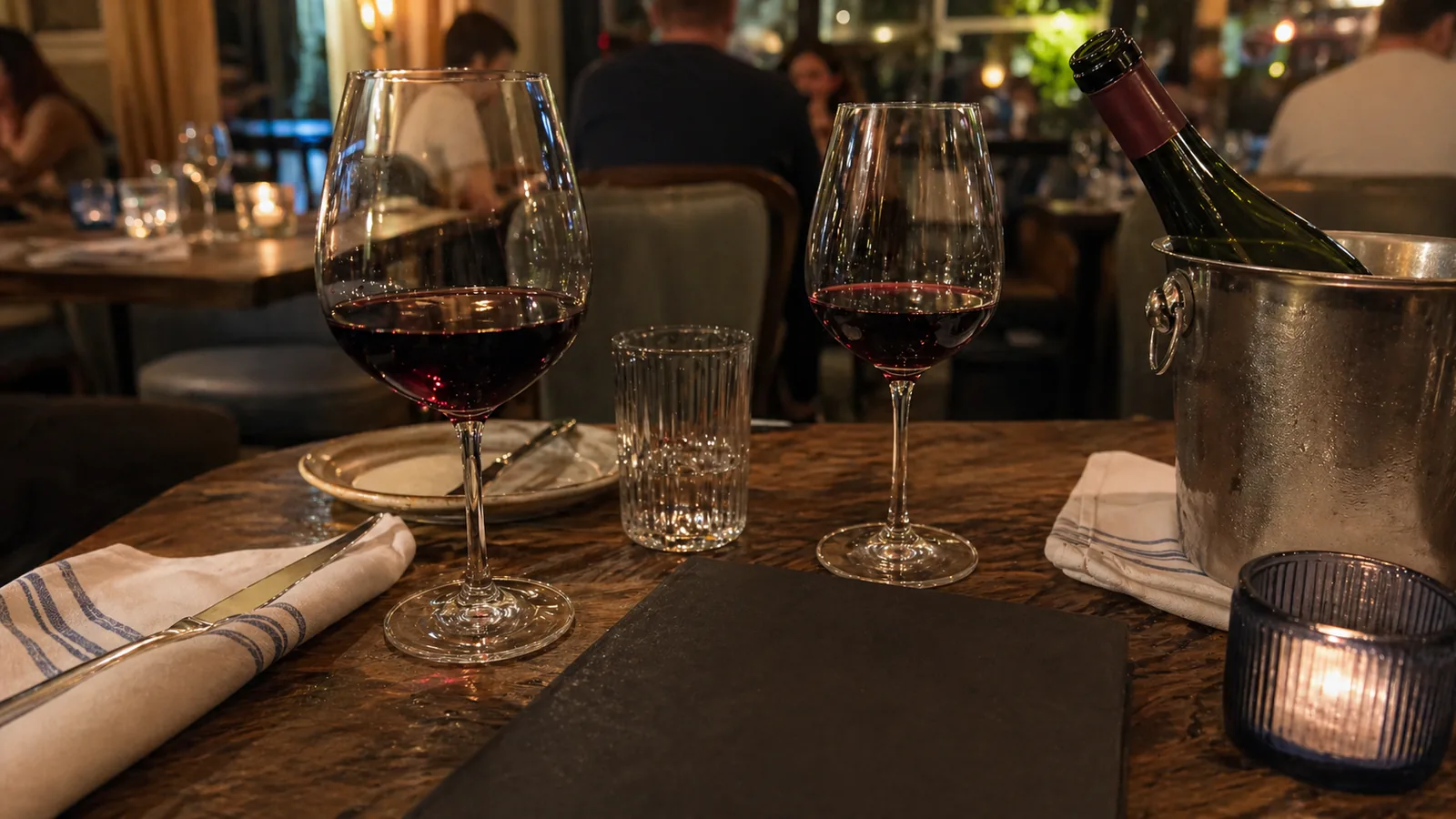
Real wine etiquette comes down to about four rules. Two are practical: they change how the wine actually tastes. Two are social: they change how the evening reads. Everything else is invented tradition layered on top of those four to make people feel like they’re doing it wrong. This page covers what actually matters at the table, what you can safely ignore, and the two-second move that handles any wine-snob moment without requiring you to know more than they do.
By the end of this page you’ll know:
- The fill rule the best restaurants use, and why over-pouring is the rookie giveaway
- Why holding the bowl of a red wine glass actually does change how it tastes within a few minutes
- The two-second move that defuses any wine-snob moment without you having to know more than them
- What to bring to dinner when you have $20 to spend, and the bottle range that gets opened on the night vs quietly shelved
- The exact phrase that lets you decline a top-up without making the host worry they’re a bad host
- The thing to never do when someone hands you the cork at a restaurant, and what to do instead
What Should I Bring When I’m Invited to Dinner?
Bring a bottle in the $20 to $30 range if you’re a regular guest, $30 to $50 if it’s something special or you don’t know the host that well. Below $15 reads as throwaway. Above $60 can feel showy unless the host is genuinely a wine person.
Pick something the host can keep if they want to. Open bottles get opened. A nice bottle that doesn’t fit the menu often gets shelved for another night, which is also fine. Don’t be offended if your bottle doesn’t appear at the table. The wine the host already chose has been paired with the food they cooked. Yours is a thank-you, not a contribution to the menu.
If you know the host well enough to ask, ask. “Want me to bring a red, a white, or something fizzy?” saves everyone the guessing game. If you don’t know them well, default to a medium-bodied red. Pinot Noir, Grenache, or a softer Tempranillo go with most things and offend almost nobody.
Who Pours the Wine, and How Much Goes in the Glass?
The host pours at a private dinner. The server pours at a restaurant. If you’re the host, the order is: pour a small splash for yourself first to catch any cork bits, then go around the table. If you’re a guest, wait to be poured to. Reaching across to top yourself up before the host has finished pouring everyone else reads as impatient.
The fill rule: red wine to about a third of the glass, white to about halfway, sparkling to two-thirds of a flute. The reason isn’t aesthetics. A third-full red glass leaves room for swirling without sloshing, which is what releases the aromas. Filling the glass to the top traps the wine and dulls the smell, which is doing 80% of the work in tasting.
If you’re hosting and someone’s glass is empty, top it up before they have to ask. If they put a hand over the glass, that’s the universal “I’m fine, thank you” gesture. Don’t push.
At a restaurant, the server should be checking your glass without you flagging them down. Good service means a refill arrives at the right moment without anyone having to ask. If your glass keeps emptying and nothing’s coming, it’s fine to catch the server’s eye and gesture politely.
Why Do People Hold the Glass by the Stem?
Two real reasons, both physics. First, your hand is roughly 36°C. White wine wants to be served around 8°C to 12°C, red around 15°C to 18°C. Cup the bowl for five minutes and you’ve warmed your wine past its sweet spot, which mutes the acidity and makes the alcohol stand out more. Hold the stem and the wine stays where it should.
Second, fingerprints on the bowl. When you tilt the glass to look at the colour or sniff over the rim, smudges get in the way. Holding the stem keeps the bowl clean and the visual clear.
For stemless glasses, the trick is to hold them by the base rather than the bowl. It feels a little awkward the first time. After a couple of pours it becomes automatic. The full breakdown of grip mechanics lives in how to hold a wine glass. If the glass is so cold from the fridge that the base is ice, you can briefly hold the bowl, just don’t park your hand there.
Cradling the bowl looks confident in films. In real life, anyone who knows wine notices it within a minute, and your wine warms up faster than you’d think.
How Do I Toast Without Looking Awkward?
Make eye contact, raise your glass to about chin height, and say what needs saying. That’s it.
The clinking question gets asked a lot. The honest answer is regional. In most of Europe, glasses touch and people meet eyes one by one as they say “cheers” or the local equivalent. In some American and Australian circles, the touch is light or skipped entirely, especially with delicate stemware. Either is fine. The non-negotiable is the eye contact. Skipping it is the bit that actually feels rude.
If you’re toasting fine crystal, touch glasses gently at the bowl, not the rim. Rim-to-rim chips them faster. If it’s everyday stemware, you can clink with normal force.
A toast is meant to be short. One or two sentences. “Thanks for having us, this is exactly where I wanted to be tonight” lands every time. Long toasts at small tables make everyone hold a heavy glass while the soup goes cold.
How Do I Sit Through a Dinner With Wine Snobs?
Two moves. First, ask them about the wine before they get the chance to lecture you. “What am I drinking? It’s lovely.” That gives them the floor without them having to take it. People who care a lot about wine usually just want a chance to talk about it. Hand them that chance and the dynamic flips: you’re the curious one, not the one being tested.
Second, when they say something you don’t understand, don’t fake it. “What does it mean when you say it’s tannic?” reads as confident, not clueless. People who know wine love explaining it to people who care enough to ask. Pretending to know terms you don’t know is the only way to actually feel small at the table.
If they’re being snide rather than informative, the move is to laugh and change the subject. “I’ll take your word for it. What I know is I’m having a good time.” It’s hard to be a snob in the face of someone enjoying themselves more than you are.
How Do I Politely Decline More Wine?
Place your hand briefly over the glass and say “I’m good for now, thanks”. Most hosts and servers will read it instantly. If they reach for the bottle anyway, a soft “really, I’m fine” closes it without anyone losing face.
If you’re not drinking at all that night, lead with that early. “I’m not drinking tonight, but please don’t hold off on my account” lets the host pour everyone else without doing the awkward dance of pouring and then noticing your glass is full.
Don’t tip out a poured glass to refuse the next one. Don’t say “I don’t drink red” mid-pour. The polite version is to take what’s offered, sip a little, and let it sit. The host has chosen this wine and made an effort. If you need to pace yourself, water glasses between sips do most of the work.
If someone keeps trying to top you up because they’re enthusiastic rather than pushy, “I’m savouring this one” is the sentence that buys you ten more minutes without them feeling rejected.
What Do I Do If I Spill?
Apologise once, then move on. Don’t dab at it forever. White wine on white tablecloth: blot, don’t rub, with a napkin or paper towel, then sprinkle salt. Red wine on white tablecloth: blot first, then pour white wine on it (yes, white wine genuinely lifts red), then salt or club soda. Cold water and salt is the home cure. The host’s tablecloth is rarely the problem people think it is. Their dinner is.
Red wine on a guest’s clothes is more delicate. Hand them paper towels and ask quickly if they want salt or club soda. Don’t dab them yourself. Keep moving. The mood of the dinner is more important than the carpet, and a host who handles a spill calmly sets the tone for the whole evening.
If you spilled, offer to replace the cloth or pay for cleaning. Most hosts will wave you off. The offer is what matters.
What’s the Etiquette for Hosting With Wine?
Open the first bottle a few minutes before guests arrive so reds can breathe. Have a white in the fridge ready. (The wine serving temperature guide covers exactly how cold each style should land.) Pour a welcome drink within five minutes of someone walking in. A glass in hand turns a stranger into a guest faster than anything else.
Keep glasses topped up but never to the brim. Aim for a third on reds, half on whites. If a guest’s glass keeps emptying within minutes, slow down on the food. If a glass is barely touched, switch styles. The wine you love isn’t always the wine they want.
Have water on the table from the start, not as an afterthought. People drink wine at the right pace when there’s a glass of water within reach. Without it, they either over-drink or stop drinking your wine to ask for water and break the rhythm of the meal.
Don’t quiz guests on the wine. “What do you think?” is a friendly question. “Can you guess the region?” is a test. People remember the dinners where they felt at ease, not the ones where they got asked to perform.
What About Restaurant Wine Etiquette?
Restaurant rituals look stiffer than they are. Most of them are practical when you understand what they’re checking for.
The bottle presentation: the server brings the bottle to the table and shows you the label. You’re checking that they brought the wine you ordered. Vintage, producer, varietal. If the wrong year arrived and you specifically wanted a different one, this is the moment to mention it. If the label matches, nod and they’ll open it.
The cork: the server may set the cork down or hand it to you. Don’t sniff the cork. Don’t put it to your ear. Don’t make a show of inspecting it. Look at it briefly to see that it’s intact and not soaked through. That’s all the cork tells you. The wine itself does the talking.
The splash taste: the server pours about an ounce. You’re checking for one thing: is the wine flawed? Cork taint smells like wet cardboard or a damp basement. Oxidation smells flat and stale, like sherry when the wine isn’t sherry. If something is genuinely wrong, say so calmly: “I think this is corked, would you mind tasting it?” A good server will swap it without fuss. If the wine is fine but you don’t love it, that’s not grounds to send it back. You ordered it.
If you didn’t order it, you can absolutely send it back. Just be polite and quick about it.
Frequently Asked Questions
Should I always swirl my wine before tasting?
Swirling helps reds and oaked whites release their aromas, so yes, it’s worth doing on most wines you’re paying attention to. For sparkling, skip it. The bubbles do the aroma work for you, and swirling flattens them. For light, crisp whites, a gentle swirl is enough.
Is it rude to ask for a wine recommendation at a restaurant?
The opposite. Sommeliers exist for this exact moment. Tell them your budget, what you’re eating, and one wine you’ve enjoyed before. They’ll find something that fits. Asking is confidence, not weakness.
Can I bring my own bottle to a restaurant?
Sometimes, with corkage. Call ahead. Many restaurants charge between $15 and $40 to open a bottle you’ve brought, and most won’t allow a bottle that’s already on their list. If you’re celebrating something specific or have a wine that means something, it’s worth the call.
What do I do if I’m allergic or sensitive to wine?
Sulfite sensitivity is real but rarer than people think. Histamine sensitivity is more common with reds. If you genuinely react, tell the host privately before the dinner so they can offer something else. At a restaurant, ask the server. Most lists have low-sulfite or natural options if you ask.
Is it ever okay to add ice to wine?
In the summer, on a hot day, with a glass of crisp white or rose? Absolutely. Anyone who tells you otherwise is performing. Plenty of European producers will pop a cube into a glass of vinho verde or a young rose without thinking twice. The wine you enjoy is the wine you’re drinking right.
How long should I keep a bottle a guest brought before opening it?
If it goes well with the meal, open it. If not, set it aside and send a thank-you the next day. There’s no time limit. Some hosts open every guest bottle on the night, some keep them for the next dinner. Either is correct. The bottle was a gift.
Wine etiquette is mostly about reading the room. Get the four basics right (stem, fill, eye contact, host pours first) and the rest is just being a good guest. Want to keep building the confidence? Read how to taste wine next, or how to order wine at a restaurant for the next time you’re handed a list.
Keep Reading

How to Hold a Wine Glass (and Why It Matters)
The grip that keeps your wine at the right temperature, the swirl that releases the aroma, and the shortcut for stemless glasses.
How to Order Wine at a Restaurant Without Panicking
Read any wine list in 30 seconds, talk to the sommelier with three magic phrases, and handle the bottle approval ritual without sweating.
Wine Serving Temperature Guide (Cheat Sheet)
Exact serving temps for every wine style, the 20-minute rules for fixing fridge wine, and why room temperature is a 1700s lie.