
Claire Bennett
Wine Editor12 min read
Wine Body Explained: Light, Medium, or Full?
How to tell light, medium, and full-bodied wines apart, what actually causes body, and how to match it to food so dinner stops feeling random.
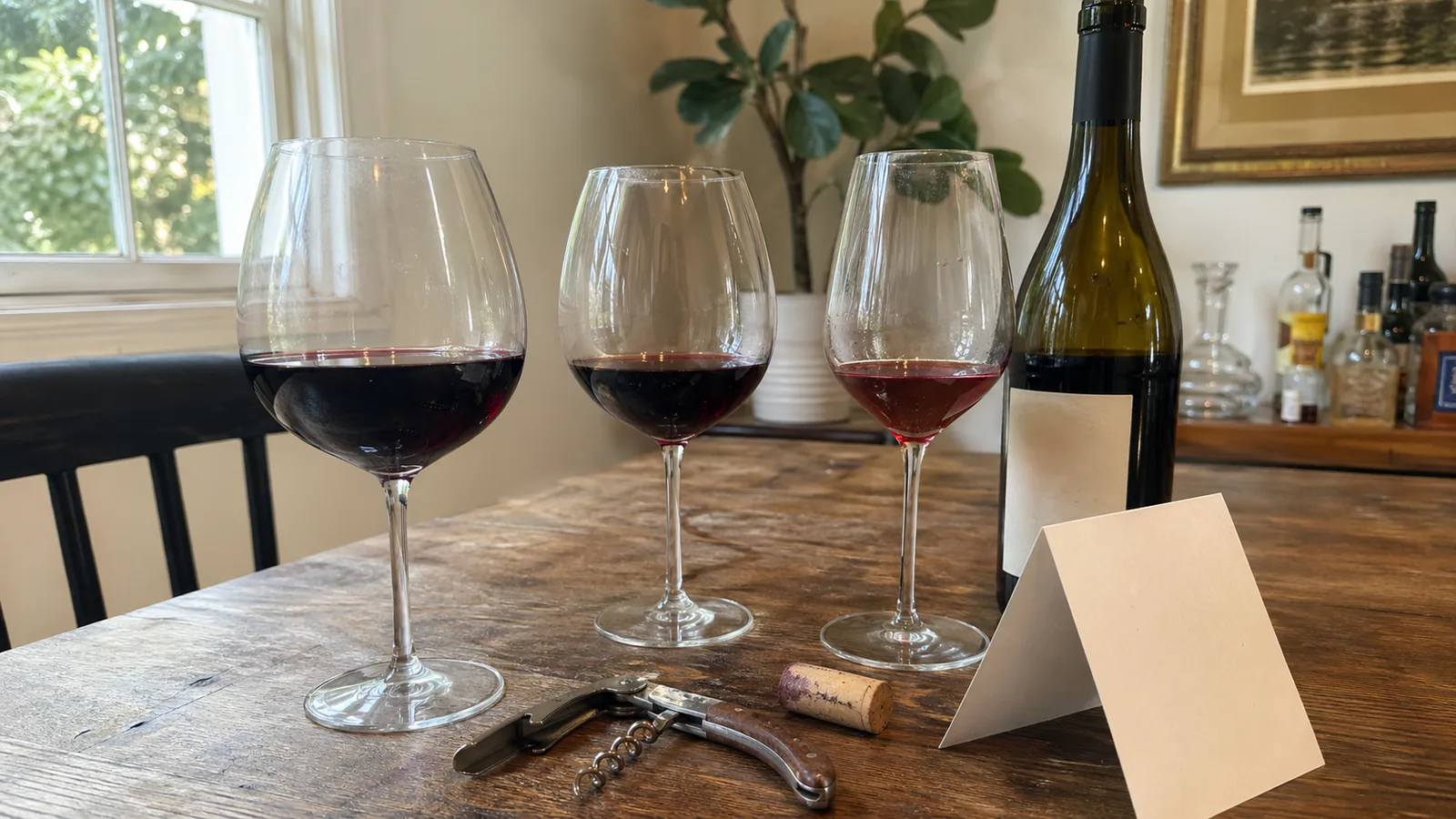
You pour a Pinot Grigio at lunch and it disappears off your tongue like sparkling water. That night you open a buttery Chardonnay and it sits in your mouth like cream. Same drink, same colour, completely different feel. Body is what changed. Once you can sense it, you stop ordering wines that fight your food and start picking ones that lift it.
By the end of this page you’ll know:
- The skim-vs-whole-milk test that lets you spot a wine’s body in two seconds
- The four things in a wine that build body (and the one thing that doesn’t, even though everyone thinks it does)
- Why a 14.5% Zinfandel feels heavier than a 12% Pinot even with the same grape concentration
- The “legs” myth (and what those streaks down your glass actually tell you)
- A weight-matching cheat sheet that solves about 80% of dinner pairings on its own
- Which grapes default to light, medium, or full so you can read the rough body off any wine list
What Does “Wine Body” Actually Mean?
Body is the weight and texture of the wine in your mouth. It’s not the flavour. It’s the physical sensation of how dense the liquid feels on your tongue.
The cleanest reference point is milk. Pour skim milk and pour whole milk, and feel each one on your tongue. Same colour. Same general taste. Completely different weight. The whole milk coats your palate and lingers; the skim feels watery and is gone before you swallow. That’s body.
Wine works the same way:
- Light-bodied feels like skim milk or water with personality. The wine moves quickly off your tongue. Examples: Pinot Grigio, Riesling, Beaujolais, Pinot Noir from cool sites.
- Medium-bodied feels like 2% milk or a glass of orange juice. There’s weight but the wine still flows. Examples: Sangiovese (Chianti), Merlot, unoaked Chardonnay, Sauvignon Blanc from warmer regions.
- Full-bodied feels like whole milk or a smoothie. The wine coats your mouth and stays. Examples: Cabernet Sauvignon, Syrah/Shiraz, Malbec, oaked California Chardonnay.
Body is independent of colour. There are light reds and full whites. A Pinot Noir is lighter than a Chardonnay aged in new oak, even though one is red and one is white. People who default to “red equals heavy, white equals light” miss this all the time and end up with a fish dish drowned by an oaked Chardonnay because they ordered a “lighter” wine.
What Determines a Wine’s Body?
Four real factors, and one famous red herring.
Alcohol. This is the biggest single driver. Alcohol carries weight on the palate. A wine at 14.5% feels noticeably heavier than the same wine at 12%. Anything under 12% will lean light-bodied; anything 14% or higher will lean full-bodied. The middle ground (12.5 to 13.5%) is usually medium. Cool climates produce lower-alcohol wines (lighter body); warm climates produce higher-alcohol wines (fuller body).
Residual sugar. Sugar adds viscosity. A semi-sweet Riesling feels heavier than a bone-dry one even at the same alcohol. This is why dessert wines feel almost syrupy: high sugar, often high alcohol, and the body is huge.
Glycerol and extract. These are the technical terms for the dissolved compounds beyond water and alcohol. Riper grapes produce more glycerol (a slightly sweet, viscous liquid produced during fermentation) and more “extract” (the dissolved solids from the skin and pulp). Both add weight. This is why a wine made from very ripe grapes feels denser than one made from underripe grapes at the same alcohol.
Oak ageing. Time in oak adds body in a few ways. Oak imparts vanillins and lignins that thicken the texture. It also allows tiny amounts of evaporation through the wood, concentrating the wine. An oaked Chardonnay feels distinctly heavier than the same juice aged in stainless steel. This is the single biggest reason California Chardonnay feels so different from Chablis.
The red herring: tannin. Tannin makes a red feel structured and grippy, but it doesn’t actually add body. A high-tannin wine can feel chewy on your gums while still being medium-bodied (think Nebbiolo, which has fierce tannin but a surprisingly graceful weight). Body and tannin are related but separate. Don’t confuse “grippy” with “heavy.”
The shorthand: high alcohol + ripe fruit + oak = full-bodied. Low alcohol + cool climate + stainless steel = light-bodied. Everything else falls between.
What Are Some Light, Medium, and Full-Bodied Wine Examples?
Here’s a working map you can use the next time you’re staring at a wine list.
Light-bodied whites:
- Pinot Grigio (Italian, the lean style)
- Riesling (Mosel, Alsace dry)
- Vinho Verde
- Albarino
- Muscadet
- Picpoul
- Most unoaked Sauvignon Blanc from cool regions
Medium-bodied whites:
- Sauvignon Blanc (warmer regions like California, Chile)
- Unoaked or lightly-oaked Chardonnay (Chablis, cooler Australian)
- Gruner Veltliner
- Chenin Blanc
- Pinot Gris (the richer Alsatian style)
- Most rose wines
Full-bodied whites:
- Oaked Californian Chardonnay
- Australian Chardonnay (Margaret River, Yarra Valley)
- Viognier
- White Rhone blends (Marsanne, Roussanne)
- Late-harvest and sweet wines (Sauternes, Tokaji)
Light-bodied reds:
- Pinot Noir (especially from Burgundy, Oregon, cool climate Australia and New Zealand)
- Gamay (Beaujolais)
- Schiava
- Most Lambrusco
- Cool-climate Trousseau and Poulsard from the Jura
Medium-bodied reds:
- Sangiovese (Chianti, Brunello)
- Tempranillo (Rioja, Ribera del Duero)
- Grenache (lighter styles)
- Merlot (most styles)
- Cabernet Franc
- Barbera
- Most Italian reds (Dolcetto, Valpolicella)
Full-bodied reds:
- Cabernet Sauvignon (especially Napa, Coonawarra, warm Bordeaux)
- Syrah/Shiraz (Australian, Northern Rhone)
- Malbec (Argentina)
- Zinfandel
- Petite Sirah
- Amarone
- Most warm-climate New World reds
A grape isn’t locked to one body slot. A Pinot Noir from a hot vintage in Sonoma can feel medium-bodied. A Cabernet from a cool corner of New Zealand might feel medium too. Use this map as the rough default, then trust your mouth on the actual bottle.
How Does Body Match Food?
The classic rule: match the weight of the wine to the weight of the food. Heavy food, heavy wine. Light food, light wine. Get this right and 80% of pairings work without any further thought.
Light wines for light food: delicate fish, raw oysters, salads, sushi, light pasta in oil and herbs, soft cheeses. A Chardonnay aged in new oak will steamroll any of these. A Pinot Grigio or unoaked Riesling lets the food come through.
Medium wines for medium food: roast chicken, grilled vegetables, charcuterie, semi-hard cheeses, mushroom dishes, pasta with tomato or simple cream sauces. Sauvignon Blanc, unoaked Chardonnay, Chianti, Pinot Noir, Tempranillo all work in this band.
Full wines for full food: steak, lamb, braised meats, BBQ, hard aged cheeses, rich pasta with cream and cheese, anything with deep umami. Cabernet, Syrah, Malbec, oaked Chardonnay if the protein is poultry-based. Our best full-bodied red wines round-up has bottle picks if you want to try the heavyweights.
A delicate fish doused in butter sauce moves up a band: the dish has become rich, so the wine should match. A steak in a delicate jus pulls down a band: the meat is heavy but the dish is restrained, so a medium red plays nicer than a full-throttle Cab.
How Does Climate Affect Wine Body?
Climate sets the ceiling on body. Warm regions ripen grapes more, producing higher sugar (and therefore higher alcohol), more concentrated fruit, and more glycerol. All three add body. Cool regions do the opposite: less sugar, less alcohol, brighter acid, lighter feel.
This is why the same grape can taste like two different wines depending on where it grew:
- Pinot Noir from Burgundy (cool): light, ethereal, often around 12.5% alcohol, feels like silk.
- Pinot Noir from Sonoma Russian River (warmer): often 14% alcohol, riper fruit, medium-bodied, feels juicy.
- Pinot Noir from a hot Californian vintage: can push into full-bodied territory, almost Syrah-like.
It’s also why the cool-climate movement matters. Producers searching for elevation, ocean influence, or cooler vineyards are chasing freshness and lighter body. Some of the most exciting wines of the past decade have come out of regions like Tasmania, the Mornington Peninsula, and the upper reaches of the Adelaide Hills. These are places where the grapes ripen slowly and the wines stay lifted.
The vintage matters too. A hot year produces fuller, riper wines from the same vineyard that might make medium-bodied wines in a cooler year. Vintage charts often note “ripe and powerful” or “lifted and elegant” precisely because of how each year nudged the body up or down.
Do “Legs” Tell You About Wine Body?
Here’s the persistent myth. People swirl a glass, watch the streaks (called legs or tears) trickle down the inside, and declare the wine “good” or “complex.” Both claims are nonsense.
What legs actually tell you is the wine’s alcohol level (and to a lesser extent, sugar). Higher alcohol creates thicker, slower legs because alcohol evaporates faster than water, which causes a surface tension effect known as the Marangoni effect. So legs do correlate with body in one limited sense: a wine with bold legs is probably high-alcohol, and high-alcohol wines tend to be fuller-bodied. Useful as a clue. Not useful as a quality verdict.
A wine with thin, fast legs is probably lower-alcohol and lighter-bodied. A wine with thick, slow legs is probably higher-alcohol and fuller-bodied. That’s it. Cheap wines can have huge legs. Expensive wines can have thin legs. Some of the best wines on earth (older Burgundies, Mosel Rieslings) have almost invisible legs because their alcohol is moderate.
If someone tells you “look at those legs, that’s a great wine,” nod politely and pour the next glass.
How Do You Identify Body in a Wine You’ve Never Tried?
Three quick checks before you order or buy.
Read the alcohol off the label. It’s usually printed in small text on the back. Under 12%: probably light-bodied. 12.5 to 13.5%: probably medium. 14% or higher: probably full. This rule fails about 10% of the time (a sweet Mosel Riesling at 8% alcohol can feel medium-bodied because of sugar; a high-acid Champagne at 12.5% feels light), but it’s the single most useful number on a label.
Check the region. Cool-climate origins (Mosel, Loire, Burgundy, Marlborough, Tasmania) lean light to medium. Warm-climate origins (Napa, Barossa, Mendoza, southern Spain, southern Italy, central California) lean medium to full. Combine this with alcohol and you get a pretty reliable estimate.
Check for oak ageing. Words like “barrel-aged,” “barrel-fermented,” “oaked,” “elevage en futs de chene,” or specific barrel programs (“aged 18 months in French oak”) all signal a wine that’s been bulked up by wood. Stainless-steel ageing or “unoaked” usually means a lighter, fresher style.
These three pieces of information together let you read body off almost any wine label without ever tasting it. Combine them with the body-and-food rule and you can build dinner pairings from a wine list with surprising accuracy.
Frequently Asked Questions
What does “full-bodied” mean for wine?
It means the wine feels heavy and viscous on your palate, the way whole milk feels heavier than skim. Most full-bodied wines are 14% alcohol or higher and have either ripe fruit, oak ageing, or both. Cabernet Sauvignon, Shiraz, Malbec, and oaked Chardonnay are the classic examples.
Is light-bodied wine lower in calories?
Slightly, yes. Calories in wine come mostly from alcohol and sugar. A 12% Pinot Grigio has fewer calories per glass than a 14.5% Zinfandel. But the gap isn’t huge: think 100 to 110 calories per glass for the lighter wine versus 130 to 140 for the bigger one. Watching your alcohol level is the simplest tool if calories matter to you.
Can a wine be too full-bodied for dinner?
Definitely. A massive Cabernet with delicate sea bass will smother the food, and the wine itself will feel exhausting halfway through the bottle. Big wines need big food, and even then they’re often better in the autumn and winter than on a hot summer night. If a wine is fatiguing, the body is probably wrong for the moment.
What’s the difference between body and richness?
Body is the physical weight on your palate. Richness usually refers to flavour intensity (concentration of fruit, oak, and complexity). They often go together but not always. A modestly-bodied Mosel Riesling can be incredibly rich in flavour while staying light on the tongue. A flabby, low-acid full-bodied wine can feel heavy without being rich.
Does decanting change a wine’s body?
Not really. Decanting changes how a wine smells and softens its tannins through oxygen. Body comes from alcohol, sugar, glycerol, and oak: nothing decanting can alter. A young, full-bodied Cabernet decanted for an hour still feels full-bodied. The tannins integrate, but the weight stays.
Are there light-bodied red wines for white-wine drinkers?
Yes, this is the sweet spot for converts. Pinot Noir, Gamay (Beaujolais), Schiava, and lighter Italian reds like Dolcetto and Frappato all feel closer to a substantial white than a tannic red. Serve them slightly chilled (about 14 to 16 degrees Celsius / 57 to 60 Fahrenheit) and they’re as approachable as a Pinot Grigio with more depth.
What’s Next?
Body is one of four pillars of wine structure. The others are acidity (the mouth-watering tartness), tannin (the drying grip in reds), and sweetness (the sugar level). Once you can read all four off a glass, picking a bottle stops being a guess and starts being a decision.
For a step-by-step framework that ties them all together, How to Taste Wine Like You Know What You’re Doing walks you through it in four clean moves. Or if you want to feel body in action, set up a side-by-side this weekend: a Pinot Grigio and an oaked Chardonnay, same temperature, sip back and forth. Your tongue will explain body better than any article ever can.
Keep Reading
Tannins in Wine, Explained Without the Jargon
What tannins actually feel like, where they come from, and how to handle them so your big reds taste smoother and pair better with food.
Wine Acidity, Explained: Why It Makes You Salivate
What acidity feels like, why it makes wine taste fresh, and how to use it to pair better with food. No chemistry degree required.
Best Full-Bodied Red Wines: 8 Heavyweights Under $30
Eight full-bodied red wines worth opening. Cab, Zinfandel, Petite Sirah, Malbec, Shiraz, Nebbiolo, Aglianico. All under $30.