
Claire Bennett
Wine Editor11 min read
Wine Acidity, Explained: Why It Makes You Salivate
What acidity feels like, why it makes wine taste fresh, and how to use it to pair better with food. No chemistry degree required.
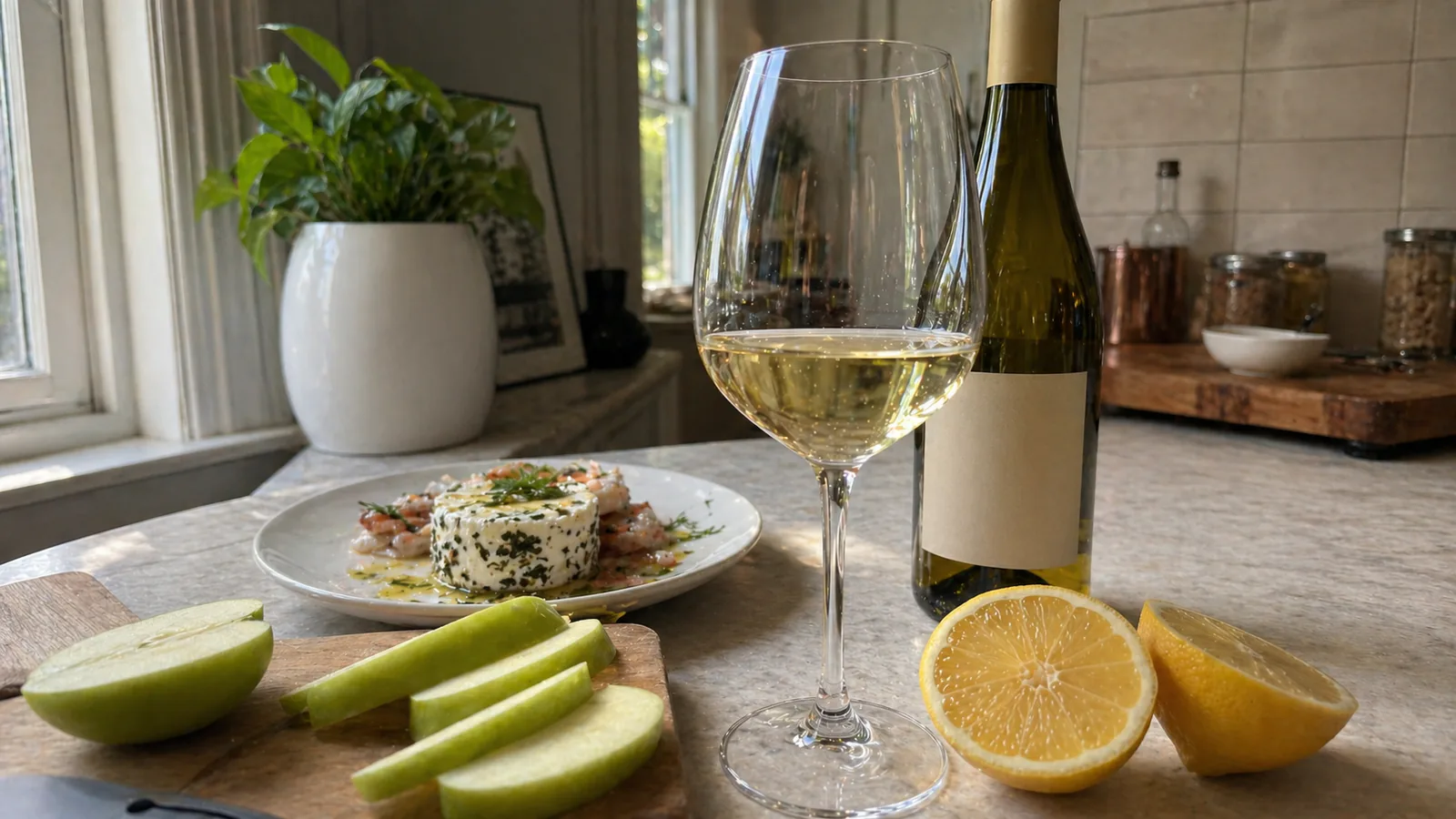
You take a sip of a Sauvignon Blanc on a hot afternoon and your mouth lights up. Saliva pools at the back of your jaw. The wine tastes alive, almost crackling. Then later in the week you try a warm-climate Chardonnay that’s all peach and butter, and somehow it sits on your tongue like cream. Same drink, same grape family, completely different sensation. The thing that’s changed is acidity, and once you can name it, you can pick the right wine for the right moment every time.
By the end of this page you’ll know:
- The exact mouth sensation that tells you a wine is high in acid (and what people confuse it with constantly)
- Why a wine grown in Marlborough tastes more electric than the same grape grown in California
- The two grapes that have the highest natural acidity on earth, and what to do with them
- Why your “dry” wine sometimes tastes sweet and your sweet wine sometimes tastes balanced
- A cheat sheet for matching acid to food so a good bottle doesn’t get sabotaged at dinner
- The difference between pH and total acidity in 30 seconds, without needing a chemistry book
What Does Wine Acidity Feel Like?
Acidity is a physical sensation, not a flavour. The flavour you might call “lemony” or “tart” is your brain interpreting acid, but the actual cue is what happens inside your mouth.
Bite into a green apple. Squeeze a lemon onto your tongue. Suck on a slice of pickled ginger. Notice how your salivary glands kick in immediately, almost painfully, around the back corners of your jaw? That mouth-watering reflex is your body trying to neutralise acid. It’s the most reliable signal there is.
In wine, the same thing happens. Take a sip of a young Riesling or a Vinho Verde. The wine vanishes from your mouth and your saliva keeps flowing for ten or fifteen seconds afterward. That’s the acidity at work. A low-acid wine, by contrast, just sits there. The wine goes down and nothing follows. The mouth feels round but a bit flat.
The salivation reflex is also what makes acidity feel “refreshing.” When a wine triggers your mouth to wet itself, the next sip feels cleaner and the wine tastes brighter. This is why high-acid wines are the ones you want on a hot day, with rich food, or when your palate gets fatigued. Low-acid wines do the opposite: they coat the mouth and dull subsequent sips. Both have their place. Knowing which is which is the win.
Why Does Acidity Matter in Wine?
Three reasons, and all of them affect what you actually taste.
It keeps wine from tasting flabby. Sugar, alcohol, and ripe fruit all contribute body and weight. Without acidity to balance them, the wine just collapses into itself. It becomes one-dimensional and tiring after half a glass. The same level of fruit and sugar held up by good acid feels lively and you want another sip.
It makes wine pair with food. Almost every food-and-wine pairing trick is really an acid trick. A high-acid wine cuts through fat and richness. It refreshes your palate between bites. It lifts a heavy dish. A low-acid wine slides off the plate without doing any of this work, and the dish ends up dragging the wine down. If you’ve ever had a bottle that tasted great on its own and disappeared when you sat down to dinner, the acidity was probably wrong for the food.
It lets a wine age. Like tannin in reds, acidity acts as a preservative in whites and rosés. A high-acid Riesling or Chenin Blanc can age for decades, slowly developing honey and petrol notes. A low-acid white made for early drinking is usually past its best within a couple of years. If you’ve ever wondered why some whites are sold for $200 and others for $14, acidity is part of the answer.
The shorthand for all three: acidity is the spine of a wine. Take it out and the wine slumps. Build the rest of the bottle around the right amount and you have something that holds shape on its own and at the table.
What Are the Highest-Acid and Lowest-Acid Wines?
Acidity tracks closely with two things: the grape variety and the climate it grew in. Cooler climates make higher-acid wines. Warmer climates make lower-acid wines, all else being equal.
The high-acid stars:
- Riesling. The acid king. Even sweet Rieslings stay vibrant because the acid balances the sugar.
- Sauvignon Blanc. Especially from Marlborough (New Zealand), the Loire Valley (France), and Chile’s cooler regions. The “zingy” feel is acidity.
- Chenin Blanc. Particularly from the Loire (Vouvray, Savennieres) and South Africa. Can be searingly fresh.
- Albarino. Spain’s Atlantic-coast white. Salty, mineral, mouth-watering.
- Vinho Verde. Portuguese white that’s almost spritzy with acid, perfect for hot weather.
- Champagne and traditional-method sparklers. Bubbles and acid together feel even sharper.
- Chianti and other Sangiovese-based reds. One of the few high-acid red grapes. Goes wild with tomato sauce.
- Pinot Noir from cool sites like Burgundy, Mornington, or Oregon. Light tannin, surprisingly bright acidity.
- Barbera. Italian red with low tannin and high acid. The pasta-night red.
The lower-acid wines:
- Most warm-climate Chardonnays (especially oaked Californian, Australian, and South American versions). Round and creamy.
- Viognier. Floral and rich, low acid by nature.
- Gewurztraminer. Big, perfumed, often low-acid. Powerful but soft.
- Pinot Gris (the rich Alsatian style, not the lean Italian Pinot Grigio).
- Warm-climate Grenache and Zinfandel. Reds with ripe fruit and gentler acid.
- Most Australian Shiraz outside the cool-climate spots. Bigger fruit, softer acid.
A wine label rarely tells you the acidity directly, but two clues help. One: cool-climate regions on the label (Loire, Mosel, Marlborough, Tasmania, Mornington) almost always mean higher acid. Two: low alcohol (under 12.5%) often correlates with higher acid because the grapes were picked earlier when the acid was still high and the sugar hadn’t peaked.
How Does Climate Affect Wine Acidity?
Grapes start out high in acid and low in sugar. As they ripen on the vine, sugar climbs and acid falls. The longer and warmer the growing season, the more this happens.
Cool climates ripen grapes slowly. The acid stays high while the sugar slowly catches up. Pick the grapes at the right moment and you get a wine with both ripe flavour and bracing freshness. Mosel Riesling at 8 to 9% alcohol is the textbook example: the grapes ripened just enough for fruit, the acid never had a chance to drop.
Warm climates push grapes through ripening fast. Sugar climbs quickly, acid plummets, and you end up with a riper, fruitier, lower-acid wine. Napa Valley Cabernet at 14.5% alcohol is on this end of the spectrum.
Altitude works like cool climate: vineyards at 2,000 feet have cooler nights, which slows ripening and preserves acid. This is why high-altitude Argentine Malbec or Tuscan reds from hilltop sites have more freshness than the same grape from a flat valley floor.
Vintage matters too. A cool, wet year in Bordeaux makes leaner, higher-acid wines. A hot, dry year makes ripe, lower-acid ones. This is why people obsess over vintage charts. The same vineyard can pump out wines with very different structures from one year to the next.
What’s the Difference Between pH and Total Acidity?
You’ll see both terms on tech sheets if you ever look. They measure different things.
Total acidity is how much acid is in the wine, full stop. It’s expressed in grams per litre. Most table wines fall between 5 and 9 g/L. Higher numbers feel sharper.
pH is how the acid behaves chemically. Lower pH equals more sour-tasting and more shelf-stable. Most wines sit between pH 3.0 and 3.8. A pH of 3.0 (think Mosel Riesling) is bracing; a pH of 3.7 (think warm Chardonnay) feels round.
Two wines with the same total acidity can taste different because of pH. And two wines with the same pH can taste different because of total acidity. The numbers are a guide, not a verdict. What you feel in your mouth is what counts.
The practical takeaway: don’t worry about the chemistry. Just pay attention to how a wine makes your mouth respond. The label tells you the wine’s name. Your saliva tells you the truth.
Why Does My “Dry” Wine Taste Sweet?
This is one of the most common confusions in wine, and acidity is the answer.
Sweetness on the tongue and “fruitiness” in the nose are two different things. A wine can smell intensely of ripe peach and tropical fruit while having almost no actual sugar in it. Your brain registers the fruit aromas and decides “sweet,” even though there’s nothing sweet on your tongue.
Acidity is what reveals the truth. A wine with high acid feels dry even when there’s a touch of sugar in it (this is why German Kabinett Riesling can have 30 grams of sugar per litre and still feel refreshing). A wine with low acid can feel sweet even when it’s bone dry, because the fruit aromas dominate and there’s nothing tart to push back.
This is why a Marlborough Sauvignon Blanc and a warm-climate Chardonnay can have the same residual sugar but taste like wines from different planets. The Sauv Blanc’s acid keeps it tasting bracing. The Chardonnay’s softness lets the fruit come forward and feel almost confected.
If you want to taste this for yourself, pour a German Kabinett Riesling and a Californian Chardonnay side by side. The Riesling probably has more sugar. It will taste drier. That’s the acid trick.
How Do You Use Acidity to Pair Wine with Food?
The single best food rule there is: match the acid level of the wine to the acid level of the dish.
High-acid food = high-acid wine. Anything with vinegar, citrus, tomato, or pickles wants a high-acid wine. A salad with vinaigrette will make a low-acid Chardonnay taste flat and dull. A Sauvignon Blanc, Vinho Verde, or Gruner Veltliner will sing alongside it. Tomato pasta needs Chianti or Barbera. Ceviche needs Albarino. Goat cheese needs Sancerre. Once you see the pattern, it’s everywhere.
Rich, fatty food = high-acid wine. This is the steakhouse trick reversed for whites. A buttery lobster, a creamy risotto, fried chicken: rich foods coat the mouth, and you need acid to clean it back up. A high-acid Champagne with fried chicken is one of the great pairings precisely because the acid cuts through the fat. A low-acid Viognier with the same dish would tap out by the second bite.
Delicate food = lower-acid wine. A subtle white fish, a poached chicken, a mild cheese: high-acid wine can flatten these dishes. A softer Pinot Gris or oaked Chardonnay treats the food more gently.
Sweet food = wine sweeter than the food. Dessert pairings break if the wine is less sweet than the dessert (the dessert makes the wine taste sour and thin). The wine has to be sweeter, and high acid keeps it from cloying. This is why Sauternes and chocolate cake works.
Frequently Asked Questions
Is high-acid wine bad for your stomach?
It depends on you. Some people with reflux find high-acid wines uncomfortable. Most people are fine, especially if they drink with food (which buffers the acid). If wine bothers your stomach, try lower-acid options like Viognier, oaked Chardonnay, or Grenache, and always eat something alongside.
Why does my mouth water when I drink some wines?
That’s acidity doing its job. The wine triggers your salivary glands, which is the same reflex you get from biting into a lemon or a green apple. High-acid wines (Sauvignon Blanc, Riesling, Chianti) produce this effect strongly. It’s a feature, not a flaw, and it’s why those wines pair so well with food.
What grape has the highest natural acidity?
Riesling is the headline answer. It can hold staggering amounts of acid even at full ripeness, which is why it ages so well and balances sweetness so beautifully. Other contenders include Chenin Blanc and Assyrtiko (from the Greek island of Santorini, where acid levels are some of the highest on earth).
Can a wine be too acidic?
Yes. A wine with too much acid and not enough fruit or sugar tastes thin and aggressive, like sucking on a lemon. Good winemakers balance acidity against the rest of the wine. If a wine feels like it’s all acid and nothing else, it was probably picked too early or grown in a vintage that didn’t ripen properly.
How can I tell if a wine is high in acid before I buy it?
Two clues on the label. Cool-climate regions (Mosel, Loire, Marlborough, Tasmania, Mornington Peninsula) almost always mean higher acid. Lower alcohol (under 12.5%) often signals higher acid because the grapes were picked earlier. If both are true, the wine is going to be bracing.
Does acidity have anything to do with sulfites?
No. Sulfites are a preservative added to wine to keep it stable. Acidity is a natural part of the grape itself. The two are unrelated, even though they sometimes get blamed together for headaches and stomach issues.
What’s Next?
Acidity is one of four pillars of wine structure. The others are tannin (the drying grip in reds), body (the weight on your palate), and sweetness (the actual sugar level). Once you can read all four, picking a bottle stops being a guess.
If you want a guided tour of all of them at once, How to Taste Wine Like You Know What You’re Doing walks you through them step by step. Or if you want to feel high acidity in action, grab a Marlborough Sauvignon Blanc this weekend and pair it with goat cheese on toast. You’ll never forget what acid feels like after that.
Keep Reading
Tannins in Wine, Explained Without the Jargon
What tannins actually feel like, where they come from, and how to handle them so your big reds taste smoother and pair better with food.
Wine Body Explained: Light, Medium, or Full?
How to tell light, medium, and full-bodied wines apart, what actually causes body, and how to match it to food so dinner stops feeling random.

Riesling: Sweet vs Dry, Regions, and Pairing Guide
Riesling runs from bone-dry to dessert-sweet, and the label tells you which. Here's how to read it, what it tastes like, and what to eat with it.