
Claire Bennett
Wine Editor9 min read
Riesling: Sweet vs Dry, Regions, and Pairing Guide
Riesling runs from bone-dry to dessert-sweet, and the label tells you which. Here's how to read it, what it tastes like, and what to eat with it.
Riesling: Sweet vs Dry, Regions, and Pairing Guide
You bought a Riesling once, it tasted sweet, and you wrote off the whole grape. Or you’ve seen the twelve-syllable German labels and decided this one wasn’t worth the homework. Fair enough. But Riesling is the most misunderstood great white wine on the planet, and arguably the best food wine in the world.
Here’s the part nobody tells you: the label tells you whether it’s sweet or dry. Once you know one word, the whole category opens up.
By the end of this page you’ll know:
- The single word on a German label that tells you in one second whether the bottle is dry or sweet
- Why off-dry Riesling is the wine sommeliers reach for with spicy Thai food, every time
- What “petrol” means on aged Riesling, and which side of that smell you should be on
- The Australian region quietly making the best dry Riesling outside Europe, for half the price of Alsace
- The $18 bottle to start with if you’ve never properly tried the grape
Is Riesling Sweet Or Dry?
Both. Same grape, completely different wines depending on the style.
The trick is one word on the bottle. On a German label, look for Trocken. It means dry, no exceptions. If you see Trocken, the wine has almost no sugar and tastes crisp like a Sauvignon Blanc.
No Trocken on the label? It’s probably off-dry to sweet. The German ripeness ladder goes Kabinett (lightest, often a touch off-dry), Spätlese (riper, usually sweeter), Auslese (sweeter still), then Beerenauslese and Trockenbeerenauslese, which are full-on dessert wines.
Alsace works the opposite way. French Riesling is dry by default unless the label says Vendanges Tardives or Sélection de Grains Nobles, which are the late-harvest sweet versions. Australian, American, and New Zealand Rieslings usually print “Dry” or “Off-Dry” right on the front label, which is honestly the friendliest system of the three.
If you want the full label decoder, our dry vs sweet wine guide covers every country.
What Does Riesling Taste Like?
Lime, green apple, white peach, apricot, honeysuckle. On older bottles, a famous petrol note that wine geeks chase and beginners side-eye. Underneath the fruit there’s almost always a steely, wet-stone minerality, especially from the Mosel.
Acidity is Riesling’s secret weapon. Even the sweet versions don’t taste cloying because the acid is so high. A Mosel Spätlese has roughly the sugar of soda but tastes refreshing, because the acid cuts through every sip.
Most Riesling sees no oak. Oak masks the very character that makes the grape worth drinking, so quality producers stick with stainless steel or large neutral casks.
Quick stats:
- Body: Light to medium
- Acidity: High to very high
- Sweetness: Bone-dry to dessert-sweet (label tells you which)
- Oak: Almost never
- Alcohol: 7.5 to 13.5%. Mosel Kabinett is famously low
Where Is The Best Riesling Grown?
Riesling shows off its vineyard like no other grape. A Mosel and a Clare Valley taste so different you’d swear they were different varieties.
Mosel, Germany
The spiritual home. Vines cling to steep slate slopes above the Mosel River, soaking up reflected sun and putting that slate character straight into the glass. Classic Mosel is off-dry, low in alcohol (often 7.5 to 9%), and built around green apple, lime, white flowers, and wet-stone minerality.
Look for Dr. Loosen, Selbach-Oster, Markus Molitor, or J.J. Prüm. Expect $18 to $40. This is the bottle to grab for spicy Asian food, smoked fish, and pork.
Alsace, France
Alsace makes the most reliably dry Riesling in Europe. The bottles look German (tall flute, varietal name on the label) but drink in a French style: bone-dry, fuller-bodied, mineral, and structured. Alcohol sits at 12 to 13.5%, so they handle richer dishes than Mosel can.
Producers worth knowing: Trimbach, Hugel, Domaine Weinbach, Zind-Humbrecht. Expect $20 to $50.
Clare Valley and Eden Valley, Australia
Australia’s answer to Alsace, and the value play of the category. Clare and Eden Valley make some of the world’s best dry Riesling: bone-dry, lime-driven, electrifying acidity, and built to age twenty years. The signature is intense lime juice, a flicker of toast, and a petrol note that develops after five to ten years.
Grosset is the gold standard. Pewsey Vale, Mount Horrocks, and Jim Barry over-deliver at $20 to $35. If you’ve never had Aussie Riesling, this is the rabbit hole.
Other regions worth knowing
The Rheingau (Germany) makes a slightly fuller, richer style. The Finger Lakes in New York produces lovely off-dry bottles from Hermann J. Wiemer and Dr. Konstantin Frank at $18 to $30. Washington State (Chateau Ste. Michelle, Pacific Rim) does solid budget bottles under $15.
What Food Goes With Riesling?
This is where Riesling earns its reputation. It’s the most flexible food wine on Earth, full stop.
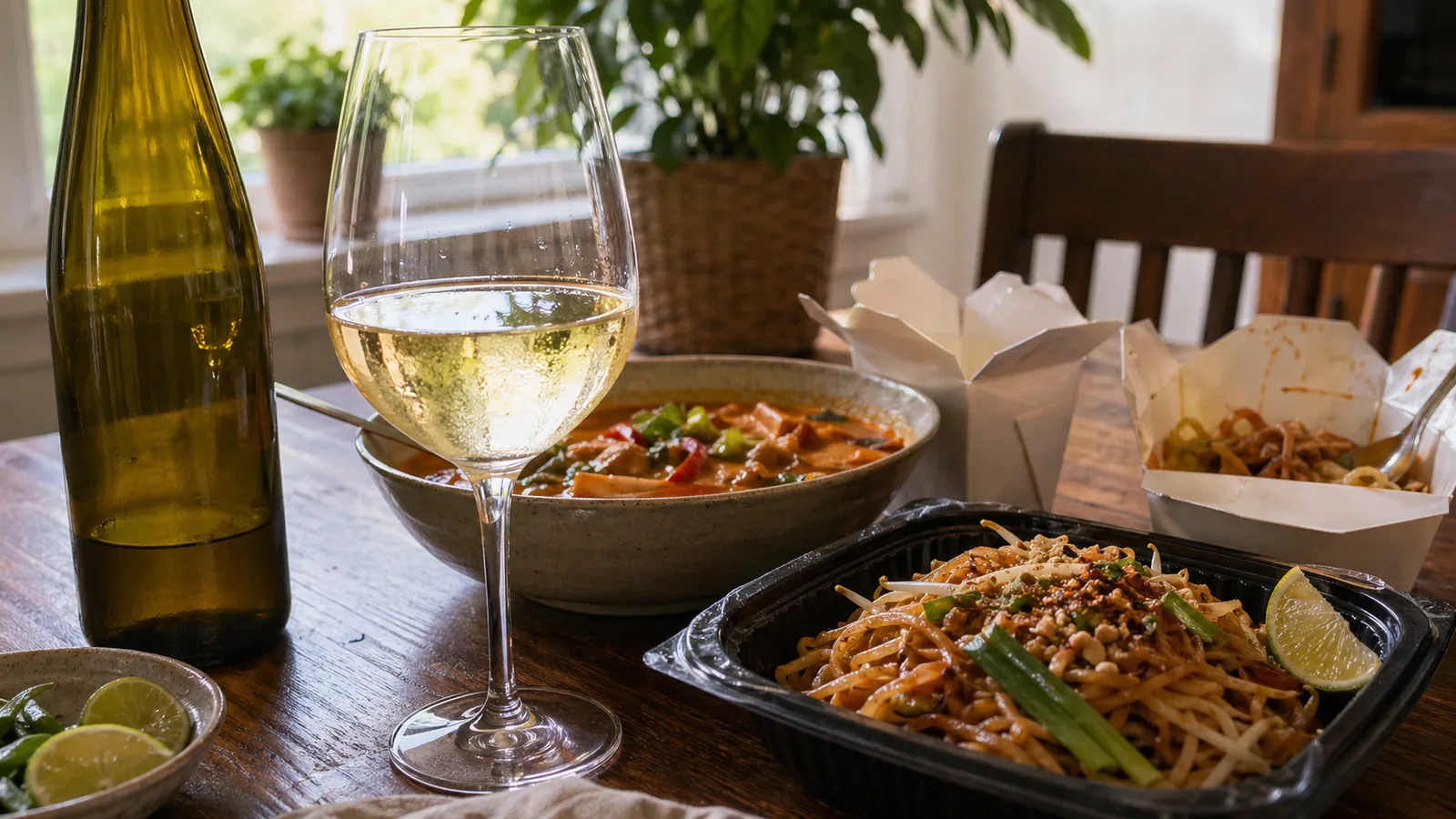
The single best pairing in the wine world is off-dry Riesling with spicy Thai food. The slight sweetness tames chilli heat the way alcohol can’t, and the high acid refreshes your palate between bites. Once you’ve had a Mosel Spätlese with green curry, every other pairing feels like a compromise.
Specific dishes that work:
- Thai green curry, red curry, papaya salad
- Vietnamese pho and bun cha
- Sichuan dishes like mapo tofu and kung pao chicken
- Indian butter chicken, korma, tikka masala
- Smoked salmon and smoked trout
- Pork belly, schnitzel, roast pork with apple sauce
- Sushi with fattier fish (salmon, tuna belly, eel)
- Roast duck with cherry sauce
- Aged hard cheeses like Comté and Gruyère
Pick the style by the dish. Dry Riesling with seafood, roast chicken, and lighter pork. Off-dry with anything spicy or sweet-sour. Sweet Riesling with blue cheese or fruit-based desserts.
How Should I Serve Riesling?
Cool, not freezing. Around 8 to 12°C (45 to 54°F) is the sweet spot. Take it out of the fridge ten to fifteen minutes before pouring. Drier styles tolerate a touch cooler. Sweeter styles open up better slightly warmer.
Use a standard white wine glass with a decent bowl. Riesling is highly aromatic and you want surface area to release the lift. Skip the decanter. Riesling is meant to drink fresh.
An open bottle keeps three to five days in the fridge with the cork back in. The high acid acts as a natural preservative, so it’s one of the best whites for stretching across multiple nights.
Riesling also ages spectacularly. A good Mosel Spätlese drinks beautifully at twenty years and develops honey, dried apricot, and that famous petrol note. Buy two bottles of any Riesling you love. Drink one now. Try the other in five years.
How Much Should I Spend On Riesling?
Riesling is one of the most under-priced great wines going. The expensive end is laughable compared to top Burgundy, and the cheap end actually delivers.
Under $15: Washington State and Finger Lakes options. Pacific Rim, Chateau Ste. Michelle, Dr. Konstantin Frank. German bottles at this price are rarely worth it.
$15 to $25: The everyday sweet spot. Mosel Kabinett from Dr. Loosen or Selbach-Oster, entry-level Alsace Trimbach and Hugel, and Aussie dry Rieslings from Pewsey Vale and Jim Barry.
$25 to $50: Serious Mosel Spätlese, Alsace Grand Cru, and top Clare Valley bottles like Grosset Polish Hill. Wines that genuinely age.
Over $50: Top single-vineyard Mosel and Rheingau, and the dessert tier. Even the unicorns are modestly priced for their quality.
Honest answer: $18 to $25 gets you world-class Riesling. Spend more only when you’ve fallen in love with a specific producer.
Frequently Asked Questions
What does the petrol smell on aged Riesling mean?
It’s a compound called TDN that develops as Riesling ages, especially in warmer or sun-exposed vineyards. Fans love it because it signals a complex, mature wine. Newcomers often find it weird. If you don’t like it, drink your Riesling young (within five years of the vintage). If you love it, age the good stuff ten to fifteen years.
What’s the difference between Kabinett and Spätlese?
Both are points on the German ripeness ladder. Kabinett is picked earlier, so it’s lighter, fresher, and lower in alcohol. Spätlese means “late harvest” and is riper, with more concentration and usually a touch more sweetness. Neither word guarantees dry or sweet on its own. If the bottle also says Trocken, it’s dry. If not, assume off-dry to sweet, and sweeter as you climb the ladder.
Does Riesling pair with sushi?
Yes, and it’s one of the best pairings around. Off-dry Mosel handles fattier fish like salmon, tuna belly, and eel better than Sauvignon Blanc does, and the slight sweetness plays beautifully with soy and wasabi. Dry Alsatian works with white-fish sushi. Avoid oaked whites with sushi. They flatten the fish.
What’s the best Riesling for beginners?
Start with an off-dry Mosel Kabinett around $18 to $22. Dr. Loosen Blue Slate is the textbook starting point. It introduces you to the grape’s signature acid-sweetness balance, low alcohol, and the slate minerality that defines the style. From there, try a dry Trimbach from Alsace or a Clare Valley bottle to see the range.
Why is some Riesling so low in alcohol?
Mosel Kabinett and Spätlese often clock in at 7.5 to 9% because the winemaker stops fermentation before all the sugar turns to alcohol. That leaves natural sweetness and a lighter wine. Drier styles from Alsace and Australia ferment to completion and land at 12 to 13.5%. The low-alcohol versions are perfect for long meals and warm afternoons.
Ready to put this into practice? Our guide to the best crisp white wines lists specific bottles to try, including the Mosel and Clare Valley Rieslings worth grabbing on your next trip to the bottle shop.
Keep Reading
Thai Food Wine Pairing: What To Pour With Spicy Heat
The best wines for Thai food, from off-dry Riesling and Gewurztraminer with green curry and tom yum to dry rose with pad thai and larb.
Dry vs Sweet Wine: How to Tell the Difference
Residual sugar separates dry from sweet wine. Here's how fermentation works, what label terms mean, and how to pick the right style every time.
Indian Food Wine Pairing: What To Pour With Curry
The best wine with Indian food, from Riesling with butter chicken and tikka masala to rose with vindaloo, plus what to skip with chili heat.