
Claire Bennett
Wine Editor11 min read
Rhône Valley Wine: Northern vs Southern, Grapes, Best Buys
What Rhône Valley wine actually is, how Northern and Southern Rhône differ, the grapes behind GSM blends, and why Côtes du Rhône is the smart buy.
Rhône Valley Wine: Northern vs Southern, Grapes, Best Buys
You’re at dinner and someone leans across the table to tell you Côtes du Rhône is the best value red on every wine list, full stop. They say it like it’s settled science. You sip your glass, nod, and quietly wonder whether they’re right or just confident. They’re mostly right, and by the end of this you’ll know exactly when to trust that advice and when to ignore it.
The Rhône Valley is one of those regions everyone has drunk from without realising. The blue-bottle bistro red. The peppery Syrah that came with your steak. The big-shouldered Châteauneuf you saved for an anniversary. Same valley, completely different wines, completely different grapes, two completely different climates.
By the end of this page you’ll know:
- The single geographic line that splits Rhône into two wine regions that share almost nothing except a river
- Why Northern Rhône Syrah and Australian Shiraz drink like cousins who haven’t seen each other in 20 years
- The four-letter blend recipe behind almost every great Southern Rhône red, and how to spot it on a label
- The Rhône appellation that quietly delivers $20 bottles tasting like $50 ones (it’s not the famous one)
- The exact reason Châteauneuf-du-Pape costs three times as much as the village next to it
What Is Rhône Valley Wine?
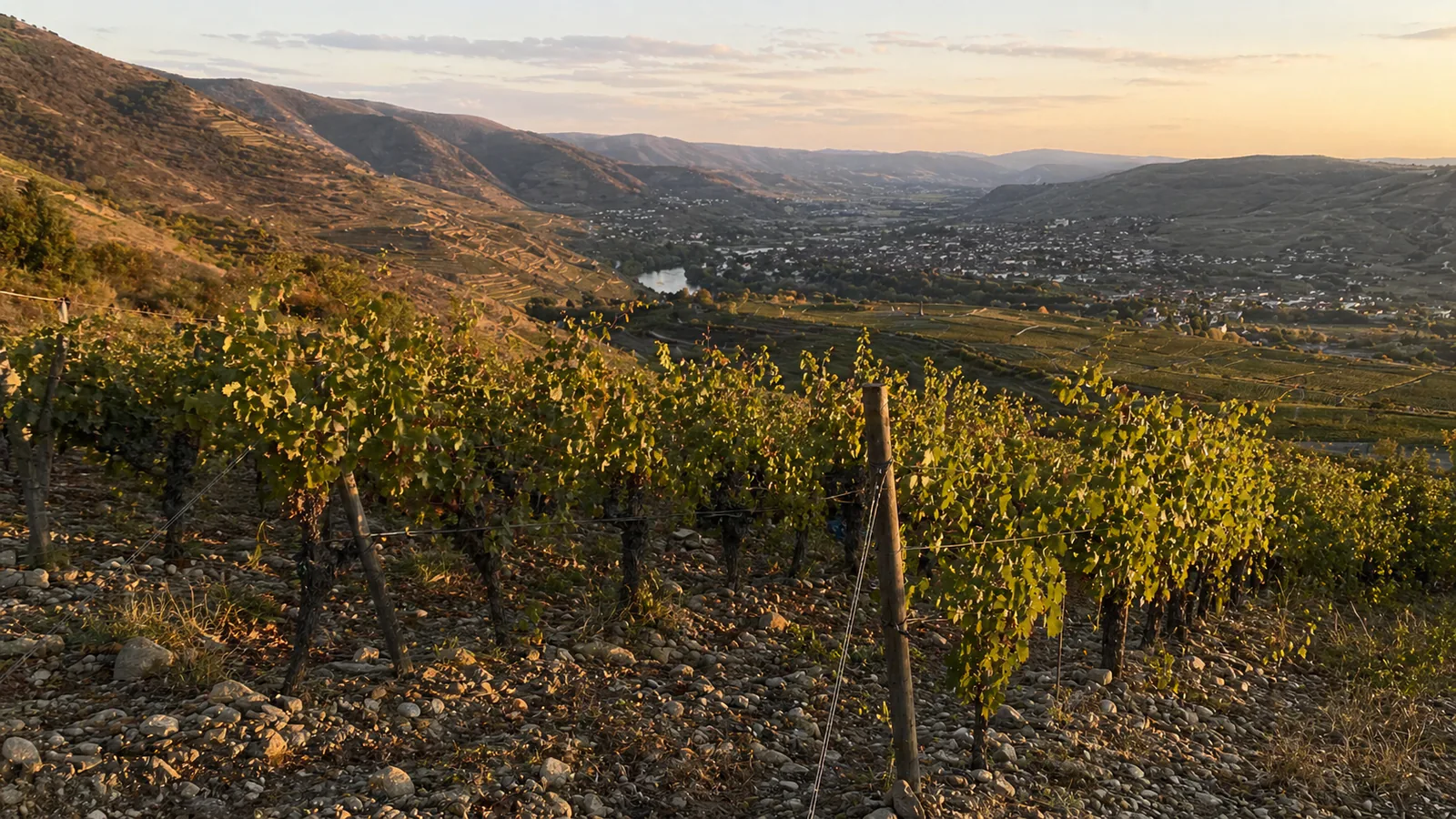
The Rhône Valley follows the Rhône river south from just below Lyon down to Avignon, near the Mediterranean. Greeks and Romans planted the first vines on these banks over 2,000 years ago, and people have been making wine here ever since. It’s the second-largest wine region in France by volume after Bordeaux.
The region produces mostly red wine, with smaller amounts of white, rosé, and a few sweet styles. About 95% of Rhône output is everyday-drinking wine sold under the broad Côtes du Rhône appellation. The remaining 5% is where the famous names live: Côte-Rôtie, Hermitage, Châteauneuf-du-Pape, and a handful of others.
Rhône isn’t really one region. It’s two, separated by a 50-kilometre dead zone where almost no wine gets made. The northern half and the southern half have different climates, different grapes, different rules, different price tags. You can’t talk about Rhône wine without picking which half you mean.
Sommelier shorthand: Northern Rhône is for connoisseurs with big budgets. Southern Rhône is for everyone else, including those same connoisseurs most nights of the week.
What Is Northern Rhône Wine?
Northern Rhône is small. Tiny, really. The whole sub-region accounts for around 5% of total Rhône production, with vineyards clinging to steep granite hillsides above the river. The climate is continental: cold winters, warm summers, real seasonal swing.
Almost every red here is 100% Syrah, sometimes co-fermented with a splash of white grapes (Viognier, Marsanne, Roussanne) for aromatic lift. The style is classically restrained: black pepper, smoked meat, violets, blackberry, olive. Nothing jammy, nothing soft. Northern Rhône Syrah is the wine that taught Australia how to make Shiraz. You can taste the family resemblance, but the French version is leaner, more savoury, and more about earth than fruit.
The five appellations to know:
- Côte-Rôtie: the “roasted slope,” steep south-facing hillsides above Ampuis. Floral, peppery Syrah often co-fermented with up to 20% Viognier. Top bottles age 20+ years. Expect $80 to $300 for serious producers.
- Hermitage: the iconic hill above Tain. Powerful, structured, age-worthy Syrah. Reds are dense and tannic; the small white production is some of France’s best. Bottles run $100 to $500.
- Cornas: rugged, granite-driven Syrah from a single hill. Darker and more brooding than Côte-Rôtie, less polished than Hermitage. The connoisseur’s pick at $60 to $150.
- Saint-Joseph: the value zone of Northern Rhône. A long stretch of vineyards on the west bank, producing lighter, brighter Syrah at $30 to $60.
- Crozes-Hermitage: the everyday wine of Northern Rhône. Flatter terrain around Tain. Often great value at $20 to $40.
There are also two white-only appellations worth a mention: Condrieu, which produces opulent, peach-and-apricot Viognier at $50 to $120, and Château-Grillet, a tiny single-estate Viognier appellation that’s even pricier.
If you want to taste Northern Rhône without remortgaging, start with a good Crozes-Hermitage or Saint-Joseph. They give you the peppery, savoury Syrah signature without the famous-name premium.
What Is Southern Rhône Wine?
Southern Rhône is the big one. Bigger production, hotter climate, broader appellations, and the source of nearly every Rhône bottle you’ll find on a supermarket shelf. The landscape opens up into rolling vineyards covered in galets roulés, the famous round white stones that hold heat through the night and push the grapes to full ripeness.
The climate is Mediterranean. Long sunny summers, mild winters, and the mistral wind that rips down the valley and keeps the vines healthy. Where Northern Rhône is single-varietal Syrah, Southern Rhône is almost always a blend, with Grenache leading the charge.
The classic Southern Rhône red is a GSM blend: Grenache, Syrah, Mourvèdre. Grenache brings ripe red fruit, soft tannins, and warmth. Syrah adds backbone, pepper, and structure. Mourvèdre contributes dark fruit, leather, and grip. The proportions vary by producer and appellation, but the formula is everywhere.
The four appellations to know:
- Châteauneuf-du-Pape: the famous one. Up to 13 grape varieties allowed, but Grenache dominates. Rich, warm, ripe, full-bodied reds that age beautifully. Expect $40 to $150 for solid producers, much more for cult bottles.
- Gigondas: Châteauneuf’s leaner, more affordable neighbour. Higher elevation, more Syrah, slightly cooler character. Often $30 to $60 and routinely outperforms Châteauneufs at twice the price.
- Vacqueyras: next door to Gigondas, similar profile, lower prices. The smart-money pick at $20 to $40.
- Côtes du Rhône: the broad regional appellation that covers everything else. Quality varies enormously, but the floor is honest and the ceiling is genuinely impressive. Expect $10 to $25.
There’s also Côtes du Rhône Villages, a step up from basic Côtes du Rhône, where 22 specific villages can put their name on the label (Cairanne, Rasteau, Sablet and others). Cairanne and Rasteau were promoted to their own full Cru status in recent years, putting them on the same footing as Gigondas. These are some of the best-value reds in France at $15 to $25.
What Grapes Go into Rhône Valley Wine?
Six grapes do almost all the work in Rhône, three red and three white. Knowing them is the difference between reading a label and guessing.
Syrah is the entire reason Northern Rhône exists. Dark fruit, black pepper, smoked meat, violets. Structured, age-worthy, savoury. In Australia it’s called Shiraz and made in a riper, fruitier style. Same grape, different climate, different glass.
Grenache is the heart of Southern Rhône. Soft tannins, ripe strawberry and raspberry fruit, high alcohol, warming spice. It’s a sun-loving grape that gives wines their generous, hospitable character. Usually blended in France; you’ll also find it as Garnacha in Spain.
Mourvèdre is the dark, brooding partner in the GSM trio. Wild blackberry, leather, garrigue (Mediterranean wild herbs), grippy tannins. It needs heat to ripen properly and brings structure and longevity to a blend.
On the white side:
Viognier is the diva. Aromatic, peachy, floral, full-bodied. Northern Rhône’s Condrieu is the world’s benchmark, and a tiny percentage gets co-fermented into Côte-Rôtie reds for aromatic lift.
Marsanne and Roussanne are the white workhorses, usually blended together. Marsanne is rich, waxy, and almond-toned. Roussanne is more aromatic, with pear and herbal notes. Together they make the white wines of Hermitage, Saint-Joseph, and white Châteauneuf-du-Pape.
A handful of others (Cinsault, Carignan, Counoise, Bourboulenc, Picpoul) play supporting roles, especially in Châteauneuf, where 13 varieties are allowed in the blend.
What Does Rhône Valley Wine Taste Like?
North and south pour two different glasses. If you only remember one thing, remember this: the north is savoury and structured, the south is generous and warm.
A typical Northern Rhône red (Crozes-Hermitage, Saint-Joseph, Cornas, Côte-Rôtie, Hermitage) tastes of black pepper, smoked bacon, blackberry, violets, and something earthy underneath. Medium-bodied to full, firm tannins, real acidity. It’s a wine that wants food, especially something with a bit of char and savouriness.
A typical Southern Rhône red (Côtes du Rhône, Vacqueyras, Gigondas, Châteauneuf) tastes of ripe raspberry and strawberry, plum, sun-baked herbs, white pepper, and a touch of leather. Fuller-bodied, softer tannins, alcohol often pushing 14% to 15%, and a warming finish. It’s the kind of bottle that drinks well on its own and even better with a roast.
The whites are worth knowing too. Condrieu and white Hermitage are rich, peachy, and aromatic. White Châteauneuf is full and waxy. Côtes du Rhône Blanc is everyday-drinking and often a bargain.
Rosé belongs in the conversation as well. Tavel is the most famous dry rosé in France, deep pink, structured, and made for actual dinners rather than poolside sipping.
Why Is Côtes du Rhône Such Good Value?
Here’s the practical answer to “what should I order off the Rhône section.” For most nights, most budgets, and most food on the table, order a good Côtes du Rhône or Côtes du Rhône Villages.
The reason is structural. Rhône is so big and so productive that the basic regional appellation gets enormous volumes of decent fruit, much of it from producers who also make the famous bottles. A serious Châteauneuf producer’s entry-level Côtes du Rhône is often made with the same care as their flagship, just from younger vines or less-prized parcels. You get a real piece of their style for $15 to $20 instead of $80.
Côtes du Rhône Villages and the named villages (Cairanne, Rasteau, Sablet, Séguret, Plan de Dieu) bump that up another notch. Same grapes, tighter regulations, slightly older vines, often a clear step up in concentration. This is where the genuine bargains live.
If you’re picking a bottle off a wine list and don’t recognise any of the producers, here’s a working rule: a $25 Côtes du Rhône Villages from a name you don’t know will out-drink a $25 Châteauneuf from a name you don’t know almost every time. The basic Châteauneuf market is full of underwhelming bottles coasting on the appellation’s reputation. The Villages tier is full of producers actually trying to over-deliver.
When to skip Côtes du Rhône: when you specifically want that peppery Northern Rhône Syrah hit (go Crozes-Hermitage or Saint-Joseph), or when you’re celebrating something and want the textural depth that only proper Châteauneuf or Gigondas brings.
Frequently Asked Questions
What’s the difference between Northern and Southern Rhône?
Northern Rhône is small, cool, steep, and almost exclusively planted to Syrah. The wines are single-varietal, savoury, peppery, and structured. Southern Rhône is huge, hot, flat-to-rolling, and dominated by Grenache-led blends. The wines are multi-grape (the GSM template), riper, fuller-bodied, and warmer. They share a river and a name. Almost everything else is different.
What is Châteauneuf-du-Pape?
Châteauneuf-du-Pape is the most famous appellation in Southern Rhône, named after the medieval papal summer residence near Avignon. It allows up to 13 grape varieties, with Grenache leading the blend. The wines are full-bodied, ripe, warming, and built to age 10 to 20 years for the best examples. Bottles run $40 to $150 for serious producers, with cult names commanding much more.
Is Syrah the same as Shiraz?
Yes, it’s the same grape, just made in different styles. Syrah is the French name and is used everywhere outside Australia. Shiraz is the Australian name, and the wines are typically riper, fruitier, and more upfront. French Syrah from Northern Rhône leans peppery, savoury, and structured. Australian Shiraz from the Barossa leans jammy, plummy, and generous. Same DNA, different glass.
What’s a GSM blend?
GSM stands for Grenache, Syrah, Mourvèdre. It’s the classic Southern Rhône red blend formula and the template behind nearly every great wine from the region, including Châteauneuf-du-Pape, Gigondas, Vacqueyras, and most Côtes du Rhône reds. Grenache brings ripe red fruit and warmth. Syrah brings backbone and pepper. Mourvèdre brings darkness, leather, and grip. The same blend has been adopted in Australia (where it’s also called GSM) and California.
What’s the best cheap Rhône wine?
Look for Côtes du Rhône Villages, especially bottles from named villages like Cairanne, Rasteau, Sablet, or Plan de Dieu, in the $15 to $25 range. These give you most of the Southern Rhône character (ripe Grenache fruit, warming spice, soft tannins) at a fraction of Châteauneuf prices. From a quality-conscious producer, a $20 Villages bottle will out-drink a $30 generic Côtes du Rhône or a $40 entry-level Châteauneuf almost every time.
Does Rhône make white wine?
Yes, and some of it is world-class. Condrieu and Château-Grillet in Northern Rhône are the global benchmark for Viognier, peachy and aromatic. White Hermitage and Saint-Joseph are rich, structured Marsanne-Roussanne blends. White Châteauneuf-du-Pape is full and waxy. Côtes du Rhône Blanc is everyday-drinking and often great value. Rhône whites are a small percentage of total production, which is why most drinkers don’t know they exist.
Ready to put this into the glass? A good Côtes du Rhône Villages is the fastest way to taste why this region has been quietly winning dinner parties for decades. Pour one alongside something roasted with herbs and you’ll see why “Rhône” is the answer when nothing else on the list looks right.
If you want a wider lineup of bottles in this style, browse the best full-bodied red wines for tested picks.
Keep Reading
Syrah vs Shiraz: Same Grape, Two Wines Explained
Why one grape goes by two names, what Syrah and Shiraz actually taste like, the regions worth knowing, and the food that brings each style to life.
Grenache: The Warm-Climate Workhorse Red
Grenache (Garnacha) is the soul of Châteauneuf-du-Pape and Priorat. Strawberry, white pepper, herbs, and a knack for lifting any blend it joins.
Viognier: The Perfumed White Wine of the Rhone
Viognier smells like apricot and honeysuckle and almost went extinct in the 1960s. Here's how it tastes, where it grows, and what to eat with it.