Claire Bennett
Wine Editor12 min read
How to Read a Wine Label (Old World vs New World)
Decode any wine label in under a minute. The 5 things that matter, what reserve and grand cru actually mean, and when vintage is worth caring about.
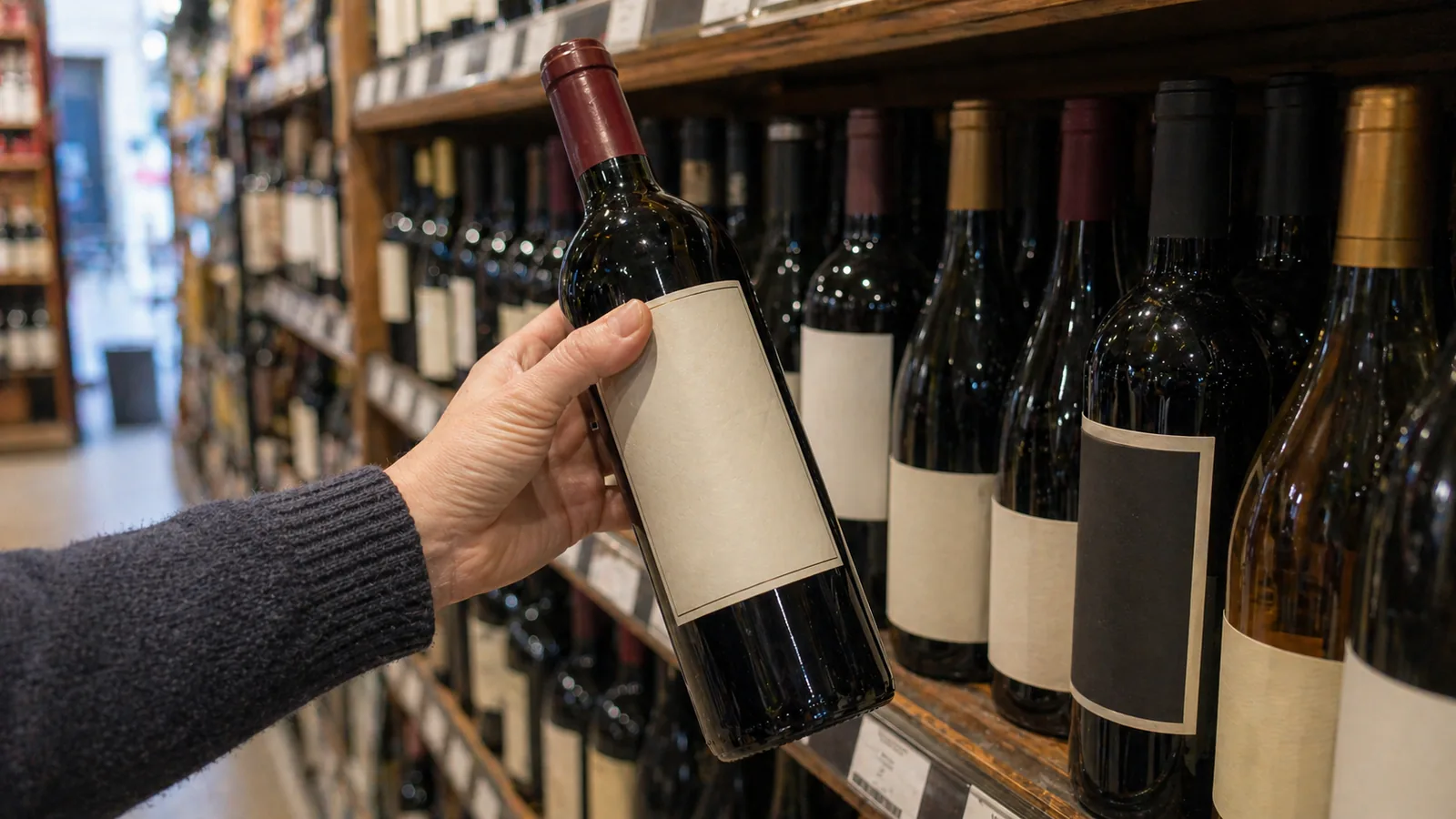
French wine labels hide the grape. American labels put it front and centre. A Sancerre and a California Sauvignon Blanc contain the same variety. The French bottle never mentions it. Those two approaches reflect opposite philosophies of what a wine drinker deserves to know at the shelf, and once you can read both systems, no label on any shelf is confusing anymore.
By the end of this page you’ll know:
- The five things every label is legally required to tell you, and the one fact people obsess over that often doesn’t matter
- Why a French label can hide the grape entirely and still be giving you the most useful info on the shelf
- What “Reserve,” “Grand Cru,” “DOCG,” and “AOC” actually mean (in plain English, not Wikipedia speak)
- The trick for reading any Bordeaux or Burgundy bottle in 10 seconds even if you’ve never heard of the producer
- Which back-label phrases are real signals and which are pure marketing fluff
- What the sulfite warning on every American bottle actually means for your headache the next morning
What Are the 5 Things Every Wine Label Tells You?
Strip a bottle of all the fancy script and gold foil and you’re left with five facts. Every label, anywhere in the world, gives you these. The order changes, the language changes, but the information is always there.
The producer. This is the winery, estate, château, or domaine. It’s usually the most prominent name on the bottle. On Old World labels it might be “Domaine Leflaive” or “Château Margaux.” On New World labels it’s “Kendall-Jackson” or “Penfolds.” When you find a producer you trust, this is the name you start hunting for.
The region or the grape (sometimes both). This is the heart of the puzzle. New World bottles usually shout the grape: “Pinot Noir,” “Chardonnay,” “Malbec.” Old World bottles often skip the grape and name a place instead: “Chablis,” “Rioja,” “Barolo.” Both methods give you the same information once you know how to translate.
The vintage. The year the grapes were harvested. You’ll see this either on the front in big numbers or on a small neck tag. If there’s no year, the wine is “non-vintage” (NV), which is common for Champagne and entry-level supermarket wine.
The alcohol percentage (ABV). Tucked somewhere in small print, usually near the bottom. It’s a real piece of intel, more useful than people realise. A Pinot Noir at 12.5% drinks lighter and crisper than one at 14.5%. Same grape, very different night.
The country of origin. Required on every imported bottle. “Product of France.” “Wine of Australia.” If you flip the label over, you’ll often find a more specific region too.
That’s the whole label, structurally. Everything else is either marketing, legal stuff, or extra detail layered on top.
How Do You Read an Old World Wine Label?
Old World labels lead with the region. The thinking goes: the place tells you everything. The soil, the climate, the laws, the winemaking traditions. So instead of saying “Pinot Noir,” a French label says “Bourgogne” and trusts you to know that Burgundy reds are Pinot Noir.
This feels like gatekeeping until you realise it’s actually doing you a favour. A bottle that says “Bourgogne” is not just telling you the grape. It’s also telling you the style, the rough flavour profile, and the rules the wine had to follow to use that name. That’s a lot of information packed into one word.
Here’s the cheat sheet for the regions you’ll see most:
- Burgundy (Bourgogne). Reds are Pinot Noir. Whites are Chardonnay. That’s it. Sub-regions like Chablis, Meursault, Pommard, and Gevrey-Chambertin all follow that two-grape rule.
- Bordeaux. Reds are blends, mostly Cabernet Sauvignon and Merlot. Whites are blends of Sauvignon Blanc and Semillon. “Left Bank” leans Cabernet, “Right Bank” leans Merlot.
- Chianti. Italian red, mostly Sangiovese.
- Barolo and Barbaresco. Italian reds, 100% Nebbiolo.
- Rioja. Spanish red, mostly Tempranillo.
- Champagne. Sparkling. Chardonnay, Pinot Noir, and Pinot Meunier blended.
- Sancerre and Pouilly-Fume. French whites, both Sauvignon Blanc.
- Chateauneuf-du-Pape. Southern French red, blend led by Grenache.
Memorise eight regions and you’ve decoded most of the Old World shelf at any decent shop. The France wine guide goes deeper into each one if you want a regional map.
How Do You Read a New World Wine Label?
New World labels are designed for people who didn’t grow up next to a vineyard. The grape is right there on the front. The region is named, but it’s a backup detail, not the headline.
A typical Australian label gives you: brand name, grape, region, vintage. Job done. You can pick the bottle up and know exactly what’s in it without memorising any geography. That’s why New World wines exploded in popularity during the 80s and 90s. You didn’t need to study to drink them.
The trade-off is that a New World label tells you less about style. “California Chardonnay” can mean a lean, mineral cool-climate version from Sonoma Coast or a tropical, oaky butter-bomb from Napa. Same grape, same state, opposite wines. So you have to pay closer attention to the region within the country.
Quick tour of the bigger producing regions and what they’re known for:
- Napa Valley (California). Cabernet Sauvignon. Powerful, ripe, often expensive.
- Sonoma (California). Pinot Noir, Chardonnay, Zinfandel. Cooler, fresher than Napa.
- Willamette Valley (Oregon). Pinot Noir. The American answer to Burgundy.
- Marlborough (New Zealand). Sauvignon Blanc, the zesty, grassy style.
- Barossa Valley (Australia). Big, jammy Shiraz.
- Margaret River (Australia). Cabernet, Chardonnay, both elegant.
- Mendoza (Argentina). Malbec central.
- Maipo and Colchagua (Chile). Cabernet, Carmenere, plus value-led everything.
- Stellenbosch (South Africa). Cabernet, Chenin Blanc, Pinotage.
A New World label that says “Marlborough Sauvignon Blanc” is giving you the grape, the country (implied or stated), and the regional style all in one go.
What Do “Reserve,” “Grand Cru,” “DOCG,” and “AOC” Actually Mean?
This is where labels start throwing words at you that sound official. Some of them are legally protected and very meaningful. Others are pure marketing.
AOC / AOP (France). Stands for Appellation d’Origine Controlee (or Protegee). It means the wine was made in a specific region following specific rules: which grapes can be used, where they can grow, how the wine has to be made. If a French bottle says “Sancerre AOC” you’re getting an official guarantee of origin and style.
DOC / DOCG (Italy). Same idea as AOC. DOCG (the G is for “Garantita”) is the higher tier. A Chianti Classico DOCG is more tightly regulated than a regular DOC bottle.
DO / DOC / DOCa (Spain). Spain’s version. Rioja DOCa is the top level. Standard DO covers most quality regions.
Grand Cru and Premier Cru (France). Vineyard rankings. In Burgundy, Grand Cru is the top tier (about 1% of all Burgundy), Premier Cru is the next (around 10%). In Bordeaux, the system is different: chateaux are ranked, not vineyards, and the famous 1855 classification put Lafite, Latour, Margaux, and Mouton at the top.
Riserva (Italy) and Reserva (Spain). Both legally regulated. They mean the wine was aged longer before release: a Rioja Reserva spends at least three years ageing, with at least one in oak. So the word actually tells you something concrete.
Reserve (USA, Australia, most New World). Not legally regulated. A producer can put “Reserve” on the front for any reason, or no reason at all. Sometimes it means their better cuvee. Sometimes it’s pure marketing. Read the producer’s track record, not the word.
Vieilles Vignes (France). “Old vines.” Not legally defined either. Older vines tend to make more concentrated wine, but “old” can mean 30 years to one producer and 80 years to another.
When Does the Vintage Actually Matter?
Vintage matters for two reasons: weather and ageing.
For everyday drinking wine (most bottles under $30), the vintage barely changes anything. Big producers blend across vineyards and adjust in the cellar to keep the style consistent year to year. The vintage on a $15 supermarket Chardonnay is more like a “best by” date than a meaningful signal.
For wines from cooler, weather-volatile regions like Burgundy, Bordeaux, Champagne, Barolo, and Northern Rhone, vintage swings are real. A great year and a poor year for the same producer can taste like different wines. That’s where vintage charts start being useful.
What’s Worth Reading on the Back Label?
The back label is where producers either give you real information or run their marketing department loose. You can usually tell within two sentences which one you’ve got.
The useful stuff to look for:
- Specific tasting notes from the producer. “Pressed whole cluster, aged 12 months in French oak (30% new)” tells you a lot about what the wine will taste like. “Aromas of forest floor and crushed berries” can be useful, especially if the producer is honest.
- The importer or distributor. A trusted importer (think Kermit Lynch, Eric Solomon, Becky Wasserman in the US) is a quiet endorsement. Their name on the back is a curated wine.
- Vineyard or sourcing detail. “Estate grown” or “single vineyard” usually signals more care than “California” with no further detail.
The fluff to ignore:
- “Pairs perfectly with grilled meats and aged cheeses.” Every bottle says this. Every bottle pairs with grilled meats.
- “Crafted with passion by our family for generations.” Marketing.
- “Perfect for any occasion.” This means nothing.
- Generic descriptors like “balanced,” “complex,” “approachable.” These could apply to anything.
What Does the Sulfite Warning Mean?
Every wine bottle sold in the US carries the line “Contains Sulfites.” It’s a federal labelling requirement, not a quality signal.
Sulfites are sulfur compounds used in winemaking as a preservative. They stop wine from oxidising and turning to vinegar. Almost all wine contains them, including wines that brag about being “natural” or “low-intervention.” Even wines without added sulfites contain trace amounts produced naturally during fermentation.
The popular myth is that sulfites cause red-wine headaches. They don’t, for the vast majority of people. Sulfites can trigger reactions in true sulfite-allergic individuals (about 1% of the population, usually severe asthmatics), but the day-after wine headache most people get is more likely caused by tannins, biogenic amines, dehydration, or simply drinking too much. A glass of dried apricots has roughly 10 times the sulfite of a glass of wine, and nobody blames apricots for hangovers.
If you see “no added sulfites” or “low-sulfite” on a label, that tells you about the winemaking style (typically natural wine), not whether you’ll feel better the next morning.
Old World vs New World: Which Style Should You Pick?
Once you can read both kinds of labels, you can pick by mood, not by anxiety.
If you want fruit-forward, easier-to-love, ready-to-drink-tonight wine, the New World shelf is your friend. The grape’s right there, the style is consistent, and most bottles drink well young.
If you want savoury, food-friendly, slightly more restrained bottles that reward a bit of curiosity, the Old World shelf gets you there. The first time you decode a Cotes du Rhone or a Vouvray label and end up with exactly what you wanted, the whole exercise pays off.
Most good wine drinkers shop both shelves. The labels are just two different invitations into the same room.
Frequently Asked Questions
What’s the difference between a wine “appellation” and a “region”?
A region is a geographic area. An appellation is a legally protected name within that area, defined by rules. Burgundy is the region. Chablis is an appellation inside it. Every appellation is a region, but not every region is an appellation. The appellation tells you the rules were followed.
Why don’t French wines list the grape?
Because in Old World tradition, the place is considered more important than the grape. A 1,000-year-old vineyard in Burgundy has rules about what can be grown there, so the region implies the grape. Recently more French producers have started adding the grape on the back label for export markets, but the front-label tradition stays.
Is a higher ABV always a stronger-tasting wine?
Higher ABV usually means a riper, fuller-bodied wine. Grapes get sweeter as they ripen, and more sugar means more alcohol after fermentation. A 14.5% Cabernet will taste richer and warmer than a 12.5% Pinot. It’s not a quality marker, but it’s a useful style signal.
What’s “natural wine” and is it labelled that way?
Natural wine is a loose movement around minimal-intervention winemaking: organic grapes, native yeasts, low or no added sulfites. There’s no legal “natural” label in most countries, so producers describe it on the back or just rely on word of mouth. If a bottle says “low intervention” or “no added sulfites,” you’re probably in natural wine territory.
Can I trust gold medal stickers on a bottle?
Treat them with mild suspicion. Wine competitions are paid to enter, and judging is wildly inconsistent across competitions. A medal from a respected critic publication (Decanter World Wine Awards, IWC) carries more weight than a sticker from a regional fair you’ve never heard of. The producer’s reputation matters more than any sticker.
What does “estate bottled” actually mean?
It means the producer grew the grapes, made the wine, and bottled it themselves, all on the same property. It’s a quality signal because it tells you nobody bought bulk grapes from elsewhere and slapped a brand on it. In France the equivalent is “Mis en bouteille au domaine” or “au chateau.”
Now that the label stops feeling like a foreign language, the next thing worth knowing is what’s actually behind those Old World vs New World style differences. That’s where the real preference jumps out, and our wine buying guide carries the thread further into how to actually shop a shelf.
Keep Reading
Wine Buying Guide: How to Pick a Bottle You'll Like
A practical framework for choosing wine you'll enjoy every time. No sommelier required.
Old World vs New World Wine: What's Different
Old World vs New World wine, finally explained without snobbery. Taste, price, label rules, and the one-sip test that tells you which is which.
France Wine Guide: Regions, Grapes, Where to Start
A plain-English tour of French wine. Bordeaux, Burgundy, Champagne, Rhone, Loire, Provence: what each region tastes like and how to pick a bottle.