Claire Bennett
Wine Editor5 min read
Why Old-World and New-World Still Matter
Two philosophies about what wine should taste like. Understanding Old World vs New World explains most of what you find in the glass.
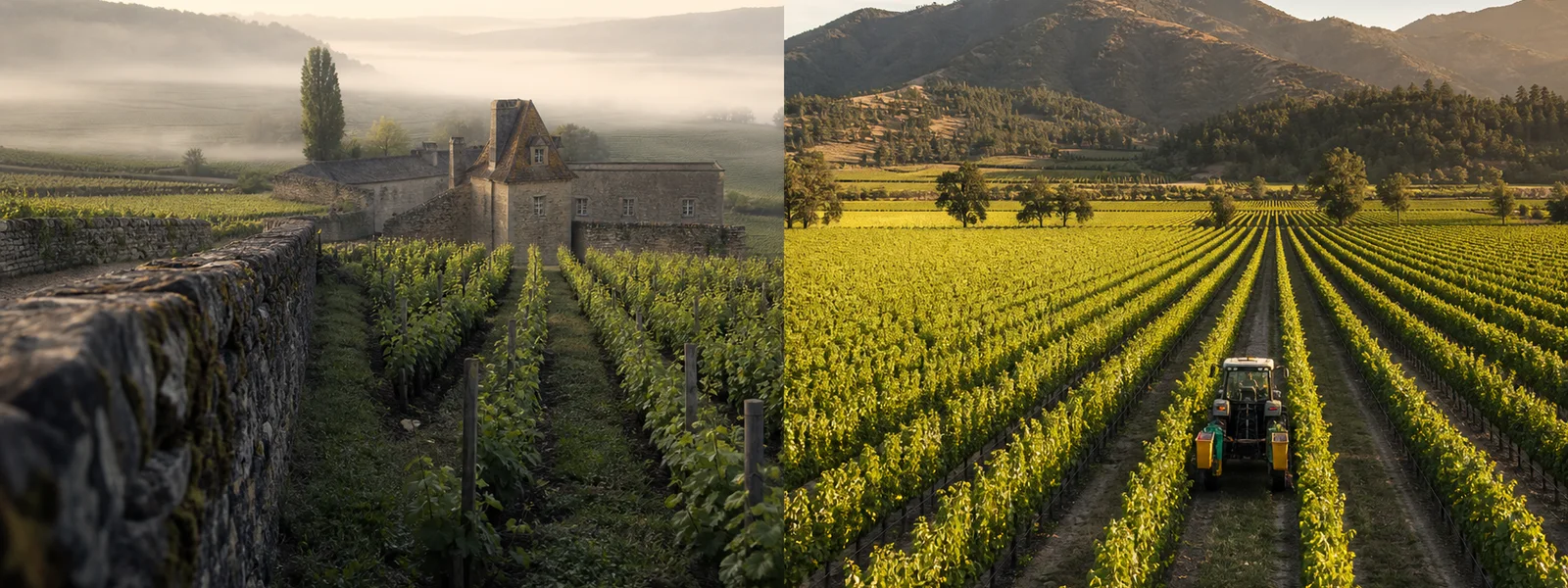
“Old World” and “New World” sound like they’re about history. They’re not. They’re about two different answers to the question: what should wine taste like, and what should it say?
The split is geographic — Europe on one side, everywhere else on the other — but the real difference is philosophical. Once you understand the two philosophies, you can predict what a bottle will taste like before you open it, and you can shop for exactly what you want without guessing.
By the end of this page you’ll know:
- The actual difference between Old World and New World winemaking philosophy
- Why climate is the most important factor, and what it does to flavour
- Concrete taste comparisons between the same grape grown in each world
- How to use the Old World / New World split when you’re shopping or ordering
Two Philosophies, Not Just Two Geographies
Old World — France, Italy, Spain, Portugal, Germany, Austria, Greece — has been making wine for thousands of years. The approach is rooted in a concept called terroir: the idea that the specific place where a grape grows (soil, microclimate, aspect, altitude) expresses itself distinctly in the wine. The winemaker’s job is to step back and let the place speak.
This produces wines that tend to be:
- Lower in alcohol (cooler climates, earlier harvests)
- Higher in acidity
- More restrained in fruit
- More savoury, earthy, mineral
- Labelled by region rather than grape variety
New World — California, Australia, New Zealand, Argentina, Chile, South Africa — has been making wine for centuries too, but without the inherited constraint of tradition. The approach is more interventionist: the winemaker shapes the wine toward an intended flavour profile. Fruit is the point. Ripeness is a virtue.
This produces wines that tend to be:
- Higher in alcohol (warmer climates, later harvests for full ripeness)
- Lower in acidity
- More fruit-forward
- More generous, approachable young
- Labelled by grape variety
Neither approach is better. They’re different objectives.
What Climate Does to Flavour
Climate is the mechanism. The philosophical difference between Old World and New World is largely explained by temperature.
In cool climates (most of Europe, New Zealand, Tasmania, parts of Oregon), grapes ripen slowly. The growing season is long. Sugars accumulate gradually while the grape retains natural acidity. The result: lower alcohol, brighter acidity, more restrained fruit, and more of the mineral and savoury notes that come from partial fermentation of less-ripe sugars.
In warm climates (much of California, South Australia, Argentina’s Mendoza), grapes ripen quickly. They accumulate sugar faster than they can develop flavour complexity. To capture flavour, winemakers harvest later, which means higher sugar, higher alcohol, and fruit that’s ripe to the point of jammy.
The same grape, grown in these two conditions, produces dramatically different wine.
Side-by-Side Comparisons
Pinot Noir: Burgundy vs Central Otago vs Willamette Valley
A Bourgogne Rouge (Burgundy) is pale garnet, earthy, with red cherry, mushroom, and a long savoury finish. Low tannin, high acid, 12.5% ABV.
A Central Otago Pinot Noir (New Zealand) is deeper ruby, with dark cherry, plum, and spice. More fruit-driven, slightly higher tannin, 13.5–14% ABV.
An Oregon Willamette Valley Pinot sits between the two — the most Burgundian of the New World interpretations, with earthy notes alongside the fruit, high acid, and finesse rather than power.
Same grape. Three very different wines.
Chardonnay: Chablis vs Napa Valley
A Chablis is almost ruthlessly lean — green apple, lemon, oyster shell, steel tank fermented (no oak), high acid, 12% ABV. It tastes of a cold limestone hillside.
A Napa Valley Chardonnay is fermented and aged in French oak barrels, put through malolactic fermentation (which converts sharp malic acid to softer lactic acid), and bottled at 14%+ ABV. Butter, vanilla, tropical fruit, a creamy texture that coats the mouth.
Same grape. Barely the same category.
Shiraz / Syrah: Northern Rhône vs Barossa Valley
Syrah in the Northern Rhône (Hermitage, Crozes-Hermitage) produces dark, peppery, savoury wine with violet aromas, tight tannins, and serious aging potential. 13% ABV, lean for its weight.
The same grape in the Barossa Valley becomes Shiraz: fuller, richer, more opulent. Dark chocolate, blackberry jam, vanilla, sometimes eucalyptus. 14.5% ABV is common. Beautiful young but can also age.
The grape even goes by different names in each context — a subtle acknowledgement that they’re not quite the same thing.
Using Old World / New World When Shopping
You don’t need to be a geography expert to apply this. A few rules that hold most of the time:
If the label shows a grape name, you’re almost certainly in New World territory. The wine will be more fruit-forward, more consistent year to year, and more approachable immediately.
If the label shows only a region, you’re in Old World territory. Do a quick translation (Burgundy = Pinot Noir or Chardonnay; Barolo = Nebbiolo; Sancerre = Sauvignon Blanc). The wine will reward attention.
If you want richness and fruit, look New World. If you want minerality, restraint, and food compatibility, look Old World — or to the New World producers explicitly trying to make Old World-style wine (many Oregon winemakers, some Australian producers from cool-climate regions).
Price performs differently in each world. Decent Old World wine at the $20–$30 level is easier to find than decent New World wine at the same price, because so many Old World producers are small estates with long histories. New World quality tends to step up more dramatically as you move up in price.
Keep Reading
Acid, Tannin, Body — The Three Axes
The three structural elements that separate a wine you enjoy from one that just sits there. Learn to identify each one and every glass tells you more.
Building a Tasting Vocabulary
The language of wine is a memory system, not a performance. How to describe what you taste, write a useful note, and remember what you liked.
Old World vs New World Wine: What's Different
Old World vs New World wine, finally explained without snobbery. Taste, price, label rules, and the one-sip test that tells you which is which.