Claire Bennett
Wine Editor12 min read
Champagne Region: Grapes, Styles, and How to Buy
What Champagne actually is, the grapes, houses vs growers, sub-regions, styles like Blanc de Blancs, and how much to spend. Plain-English guide.
Champagne Region: Grapes, Styles, and How to Buy
You spent $80 on a bottle for New Year’s Eve, popped it with some pride, and then a friend casually mentioned you should have got “the grower stuff” instead. You smiled and nodded. You also had no idea what they meant.
Champagne is the most famous wine region on earth and somehow still the one people understand the least. The gap between the big house brands at the supermarket and the bottles wine people actually get excited about is enormous, and most of us are buying on the wrong side of it.
By the end of this page you’ll know:
- The single legal rule that makes a $50 bottle from Reims worth more than a $15 bottle from anywhere else
- The three grapes that go into every Champagne and what each one brings to the glass
- Why “grower Champagne” became the obsession of every sommelier in the last decade (and how to spot it on a label)
- The sub-region whose Chardonnay is the reason Blanc de Blancs exists
- The honest answer to whether vintage Champagne is worth the markup
What Is Champagne, Actually?
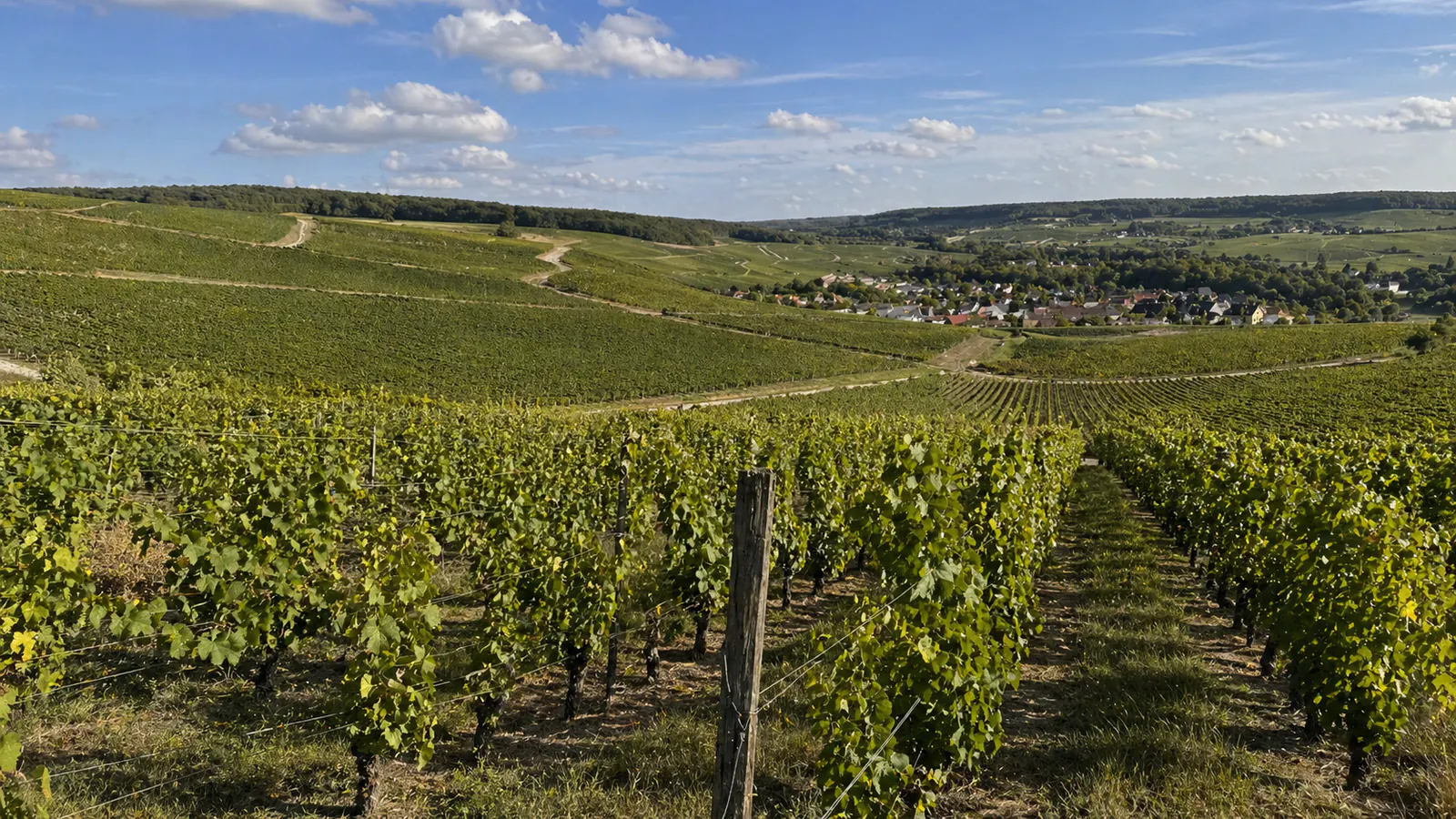
Champagne is a delimited wine region about 90 minutes east of Paris, centred on the towns of Reims and Épernay. The name is legally protected. By European Union law and international treaty, sparkling wine from anywhere else cannot be called Champagne. Cava, Prosecco, Crémant, and English sparkling are all made by similar or different methods, but none of them get the name.
The region is cool, chalky, and just barely warm enough to ripen grapes most years. That marginal climate is the whole point. The grapes hold onto razor-sharp acidity, which is exactly what you need for a sparkling wine that ages well and still tastes alive after seven years in the bottle. Push the climate any warmer and you lose the structure that makes the wine work.
Three things make Champagne, Champagne. The place (chalky soils, cool climate, defined boundary), the grapes (Pinot Noir, Pinot Meunier, Chardonnay), and the method (a second fermentation inside the bottle you actually buy). Every other sparkling wine on earth either copies one of those or substitutes its own.
The region pumps out around 300 million bottles a year, two thirds of them headed overseas. The big names you’ve heard of (Moët, Veuve Clicquot, Dom Pérignon, Krug, Bollinger) are houses. They buy grapes from thousands of growers and blend them into a consistent house style. The other side of the industry is much smaller and far more interesting if you actually like wine.
What Grapes Go into Champagne?
Almost every Champagne is made from a blend of three grapes. Knowing which is which tells you most of what’s in the glass before you even open it.
Pinot Noir brings body, depth, and red-fruit character. It’s a black grape, but the juice runs clear because the skins are pressed off quickly. Pinot Noir gives Champagne backbone and the sense of weight that lets the wine pair with food beyond just oysters. The Montagne de Reims sub-region is the Pinot Noir heartland.
Pinot Meunier is the workhorse, planted on cooler sites where the other two grapes struggle. It ripens earlier, which is useful in a region where one late frost can wipe out a vintage. Meunier brings round fruit and a soft, easy-drinking quality, which is why house Champagnes lean on it for approachability. Most growers used to dismiss it. Many of the best now treat it as a single-variety star.
Chardonnay is the elegance grape. It brings citrus, green apple, white flowers, and crisp acidity. It also ages spectacularly, developing nutty, brioche-like complexity over years in the cellar. The Côte des Blancs (literally “the slope of whites”) is planted almost entirely to Chardonnay, and the wines from there are the most age-worthy in the region.
A few rare older varieties (Pinot Blanc, Pinot Gris, Arbane, Petit Meslier) are still legal and used by a handful of producers, but together they make up well under one percent of plantings. Treat the big three as the working list.
How Is Champagne Made?
The reason Champagne costs what it costs is the method. Most still wine ferments once. Champagne ferments twice, and the second fermentation happens inside the same bottle you eventually buy.
A producer first makes a base wine, which on its own tastes thin, tart, and unfinished. They blend base wines from different villages, grapes, and sometimes years to build the house style. Then they add a small dose of yeast and sugar, seal each bottle with a temporary cap, and lay it in a cool cellar.
The yeast eats the sugar, produces alcohol and carbon dioxide, and because the bottle is sealed, the gas dissolves into the wine. That’s where the bubbles come from. Once fermentation finishes, the dead yeast cells (the lees) sit in the bottle for months or years, slowly breaking down and giving Champagne its signature brioche, toast, and roasted-nut character.
After aging, the bottles get gradually tilted upside down so the lees collect in the neck. The neck is frozen, the cap pulled, and the plug of frozen lees fires out under pressure. A small dose of wine and sugar (the dosage) is added to top up the bottle and set the final sweetness level, then a real cork goes in. Non-vintage Champagne legally has to age 15 months on lees minimum. Vintage has to age three years. Most quality producers age much longer.
That whole process is why a $50 grower bottle is essentially hand-finished labour, and why a $15 supermarket Prosecco (made in giant pressurised tanks) tastes like a different category of drink entirely.
Houses vs Growers: What’s the Real Difference?
This is the single most useful thing to learn about Champagne. Once it clicks, your buying habits change forever.
A house (a Maison) is a brand that buys grapes from growers across the region and blends them into a consistent product. Moët, Veuve, Pommery, Lanson, Mumm, Taittinger, Bollinger, Krug, Dom Pérignon. They own some vineyards but rely heavily on contracts. The advantage is consistency: the Veuve Yellow Label you drank in 2019 should taste roughly like the one you drink in 2026.
A grower (a Récoltant-Manipulant) is a farmer who grows their own grapes and makes their own wine, usually from a single village or even a single vineyard. Look at the bottom of any Champagne label and you’ll see a tiny code. RM means grower-producer. NM means a Maison. CM means a co-operative.
Why growers matter: they capture the actual character of a single place in a way that big houses (whose whole job is averaging across the region) deliberately don’t. Grower Champagne tastes of somewhere. House Champagne tastes of a brand.
The price gap is smaller than you’d think. Excellent grower Champagne starts around $50 to $70 a bottle, which is what you pay for entry-level Veuve at most bottle shops. The catch is you have to go to a real wine shop to find them. Supermarkets and big-box retailers stock houses almost exclusively. Names worth searching for: Pierre Péters, Egly-Ouriet, Vilmart, Pierre Gimonnet, Larmandier-Bernier, Marc Hébrart, Chartogne-Taillet.
What Are the Different Champagne Styles?
Champagne is a category, not a single style. The label tells you what’s in the bottle if you know what to read for.
Brut. Bone-dry to off-dry. Up to 12 grams of residual sugar per litre. The default. Roughly 95% of Champagne sold is Brut.
Extra Brut. Drier than Brut. Up to 6 g/l sugar. Crisper, more austere, more food-friendly. Trending hard among growers.
Brut Nature (also called Zero Dosage). No added sugar at all. Polarising and bracingly dry. For people who already love Brut and want to push further.
Demi-Sec. Sweeter, dessert-territory. 32 to 50 g/l sugar. Pairs with fruit tarts and birthday cake.
Blanc de Blancs. “White from whites.” Made entirely from Chardonnay. Lighter, more elegant, citrussy and floral. Best from the Côte des Blancs.
Blanc de Noirs. “White from blacks.” Made entirely from Pinot Noir, or Pinot Meunier, or both. Richer, rounder, with more body. Best from the Montagne de Reims.
Rosé. Pink Champagne. Made either by bleeding off some red juice or by adding a small amount of still red wine to the blend before secondary fermentation. Ranges from delicate strawberry to richer, almost meaty styles.
Vintage vs Non-Vintage. Non-vintage (NV) blends multiple years to maintain a consistent house style, and this is the bulk of production. Vintage Champagne is made only in years a producer declares good enough, from grapes harvested that single year. It’s more intense, more expressive of the year, and ages longer. It’s also typically twice the price. Worth it for a serious occasion, harder to defend as a Tuesday-night habit.
What Are Champagne’s Sub-Regions?
Champagne breaks into five main growing zones. Each plants different grapes and produces a different style. Knowing them helps you read a label and predict what you’re going to taste.
Montagne de Reims. Pinot Noir country. North-facing slopes, chalky soils, the source of the most powerful, structured Champagnes in the region. Look here for Blanc de Noirs and house bottles built on body and depth. Villages: Verzenay, Bouzy, Ambonnay.
Côte des Blancs. Chardonnay almost exclusively. The slope where Blanc de Blancs lives. Wines from here are linear, mineral, citrussy, and capable of aging for decades. Villages: Cramant, Avize, Le Mesnil-sur-Oger, Oger.
Vallée de la Marne. Pinot Meunier territory. Cooler, fruit-driven, often the source of approachable, easy-drinking house bottles. Frost-prone but the Meunier handles it well. Villages: Aÿ (which is mainly Pinot Noir), Damery, Cumières.
Côte des Bar. The southernmost zone, an hour and a half south of Épernay. Warmer, mostly Pinot Noir, and historically dismissed by the big houses as a grape source rather than a region in its own right. That’s changed in the last twenty years. Some of the most exciting grower Champagne now comes from here.
Côte de Sézanne. A smaller Chardonnay zone south of the Côte des Blancs. Riper, less austere style. Worth a try if you find a bottle but not a region you’ll seek out.
How Much Should You Spend on Champagne?
Champagne pricing is steep across the board, but the curve is real and most people overpay at the bottom rather than the top.
$30 to $45. Supermarket house Champagne (Moët Brut Impérial, Veuve Yellow Label, Mumm Cordon Rouge). Drinkable, branded, designed for parties where nobody’s paying close attention. Often a letdown once you know what better Champagne tastes like.
$50 to $80. The sweet spot. Entry-level grower Champagne, top-tier house non-vintage (Bollinger Special Cuvée, Pol Roger Brut Réserve), and serious quality across the board. Genuinely impressive bottles for a dinner party. If you’re trying Champagne seriously for the first time, start here, not at the supermarket tier.
$90 to $150. Vintage house Champagne, top grower bottles, rosé from quality producers. Wines that justify a special occasion and reward attention. The aromatic complexity on a Pierre Péters Cuvée Spéciale or a Bollinger La Grande Année is on a different planet to entry-level supermarket bottles.
$200 and up. Prestige cuvées (Dom Pérignon, Krug Grande Cuvée, Cristal, Salon, Bollinger R.D.) and top single-vineyard grower bottles. Real, serious wine. Whether it’s worth the money depends entirely on the occasion and how much extra you want to pay for a label everyone at the table will recognise.
The honest upgrade path: skip the $30 supermarket tier. Spend $60 once on a quality house non-vintage or a starter grower bottle and you’ll never go back. The gap between a $30 Moët and a $60 Pol Roger is the same kind of gap as between a $10 Prosecco and a $30 cava. It’s a different product entirely.
Frequently Asked Questions
What’s the difference between Champagne and Prosecco?
Champagne is from northeast France and uses a second fermentation inside each bottle, giving it fine, persistent bubbles, lower fruit, and toasted, brioche-like complexity from extended aging on dead yeast. Prosecco is from northeast Italy and uses tank fermentation (the Charmat method), which gives it bigger, frothier bubbles and a fresh, fruity character of pear and white flowers. Champagne is more structured and ageable. Prosecco is friendlier, fruitier, and cheaper. Different wines for different jobs.
Why is Champagne so expensive?
Three reasons. The land in the Champagne region costs roughly $1.5 million per hectare, more than almost any farmland on earth. The production method requires every bottle to undergo a second fermentation, hand-riddling, disgorgement, and at least 15 months of aging before release. And the name itself is legally protected, which keeps supply tight and brand value high. You’re paying for marginal climate, labour, time, and a 300-year-old marketing engine.
What’s grower Champagne?
Grower Champagne is wine made by the same farmer who grows the grapes, usually on a small estate in a single village. The labels say “Récoltant-Manipulant” or have an RM code printed in tiny letters near the bottom. Grower bottles tend to taste of a specific place rather than a brand house style, and the best of them deliver more interesting wine for the money than equivalent supermarket house Champagnes. They’re harder to find, since most retail outside specialist wine shops is dominated by big houses.
How long does Champagne last after opening?
A re-corked bottle of Champagne keeps its bubbles for around 24 to 48 hours in the fridge if you use a proper Champagne stopper (the spring-loaded kind, never a regular wine cork). Without a stopper, you’ve got maybe 12 hours of decent fizz. The wine itself is still drinkable for a couple of days as a flat white wine, and rich, toasty Champagnes can actually taste pretty interesting that way. Don’t leave an opened bottle on the counter. Refrigerate immediately.
What food pairs with Champagne?
Champagne is one of the most versatile food wines on earth. Bone-dry Brut and Extra Brut pair beautifully with oysters, sushi, fried foods (the bubbles cut through the oil), salty cheeses, and roast chicken. Richer Blanc de Noirs holds up to creamy pasta, mushroom dishes, and even soft cheeses like Brie. Rosé Champagne is a smart match for salmon, charcuterie, and tuna tartare. Demi-sec works with fruit tarts and lighter desserts. The general rule: dryer Champagne with savoury food, sweeter Champagne with sweet food.
Should I serve Champagne in a flute or a wine glass?
A regular white wine glass, every time. The narrow flute looks elegant but it compresses the aroma and traps almost everything that makes good Champagne worth drinking. A standard tulip-shaped white wine glass gives the wine room to breathe and lets you actually smell the brioche, citrus, and toasted-nut notes. Save the flutes for cheap fizz at a party where nobody’s smelling it anyway.
Ready to put this into practice with a bottle worth opening this weekend? Start with a quality grower or a top non-vintage in the $60 range and taste the difference for yourself.
Explore more sparkling wine styles for the full lineup.
Keep Reading
Sparkling Wine Types: Champagne to Pet-Nat
From Champagne to pét-nat, discover every sparkling wine type, how each is made, how sweet or dry it is, and what to pair it with.
Best Prosecco: 14 Bottles Worth Popping in 2026
14 best Prosecco bottles across Brut, Extra Dry, Rosé, Col Fondo, and Superiore DOCG. Real critic scores, real customer ratings, all $13 to $30.
Chardonnay: Taste, Best Regions, Food Pairings
What Chardonnay tastes like, why Chablis and California versions feel like different wines, the best food pairings, and how much to spend.