
Claire Bennett
Wine Editor12 min read
Barossa Valley: Australia's Shiraz Capital Explained
What Barossa Valley wine actually is, why old-vine Shiraz costs what it does, Eden Valley's cooler side, and how much to spend. Plain-English guide.
Barossa Valley: Australia’s Shiraz Capital Explained
You grab a $15 Barossa Shiraz at the bottle shop. It tastes like blackberry jam, cocoa, and a faint puff of smoke. It’s good. It’s also clearly built to please a crowd. Then a friend hands you a $60 bottle from the same region and you realise the cheap one was barely whispering what Barossa actually does.
By the end of this page you’ll know:
- Why Barossa vines are older than most countries’ wine industries (and what that does to the wine in your glass)
- The single climate trick that makes Barossa Shiraz taste richer than almost any other Shiraz on earth
- The cooler, higher sub-region that makes Barossa Riesling worth flying for
- What Penfolds Grange actually is, why it costs as much as a used car, and whether you should ever buy one
- The price band where Barossa Shiraz stops being supermarket fodder and starts being seriously good
What Is Barossa Valley Wine?
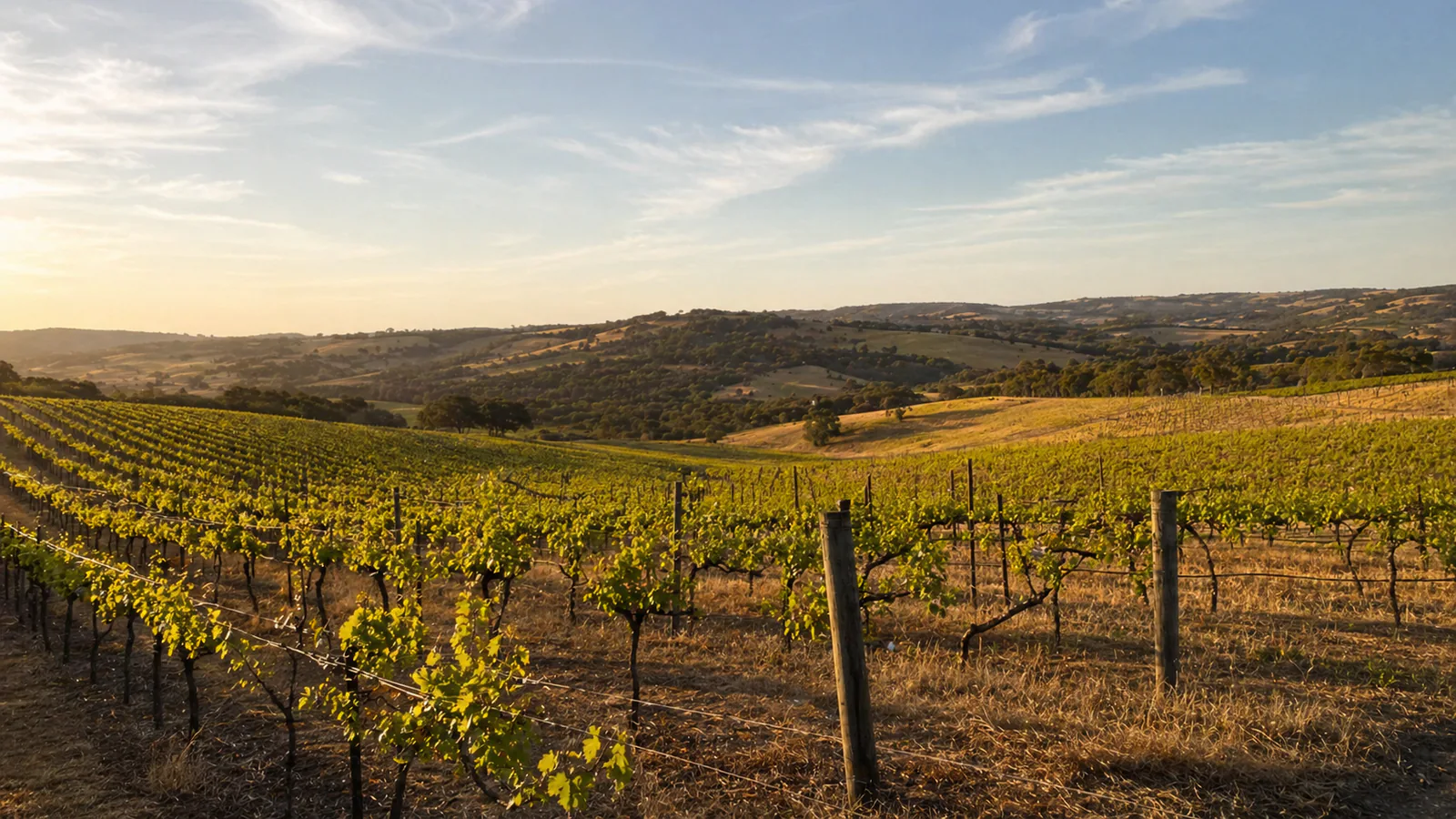
The Barossa Valley sits in South Australia, about an hour’s drive northeast of Adelaide. It’s a wide, sun-drenched valley settled by Lutheran Germans in the 1840s, who planted vineyards and built stone winemaking cellars that are still in use today. Names like Henschke, Seppelt, and Gramp (the founders of what became Orlando-Jacob’s Creek) trace back to those original families.
The climate is warm and dry. Long sunny days ripen grapes to full sweetness. Cool nights keep enough acidity in the wines to hold them together. Low rainfall means disease pressure stays minimal. That’s the textbook recipe for big, ripe red, and Barossa delivers it harder than almost anywhere else on earth.
The Barossa GI (Geographical Indication) actually contains two distinct sub-regions: the Barossa Valley floor itself, which is warm and produces the famous Shiraz, and the Eden Valley, a cooler, higher-altitude pocket on the eastern hills. Both fall under the “Barossa” umbrella, but they make wildly different wines from the same grapes.
Around 80 wineries operate in the region today, ranging from massive industrial producers (Penfolds, Wolf Blass, Yalumba) to tiny family cellars pouring single-vineyard Shiraz from grandfather’s plot. The region produces roughly 12,000 tonnes of wine grapes a year, mostly red.
Why Are Barossa’s Old Vines Such a Big Deal?
When phylloxera, a tiny vine-killing aphid, swept through Europe in the late 1800s, it destroyed almost every old vineyard in France, Italy, and Spain. Growers replanted on resistant American rootstocks, and most “old” European vines today are technically post-phylloxera.
Barossa never got phylloxera. South Australia’s strict quarantine kept it out, and a chunk of the original 1840s plantings survived intact. Some Shiraz vineyards in Barossa are pushing 180 years old, gnarled stumps that look more like driftwood than productive vines.
Old vines matter because they produce less fruit per vine, and what they do produce is wildly concentrated. A 150-year-old Shiraz vine might give you a single bottle’s worth of grapes. The flavour packed into that bottle is something a young vine simply can’t replicate. The Barossa Old Vine Charter formalises four tiers: Old Vine (35+ years), Survivor (70+), Centenarian (100+), and Ancestor (125+).
When you see “Old Vine Shiraz” on a Barossa label, it’s a real category with real history, and the wines back it up. Bottles like Henschke Hill of Grace, Penfolds Grange, Torbreck The Laird, and Rockford Basket Press all draw fruit from these ancient plots.
How Does Barossa Shiraz Differ from Other Shiraz?
Shiraz is the same grape as Syrah. The name changed when cuttings travelled from France’s Rhône Valley to Australia in the 1830s, and the Australian version evolved into something so distinct that the local name stuck. Today, “Shiraz” usually means the Australian style and “Syrah” usually means the French (or French-inspired) style.
Barossa Shiraz sits at the loud, generous, full-bodied end of the spectrum. Expect blackberry, dark plum, dark chocolate, vanilla, mocha, and a soft ripe finish. Tannins are present but rounded, acidity is moderate, alcohol typically lands between 14% and 15.5%. Most bottles age in American oak, which adds the coconut-and-vanilla layer that sets the style apart from European Syrah.
Compare that to a Northern Rhône Syrah from Hermitage or Côte-Rôtie. The French version tends to be leaner and peppery, with notes of olive, cured meat, and violets. Same grape, opposite character. The difference comes down to climate (Rhône is cooler), oak choice (French oak is subtler), and winemaking philosophy.
Barossa Shiraz is what most people picture when they think “big Australian red.” It’s the style that put Australia on the wine map in the 1990s and 2000s. If you’ve ever had Yellow Tail Shiraz and thought “this is fine but kind of one-note,” that’s the supermarket-tier version of a real style that gets genuinely incredible at the $30+ mark.
What’s the Difference Between Barossa Valley and Eden Valley?
The Barossa GI splits cleanly into two halves with very different climates and very different wines.
Barossa Valley Floor
Warm, dry, and low-altitude (around 300m). This is the home of the rich, full-bodied Shiraz the region is famous for. Grenache and Mataro (Mourvèdre) also thrive here, often blended into the classic Australian “GSM” (Grenache, Shiraz, Mataro). Cabernet Sauvignon does well in cooler pockets. Whites are minimal on the valley floor, with most plantings dedicated to red.
Sub-zones within the valley have their own personalities. Greenock and Marananga produce some of the most powerful Shiraz, often dense and chocolatey. Lyndoch and Williamstown sit at the cooler southern end and produce slightly more elegant styles. Ebenezer in the north is dry and concentrated.
Eden Valley
Cooler, higher (up to 600m), and a completely different proposition. Eden Valley is one of Australia’s premier sites for Riesling, producing tight, lime-driven, mineral-edged whites that age for decades. Pewsey Vale, Henschke, and Mountadam all make benchmark Eden Valley Rieslings.
Eden Valley Shiraz exists too, but it’s leaner and peppery, closer in style to Northern Rhône Syrah than to its valley-floor cousins. Henschke Hill of Grace, arguably Australia’s second most famous wine after Penfolds Grange, comes from Eden Valley Shiraz vines planted in the 1860s.
If you only know Barossa as “big Shiraz country,” Eden Valley is the curveball. A Pewsey Vale Riesling at $25 will reset your expectations of what Australian white wine can do.
What Other Grapes Does Barossa Grow?
Shiraz dominates, but the Barossa GI grows several other varieties seriously well.
Grenache. Barossa Grenache, especially from old bush vines in Vine Vale and Seppeltsfield, is having a major moment. The style is light to medium-bodied, juicy, red-fruited, and surprisingly graceful. Producers like Cirillo, Yangarra, and Sami-Odi make Grenache that drinks closer to Burgundian Pinot than to anything resembling a Barossa Shiraz.
Mataro (Mourvèdre). Dark, savoury, with a slightly gamey edge. Often used in GSM blends, occasionally bottled as a single variety. Older Mataro vines exist in pockets across the valley floor, and the wines have a meaty depth that Shiraz lacks.
Cabernet Sauvignon. Less fashionable than Shiraz here but consistently excellent at the top end. Yalumba The Menzies, Wolf Blass Black Label, and Penfolds Bin 707 (multi-region but Barossa-leaning) are the benchmark bottles. The style is ripe and dark, structured, and built to age.
Riesling. Eden Valley territory, as covered above. Bone-dry, lime-driven, and capable of aging 20+ years.
Semillon. A traditional Barossa white, often barrel-fermented and aged. Less famous than the Hunter Valley version but a worthy footnote.
GSM blends are a Barossa signature worth knowing. The Grenache brings perfume and red fruit, the Shiraz brings power and dark fruit, the Mataro brings structure and savoury depth. A good $30 GSM is a near-perfect dinner-party red.
What’s the Difference Between Modern and Traditional Barossa Style?
Barossa winemaking has had two main eras and the current period is something of a hybrid.
The traditional Barossa style, dominant from the 1970s through the early 2000s, leaned hard into ripeness, oak, and alcohol. Picking was late, fruit was concentrated to jamminess, new American oak was generous, and finished alcohol often pushed past 15.5%. The wines were powerful and crowd-pleasing, and they put Australia on the map in the US and UK.
The modern style, which emerged in the 2010s, dialled all that back. Picking dates moved earlier to preserve acidity, oak regimes leaned toward older barrels and French rather than American, and alcohols crept back down toward 14%. Producers like Sami-Odi, Ochota Barrels (before founder Taras Ochota’s passing), and Yangarra led this shift. The wines are fresher, more savoury, and more food-friendly without losing the Barossa core character.
Both styles are still made, often by the same wineries running multiple labels. A Penfolds Bin 28 is recognisably traditional. A Yangarra Old Vine Grenache is recognisably modern. Knowing which camp a producer sits in helps you predict what’s in the bottle before you open it.
What Does Barossa Shiraz Taste Like?
Cracking a typical Barossa Shiraz, here’s what to expect in the glass.
Colour: deep, dark, almost opaque purple-red.
Aroma: blackberry, dark plum, blueberry, cocoa, vanilla, mocha, and often a whiff of eucalyptus or mint (a real regional marker).
Palate: full-bodied and rich. The fruit is ripe and dark, tannins are soft and rounded, acidity is moderate. Oak adds vanilla and toast. The finish runs long, warm, and chocolatey.
Quick reference:
- Body: full
- Tannin: medium, soft and ripe
- Acidity: medium
- Alcohol: 14% to 15.5%
- Oak: prominent, typically American
- Sweetness: technically dry but tastes ripe enough to feel slightly sweet
The eucalyptus note is genuinely diagnostic. Australian vineyards are often planted near eucalyptus trees, and tiny amounts of eucalyptol drift onto the grapes during ripening. In a Barossa Shiraz, a faint mint or menthol lift is a regional fingerprint.
What it pairs with: barbecued meats, slow-cooked lamb shanks, beef ribs, kangaroo (genuinely), aged cheddar, and dark chocolate desserts. The wine is too big for delicate fish or salads. Match it to food with char, fat, and depth.
How Much Should You Spend on Barossa Wine?
Barossa Shiraz scales steeply with price, and there are clear quality tiers worth knowing.
$10 to $18 entry tier. Yellow Tail, Jacob’s Creek, Wolf Blass Yellow Label, Lindeman’s Bin 50. Drinkable and fruit-forward, made for volume. Fine for Tuesday-night pasta, rarely memorable.
$25 to $50 sweet spot. This is where Barossa Shiraz starts to actually be Barossa Shiraz. Producers like Charles Melton, Rolf Binder, Glaetzer, Schild Estate, and Two Hands deliver real depth and real old-vine character in bottles that punch above their price. Penfolds Bin 28, Bin 128, and Bin 389 sit in or near this band and are the classic introduction to serious Australian red.
$60 to $200 serious tier. Single-vineyard old-vine Shiraz from producers like Torbreck, Rockford Basket Press, Standish, and Penfolds RWT. The fruit gets denser, the structure gets longer, and the bottles age 15 to 25 years gracefully.
$300 and up icon tier. Henschke Hill of Grace ($800+), Torbreck The Laird ($800+), and the legend itself, Penfolds Grange.
Penfolds Grange is Australia’s most famous wine. It’s a multi-vineyard Shiraz blend (occasionally with a small amount of Cabernet) sourced from across South Australia, with significant Barossa fruit. It’s aged in new American oak hogsheads for 18 months and built to live for 30+ years in bottle. Current release prices land around $1,000 a bottle, with older vintages selling at auction for multiples of that.
Is it worth it? For most drinkers, no. The price reflects scarcity, history, and collector demand more than a literal multiple of liquid pleasure over a $100 bottle. Grange is genuinely great wine. You’re paying about $700 for the label. If you want to taste what Barossa Shiraz can do at its best, a $80 to $150 bottle from Standish, Torbreck, or Penfolds RWT will get you 90% of the way for 10% of the money.
Frequently Asked Questions
What’s the difference between Shiraz and Syrah?
They’re the same grape. Shiraz is the Australian name, Syrah is the French name, and the names have come to signal style as well as origin. “Shiraz” usually means the bigger, riper, oakier Australian style. “Syrah” usually means the leaner, peppery, more savoury French (or French-inspired) style. A bottle labelled “Syrah” from a cool-climate Australian region like Yarra Valley or Tasmania is signalling that it’s made in the French style, deliberately.
Why is Barossa Shiraz so big and bold?
Three reasons. Climate: Barossa is warm and dry, so grapes ripen to full sweetness with concentrated flavours. Vine age: many Barossa Shiraz vines are 50 to 180 years old, and old vines produce smaller crops of intensely flavoured fruit. Winemaking: producers traditionally pick late, ferment for full extraction, and age in new American oak, which all amplify body and richness.
What’s Penfolds Grange?
Australia’s most famous wine. It’s a Shiraz-dominant blend sourced from multiple vineyards across South Australia (Barossa is a major contributor), aged in new American oak for 18 months, and released about four years after vintage. Current bottles cost around $1,000. Winemaker Max Schubert created it in the 1950s. Critics initially mocked it. It went on to become a global icon. Worth knowing about. Probably not worth buying unless you collect wine.
What’s old-vine Shiraz?
Shiraz from vines that have been growing for decades, often a century or more. The Barossa Old Vine Charter sets four tiers: Old Vine (35+ years), Survivor (70+), Centenarian (100+), and Ancestor (125+). Old vines produce less fruit per vine, but the fruit is wildly concentrated, which translates to richer, deeper wine. Barossa has more old Shiraz vines than anywhere on earth, because South Australia escaped the phylloxera plague that destroyed most of Europe’s old vineyards.
What’s the best cheap Barossa wine?
In the $15 to $20 band, Schild Estate Shiraz and Charles Melton Rose of Virginia are reliable picks. For $25 to $35, Penfolds Bin 28 Kalimna Shiraz is the textbook introduction to the regional style and consistently overdelivers. Charles Melton Nine Popes (a GSM blend) is another strong sub-$50 bottle that shows Barossa’s range beyond straight Shiraz.
Can Barossa Shiraz age?
Yes, and the better bottles age beautifully. Entry-level Barossa Shiraz ($10 to $20) is built to drink within two to three years of release. Mid-tier bottles ($25 to $50) typically improve for 8 to 12 years. Premium old-vine and single-vineyard Shiraz ($60+) can age 15 to 25 years, developing leather, dried fig, and tobacco notes as the fruit fades. Penfolds Grange and Henschke Hill of Grace can age 30+ years with no real ceiling.
Ready to actually drink some? Browse our roundup of the best full-bodied red wines for tested picks across every price tier.
Keep Reading
Syrah vs Shiraz: Same Grape, Two Wines Explained
Why one grape goes by two names, what Syrah and Shiraz actually taste like, the regions worth knowing, and the food that brings each style to life.
Best Full-Bodied Red Wines: 8 Heavyweights Under $30
Eight full-bodied red wines worth opening. Cab, Zinfandel, Petite Sirah, Malbec, Shiraz, Nebbiolo, Aglianico. All under $30.
BBQ Wine Pairing: What To Pour With Every Smoke
The best wines for BBQ by meat and sauce, from Zinfandel with ribs to Malbec with brisket, plus rosé and Riesling for chicken and spicy sauces.