Claire Bennett
Wine Editor11 min read
Provence Wine: Rosé, Bandol, Grapes, and Style
What Provence wine actually is, why its rosé set the world standard, the sub-regions, the grapes, and how much to spend. Plain English.
Provence Wine: Rosé, Bandol, Grapes, and Style
Walk into any supermarket in summer and you’ll spot them on the end-cap. Tall clear bottles, pale salmon colour, swirly script on the label, all selling the same holiday-in-a-glass promise. Half of them have never been near Provence. They’re copying a style the region invented thirty years ago, and the gap between the genuine article and the imitation is bigger than most drinkers realise.
By the end of this page you’ll know:
- The single visual cue on a Provence rosé that tells you it was made for food, not poolside
- Why Bandol is the region’s best-kept secret (and the grape that makes its reds age for decades)
- The Provence sub-region that produces saltier, more mineral white wine than almost anywhere in France
- The specific moment in the 1980s that turned Provence rosé from a local oddity into a global phenomenon
- The exact price point where Provence rosé stops being marketing and starts being wine
What Is Provence Wine?
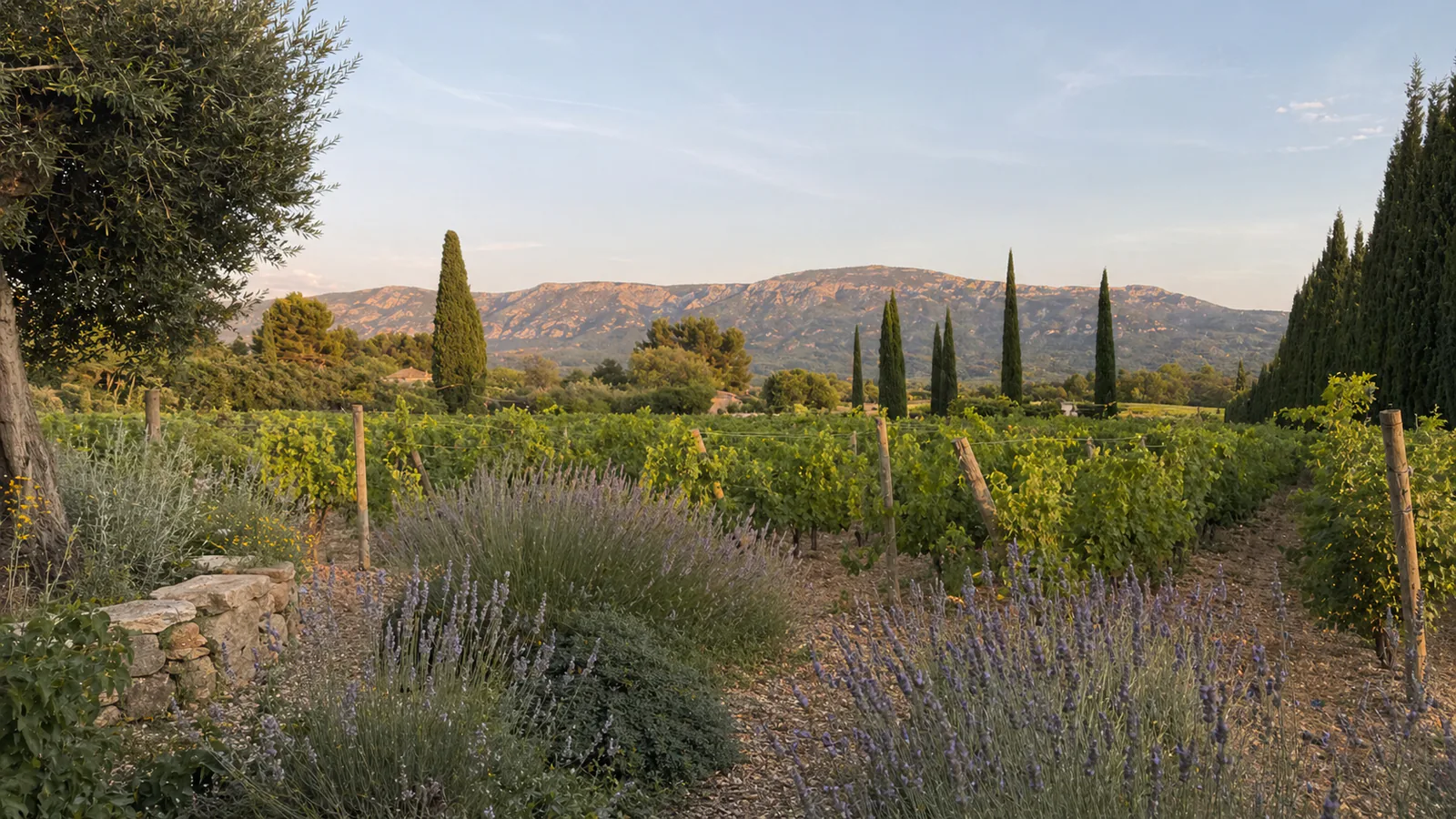
Provence is the stretch of southern France that runs along the Mediterranean coast, roughly from Marseille east to the Italian border. It’s France’s oldest wine region. The Greeks planted vines here around 600 BCE, the Romans expanded the vineyards, and Provence has been making wine for longer than most countries have existed.
The region’s identity now sits almost entirely on rosé. Around 90% of Provence’s production is pink, and Provence supplies about 40% of all the appellation rosé made in France. No other major wine region in the world is this committed to one colour.
The climate explains a lot of it. Hot dry summers, cool nights, the Mistral wind blasting down off the Alps, plus limestone and clay soils that drain fast. Red grapes ripen easily and pick up plenty of fruit, but the cool nights keep acidity locked in. That combination of ripe red fruit and high acid is exactly what rosé needs to be both flavourful and refreshing.
Provence is split into nine appellations. Three of them, Côtes de Provence, Coteaux d’Aix-en-Provence, and Coteaux Varois en Provence, account for the vast majority of the wine you’ll see exported. The other six are smaller, often higher-quality, and worth knowing about.
How Did Provence Rosé Conquer the World?
Until the 1990s, almost nobody outside the south of France drank rosé on purpose. The category had a global reputation as cheap, sweet, slightly fizzy stuff that came in jug bottles. It was a punchline.
What changed was a deliberate strategy. Producers in Côtes de Provence noticed that the rosé being made in nearby Italian and Spanish markets was darker and sweeter than what locals actually drank. So they doubled down on the opposite: pale colour, bone dry, high acid, made for the table, packaged in elegant bottles instead of jugs.
The big pivot came in the 1980s and 1990s when producers like Domaines Ott and Château Minuty pushed into export markets with bottles that looked like perfume. The pale “onion skin” colour became a deliberate visual signature. By the 2000s, Whispering Angel from Sacha Lichine had turned Provence rosé into a global cultural phenomenon, and supermarkets everywhere now copy the bottle shape, the colour, and the script-font label.
The genuine article has a few markers worth knowing. Real Provence rosé is always dry, almost always pale (the colour comes from very brief skin contact), and acid-driven rather than sweet-fruit-driven. If a “Provence-style” rosé tastes overtly sweet or candied, it’s drifting from the actual region.
What Are Provence’s Sub-Regions?
Provence isn’t one monolith. The appellations vary in climate, grapes, and quality bar. Five worth knowing:
Côtes de Provence
The big one. Around 70% of Provence’s wine comes from this single appellation, which sprawls across most of the region from Marseille to past Saint-Tropez. Mostly rosé, mostly pale, mostly drinkable but occasionally exceptional. Bottles run $15 to $30 for the everyday tier and climb past $40 for serious producers like Château Minuty, Domaines Ott, and Domaine Tempier (when their declassified rosé sneaks out).
Coteaux d’Aix-en-Provence
The western half of the region, centred on the city of Aix. Slightly cooler, slightly higher altitude, and a touch more structure in the wines. Reds are taken more seriously here than in Côtes de Provence. Quality bottles run $20 to $40.
Bandol
The serious one. Bandol is a tiny appellation near the coastal town of the same name, and it’s the only Provence sub-region truly famous for red wine. The reds are built around Mourvèdre, a thick-skinned grape that needs the hot Mediterranean sun to ripen properly. Bandol reds have structure, tannin, and the ability to age 20 years or more. Bottles start around $35 and climb past $80 for top producers like Domaine Tempier and Château de Pibarnon.
Cassis
A tiny coastal appellation just east of Marseille (not to be confused with the blackcurrant liqueur). Cassis specialises in white wine, made primarily from Marsanne, Clairette, and Ugni Blanc, with a salty, mineral, almost iodine character that comes from the limestone cliffs and the sea air. Quality bottles run $25 to $50.
Bellet
A microscopic appellation in the hills above Nice, with only around 50 hectares planted. Bellet uses two grapes you’ll see almost nowhere else, Folle Noire for reds and Rolle for whites. The wines are scarce and pricey ($40 to $80) but worth seeking out if you find them.
What Else Does Provence Make Besides Rosé?
If you’ve only ever drunk Provence rosé, you’re missing two things that the region does brilliantly.
First, Bandol red. One of the most distinctive reds in France, built on Mourvèdre with smaller portions of Grenache and Cinsault. The flavour is dark plum, leather, garrigue (the wild herb scent of the southern French hills), and a smoky, gamey character that reminds people of northern Rhône Syrah crossed with old-school Châteauneuf. A serious Bandol from a good vintage will age in a way no rosé ever can. Domaine Tempier is the benchmark.
Second, the whites. Provence makes a small amount of white wine, and the best examples are exceptional. Cassis whites have that salty, mineral character mentioned above. The white wines of Bellet are nutty and floral. Even Côtes de Provence and Bandol bottle white versions worth trying, usually built around Rolle (also called Vermentino in Italy), which gives the wines a citrus and almond character with weight in the mid-palate.
These wines fly under the radar because the rosé tide is so strong. Restaurants stock the pink, importers stock the pink, and the reds and whites get treated as side acts. If you spot a bottle of Domaine Tempier rouge or a Cassis blanc from a producer like Clos Sainte Magdeleine, grab it.
What Grapes Go into Provence Wine?
Provence is a blending region. Almost every wine, pink, red, or white, is made from a mix of grapes rather than a single variety. The main players:
Grenache. The backbone of most Provence rosé and a big component in the reds. Adds red-cherry fruit, soft texture, and warmth.
Cinsault. A pale-skinned red grape that’s almost always blended into rosé. Gives lift, freshness, and that pale colour the region is famous for.
Mourvèdre. The serious one. Thick-skinned, late-ripening, demanding. The dominant grape in Bandol reds and a structural component in many rosés. Adds tannin, dark fruit, leather, and aging potential.
Syrah. Used across the region, mostly for blending into reds and the deeper-pigmented rosés. Adds black fruit, pepper, and structure.
Tibouren. An obscure local red that’s been grown in Provence for centuries and almost nowhere else. It’s used in some of the most distinctive rosés, including Clos Cibonne, where it produces rosés that age in barrel and develop a savoury, oxidative character closer to a light red than a typical pink.
Rolle (Vermentino). The main white grape. Produces wines with citrus, almond, white peach, and a slightly bitter mineral finish. The same grape is grown across the Italian Riviera and Sardinia.
You don’t need to memorise these. The reason they matter is that the blend is what determines whether a Provence wine tastes like every other Mediterranean rosé or like something specifically of place.
What Does Provence Rosé Actually Taste Like?
A genuine Provence rosé from a serious producer hits these markers:
- Pale salmon pink to onion skin in colour, never deep
- Bone dry with high acidity
- Red fruit on the nose: strawberry, raspberry, watermelon, pink grapefruit
- A herbal, savoury edge underneath the fruit, often described as garrigue
- A mineral, sometimes saline finish that comes from the limestone soils and Mediterranean influence
- Medium body, low to medium alcohol (usually 12.5% to 13.5%)
If a rosé tastes like strawberry jam or feels heavy in the glass, it’s drifted into a different style. Provence rosé is built around freshness and a savoury edge, the kind of wine you can drink cold with dinner or on its own without getting bored of it after one glass.
The food-pairing range is huge. Provence rosé works with almost anything that isn’t red meat: grilled fish, seafood paella, salade niçoise, bouillabaisse, goat cheese, olive tapenade, pizza, tomato pasta, and Asian food (Vietnamese, Thai, Japanese). It’s one of the most flexible wines on the planet at the dinner table, and it’s the obvious choice when you’re hunting for the best wine for summer.
Serve it cold but not freezing: 8 to 10°C, similar to a crisp white wine. Tiny tulip glasses flatten it. A standard white wine glass is fine.
How Much Should You Spend on Provence Wine?
Provence rosé covers a wide price range, with quality climbing reasonably as you spend more. Three tiers worth knowing:
$10 to $15. Mostly mass-market bottles. Some are technically Provence (Côtes de Provence on the label), some are “Provence-style” rosé from cheaper southern French regions like Languedoc or Pays d’Oc. Drinkable, often pleasant, rarely memorable. Fine for a barbecue.
$18 to $30. The sweet spot. Real Provence rosé from named appellations, often from family-owned producers, with the structure and acidity that the region is known for. Whispering Angel sits here. So do Château Minuty, Mirabeau, Studio by Miraval, and many smaller domaines that import to specialty stores.
$35 and up. The serious tier. Domaines Ott (especially Clos Mireille and Château Romassan), Château d’Esclans Garrus, Domaine Tempier rosé, Clos Cibonne. These bottles have weight, complexity, and age-worthiness. They’ll quietly outclass most $40 white wines at a dinner. If you’ve decided you don’t like rosé, this is the tier that changes minds.
For Bandol reds, expect to start around $35 for an entry bottle and pay $60 to $90 for a serious producer like Domaine Tempier. For Cassis whites, $25 to $50 covers the field. Bellet is rare and runs $40 to $80 when you can find it.
The honest truth about Provence rosé: the gap between a $12 supermarket bottle and a $25 producer bottle is enormous. Above $40, the gains shrink and you’re paying for branding and packaging as much as for what’s in the glass.
Frequently Asked Questions
Why is Provence rosé pale pink?
The colour comes from very brief skin contact during fermentation. Red grapes have clear juice and coloured skins. Provence producers press the grapes and let the juice sit on the skins for only a few hours (sometimes less), which extracts just enough pigment to give the wine its pale salmon hue. Other rosé regions leave the juice on skins longer, producing darker colours. The pale Provence style is a deliberate visual signature, and it’s also a reasonable flavour cue: less skin contact means less tannin and a fresher, more food-friendly wine.
Is Provence rosé dry or sweet?
Almost always dry. Genuine Provence rosé from any of the named appellations is bone dry by law and tradition. The fruit character (strawberry, watermelon, pink grapefruit) can taste sweet because the wine is fruity, but actual residual sugar is minimal. If you’ve had a sweet-tasting “Provence-style” rosé, it was probably made elsewhere or made for a market that prefers off-dry styles. Real Provence rosé tastes more like a crisp white wine in dryness than like White Zinfandel.
What’s the difference between Provence rosé and other rosé?
Three things: colour, dryness, and grape blend. Provence rosé is paler than rosé from Spain, Italy, the Loire Valley, or California. It’s reliably dry, where rosé from other regions can be off-dry or sweet. And it’s built on Grenache, Cinsault, and Mourvèdre, which produce a savoury, herbal character you don’t get from rosé made out of Pinot Noir, Tempranillo, or Sangiovese. Provence is also designed for food pairing first. Plenty of other regions make rosé as more of a casual sipper.
What is Bandol?
Bandol is a small appellation on the Provence coast, east of Marseille, that’s famous for serious red wine made primarily from Mourvèdre. Bandol reds have to age in oak for at least 18 months before release, which is unusual for the region, and they’re capable of aging 20 years or more in bottle. The flavour profile is dark fruit, leather, herbs, and smoke, with firm tannins. Bandol also produces excellent rosé and a small amount of white. Domaine Tempier is the benchmark producer.
What food pairs with Provence rosé?
Almost anything that isn’t red meat. Grilled fish, seafood paella, salade niçoise, bouillabaisse, sushi, pizza, tomato-based pasta, goat cheese, olive tapenade, Vietnamese summer rolls, and Thai green curry all work beautifully. The high acidity and savoury herbal character make it a more flexible food wine than most whites. The classic regional pairing is rosé with bouillabaisse or grilled sardines, both of which match the wine’s salty, herbal edge perfectly.
Does Provence make red wine besides Bandol?
Yes, though very little of it gets exported. Côtes de Provence and Coteaux d’Aix-en-Provence both produce red wines from blends of Grenache, Syrah, Cinsault, and Mourvèdre. The style sits somewhere between Côtes du Rhône and southern French country reds, with red fruit, herbs, and moderate structure. They’re rarely as serious as Bandol, but offer good value when you find them, usually $18 to $35 a bottle.
Ready to find a rosé that actually delivers on the Provence reputation? The wider rosé category has options from across France, Italy, Spain, and beyond, with pricing tiers and tasting notes for each style.
Read the full guide to rosé wine for the wider lineup.
Keep Reading
Rosé Wine Guide: Styles, Regions, and Pairings
Everything you need to know about rosé wine: how it's made, the main styles by region, which grapes to look for, and what to eat with it.
Best Wine for Summer: 12 Bottles for Hot Days
12 verified summer wines covering sparkling, rosé, crisp white, and chillable light red. Critic scores, screwcap flags, every bottle live.
Grenache: The Warm-Climate Workhorse Red
Grenache (Garnacha) is the soul of Châteauneuf-du-Pape and Priorat. Strawberry, white pepper, herbs, and a knack for lifting any blend it joins.