
Claire Bennett
Wine Editor12 min read
Mendoza Wine: Argentina's Malbec Heartland Explained
What Mendoza wine actually is, why altitude makes its Malbec different, the sub-regions worth knowing, and how much to spend for the good stuff.
Mendoza Wine: Argentina’s Malbec Heartland Explained
You’ve drunk plenty of $14 Argentinian Malbec at restaurants. It’s reliably soft and plummy, and it does the job with a steak. What you’ve never really asked is whether the $30 to $50 bottle from a named Mendoza estate is genuinely better, or whether it’s just dressed-up marketing. The gap is enormous. Once you know which sub-region to look for, that upgrade is one of the best value moves in wine.
By the end of this page you’ll know:
- The single geographic factor that separates Mendoza Malbec from every other Malbec on earth (and why it tastes different to French Cahors)
- The sub-region where Argentina’s most serious producers built their flagship wines, and the one where the new wave moved when they wanted altitude and cooler nights
- The white grape almost no Argentinian restaurant pours by the glass, even though it’s the country’s most distinctive
- Why a 1,500-metre vineyard ripens grapes a Bordeaux winemaker would consider impossible
- The exact price jump that turns supermarket Malbec into a wine worth opening for guests
What Is Mendoza Wine?
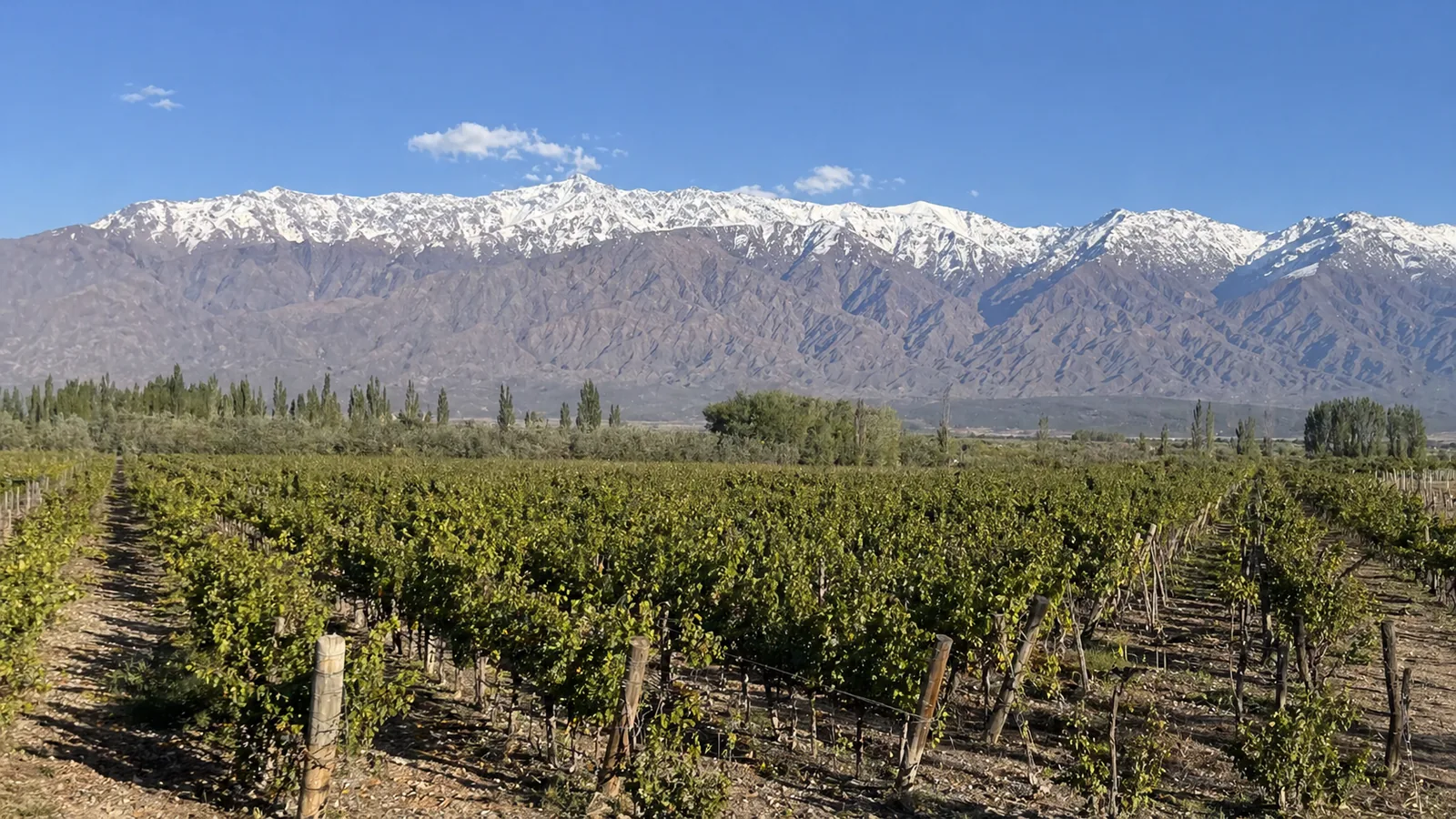
Mendoza is a province on the western edge of Argentina, pressed up against the Chilean border by the Andes. It accounts for roughly 70% of all Argentinian wine production and grows around 150,000 hectares of vineyard. That makes it one of the largest wine regions on the planet by volume.
Geographically, it’s a high-altitude desert. The city of Mendoza sits at about 750 metres above sea level and the vineyards climb from there. Rainfall is so low (around 200mm a year) that the vines survive entirely on snowmelt channelled down from the Andes through irrigation ditches the locals have run since the 1500s.
Malbec is the headline grape, and Mendoza is responsible for about 85% of the world’s plantings. The province also grows Cabernet Sauvignon, Bonarda (the second most-planted red), Syrah, Chardonnay, and the country’s signature white, Torrontes. The style across all of these is shaped by altitude and sunshine more than soil or rainfall, which is the opposite of how most European regions work.
Mendoza’s modern wine reputation is younger than people assume. Until the late 1980s it was mostly cranking out high-volume table wine for the local market. The shift to quality export wine started in the 1990s and accelerated when foreign winemakers arrived (Michel Rolland, Paul Hobbs, the Catena family’s investments). The Uco Valley boom from 2005 onward put the region on every serious wine list in the world.
Why Does Altitude Make Mendoza Wine Different?
Most wine regions live between 100 and 500 metres above sea level. Mendoza vineyards start at 600 and routinely run past 1,500. The highest commercial vineyards in the Uco Valley sit close to 1,700 metres, which is higher than the summit of most Scottish mountains.
That altitude does three things to the grapes. First, ultraviolet light is far stronger up there, which thickens the grape skins and concentrates colour and tannin. That’s why Mendoza Malbec has the inky purple shade you don’t see anywhere else. Second, the daytime sun ripens the fruit fully, so the wines have ripe, plush black-fruit flavours rather than green or stalky notes. Third, the nights at altitude crash to single digits even in summer, which preserves natural acidity.
That last point is the quiet trick. Most warm-climate regions struggle to keep wines fresh because hot nights burn off acidity. The Andes give Mendoza a built-in air conditioner. You get ripe fruit and a fresh finish in the same glass, and that’s a big part of why these wines drink so well.
The soil layer adds another wrinkle. Mendoza sits on a deep alluvial fan of stones, sand, and limestone washed down from the mountains over millions of years. Different sub-zones have different proportions of each, and the better producers now bottle single-vineyard wines that taste recognisably different from the estate next door.
How Did Malbec Make Mendoza Famous?
Malbec originated in southwest France, where it’s still grown in Cahors as a dark, rustic, often austere red. It arrived in Argentina in 1853 with a French agronomist hired by the provincial government, found the soil and altitude perfect, and slowly took over. Phylloxera and frost wiped out most of France’s Malbec plantings in the 20th century. Mendoza’s kept growing.
The Argentinian style is softer, riper, and more generous than French Cahors. You get blackberry, plum, and violet on the nose, a velvety mid-palate, and tannins that feel rounded rather than grippy. Oak aging adds vanilla, cocoa, and a hint of leather to the better bottles. Most Malbec drinks well within five years of release, though serious Uco Valley wines can age 10 to 15.
The grape’s colour is its calling card. Mendoza Malbec is so dark it’s nearly opaque in the glass, with a vivid violet rim. That’s a function of the thick skins altitude produces. If you’ve ever held a glass to the light and thought “that’s a lot of wine in there,” you weren’t imagining it.
Quick reference for how Mendoza Malbec feels in the glass:
- Body: medium-full to full
- Tannin: medium, ripe, rounded
- Acidity: medium to medium-high (the altitude kicker)
- Sweetness: dry
- Oak: common, ranges from gentle to noticeable
- Alcohol: 13.5% to 15%
What Are Mendoza’s Sub-Regions?
Mendoza isn’t one place. It’s at least four meaningfully different growing zones, and the front label will usually tell you which one you’re drinking.
Lujan de Cuyo
The historic heart of quality Mendoza Malbec. Lujan sits just south of the city at 800 to 1,100 metres and is home to the oldest vineyards in the country, including some original 1900s Malbec plantings. The wines tend toward ripe black fruit, plush texture, and a slightly warmer, riper profile than the Uco Valley. This is where producers like Catena, Achaval-Ferrer, and Norton built their reputations. Bottles start around $20 and climb past $100 for top single-vineyard wines.
Maipu
Even closer to the city, lower altitude, and historically the workhorse zone. Maipu produces a lot of mid-priced Malbec, plus excellent Cabernet Sauvignon and old-vine Bonarda. The style is generous and approachable. Trapiche, Zuccardi’s basic tier, and many of the bottles in the $12 to $20 range come from here.
Uco Valley (Tupungato, Tunuyan, San Carlos)
The new wave. Uco runs along the foothills southwest of the city at 900 to 1,700 metres, and it’s where modern Mendoza built its reputation for serious, age-worthy reds. The three departments inside Uco each have a feel of their own. Tupungato is the highest and coolest, with bright, structured wines that often carry a herbal lift. Tunuyan sits in the middle and turns out some of the most balanced, layered Malbec in the country. San Carlos is the southernmost, with stony soils that give the wines real concentration.
If you’ve heard of Catena Zapata’s Adrianna Vineyard, the Vines of Mendoza, or any “high altitude” Malbec, it’s almost certainly Uco. Expect $30 to $80 for serious bottles and plenty of room above that for cult wines.
Eastern Mendoza
The volume zone. Lower altitude, hot, irrigated farmland producing the bulk Malbec that fills supermarket shelves and restaurant by-the-glass programs. Drinkable, fruity, rarely complex.
What Else Does Mendoza Grow Besides Malbec?
Reducing Mendoza to Malbec misses three grapes that are genuinely worth knowing.
Cabernet Sauvignon. Mendoza Cabernet sits between the leaner Bordeaux style and the riper Napa style, with deep blackcurrant fruit, fresh acidity, and firm tannin. The best bottles come from Lujan de Cuyo and Uco Valley, often in Bordeaux-style blends with Malbec. If you like Napa Cab but find the prices punishing, Mendoza Cab at $25 to $45 is one of the great value plays in red wine.
Bonarda. Argentina’s second most-planted red grape, also called Charbono in California and Douce Noir in France. Bonarda makes juicy, plummy, easy-drinking reds at the entry level and serious old-vine wines at the top. Malbec has overshadowed it for decades, but a small group of producers in Maipu and eastern Mendoza are turning out genuinely brilliant Bonarda from gnarly 80-year-old vines for under $30.
Torrontes. Argentina’s signature white, mostly grown further north in Salta but also in Mendoza. Torrontes is intensely aromatic, with notes of rose petal, jasmine, peach, and citrus, and it tastes much sweeter than it actually is (most are dry). It’s the kind of white that pairs beautifully with Asian food, ceviche, and goat cheese. Quality bottles run $12 to $25 and almost nobody in Argentina drinks anything else with empanadas.
What’s the Difference Between Modern and Traditional Mendoza Style?
The biggest stylistic shift in Mendoza happened roughly between 2010 and 2020. The older quality style favoured ripe, oaky, full-throttle Malbec, often pushed past 15% alcohol and aged in heavy new French oak. Think early Catena Zapata flagships and big Achaval-Ferrer single vineyards. These were the wines that pulled 95-point Robert Parker reviews in the 2000s.
The modern style has dialled the volume down. Producers are picking earlier, using less new oak, working with concrete eggs and old foudres instead of barriques, and letting the altitude and soil show through. Wines from Zuccardi’s Piedra Infinita, Mendel, Bressia, and the newer Uco Valley estates feel more transparent, more linear, and more food-friendly than their predecessors.
Both styles are still made and both have their fans. If you grew up on plush, oaky Malbec and find the new wave too fresh, that’s fine. If you’ve tried the bigger style and found it wearying after one glass, the modern wines are built for you.
What Does Mendoza Malbec Taste Like?
Open a glass of mid-tier Mendoza Malbec and you should get blackberry, plum, and a clear floral lift of violet on the nose. Underneath that, depending on the bottle, there’s often a layer of dark chocolate, mocha, vanilla, or sweet baking spice from oak aging.
In the mouth, the texture is the giveaway. Mendoza Malbec feels rounded and almost glossy, with tannins that grip gently rather than scrape. The fruit reads as ripe but not jammy, and the finish is fresher than the weight of the wine suggests. That altitude acidity keeps the whole thing from feeling heavy.
The most common mistake people make is over-chilling Malbec or pouring it straight from a warm rack. It’s at its best around 16 to 18 degrees, slightly cooler than room temperature. Twenty minutes in the fridge before pouring fixes a too-warm bottle and pulls the freshness forward.
Mendoza Malbec pairs beautifully with grilled red meat (Argentinian asado is the obvious match), lamb, mushroom dishes, hard cheeses, and anything cooked over wood or charcoal. It also handles a surprising amount of spice, which is why it works with chimichurri-heavy plates and even some Indian curries.
How Much Should You Spend on Mendoza Wine?
The price tiers for Mendoza wine line up cleanly with the sub-regions, and once you understand the brackets the buying gets easy.
$10 to $15 entry tier. Mostly Eastern Mendoza and basic Maipu fruit. Brands like Trapiche Oak Cask, Alamos, and Norton’s basic line. These are reliable, fruity, soft, and fine for a Tuesday night with pasta. They won’t surprise you.
$20 to $35 sweet spot. This is where Mendoza punches hardest. Lujan de Cuyo Malbec from established estates (Catena, Achaval-Ferrer Quimera, Mendel Lunta), entry Uco Valley bottles, and the better Bonardas all sit here. You get genuine depth, real structure, and a clear sense of place. If you’re picking a bottle to bring to dinner, this is the zone.
$50 and up. Single-vineyard Uco Valley wines, top Lujan de Cuyo flagships, and the Catena Zapata family of high-altitude bottlings. Catena’s Adrianna Vineyard wines, Zuccardi’s Piedra Infinita Gravascal, Mendel Unus, and Achaval-Ferrer Finca Altamira are all in this tier. These are wines you open for a serious meal and discuss while drinking.
The honest truth: the jump from $14 supermarket Malbec to a $25 Lujan de Cuyo bottle is the single biggest quality leap in Argentinian wine. The jump from $25 to $60 is real but smaller. If you’ve never spent more than $15 on a Malbec, that next bracket is where it starts to feel like a genuinely different drink.
Frequently Asked Questions
Why is Mendoza Malbec different from French Malbec?
Climate, altitude, and soil. French Malbec from Cahors grows at 100 to 200 metres in a cooler, wetter climate on limestone and iron-rich soils, which produces a leaner, more austere, sometimes rustic wine. Mendoza Malbec grows at 600 to 1,700 metres in dry desert sunshine on alluvial stones, which gives ripe, plush, generous wines with deep colour and softer tannin. Same grape, completely different drinks.
What is the Uco Valley?
The Uco Valley is the higher-altitude southwest portion of Mendoza, made up of three departments: Tupungato, Tunuyan, and San Carlos. Vineyards there sit between 900 and 1,700 metres, which gives wines from Uco a fresher acidity, more structure, and more aromatic lift than the lower zones. It’s where most of the modern, age-worthy Mendoza reds come from, and “Uco Valley” on a label is a strong signal of quality.
Is all Argentinian wine from Mendoza?
No, but most of it is. Mendoza accounts for roughly 70% of total production. The other significant regions are Salta (in the far north, home to high-altitude Torrontes and Malbec), San Juan (north of Mendoza, hot and dry, mostly Syrah and Bonarda), Patagonia (in the south, cooler climate, increasingly serious Pinot Noir and Malbec), and La Rioja (basic table wine plus some Torrontes). If a label just says “Argentina” with no region, it’s almost certainly bulk Mendoza fruit.
What is Torrontes?
Torrontes is Argentina’s signature white grape, an aromatic variety that smells of rose petal, jasmine, peach, and citrus. The name covers three related grapes (Riojano, Sanjuanino, and Mendocino), with Riojano being the most prized. Most Torrontes is dry despite smelling sweet, and the best bottles come from the high-altitude vineyards of Cafayate in Salta. It’s a brilliant pairing with spicy food, ceviche, goat cheese, and Asian dishes, and rarely costs more than $20.
What is the best cheap Mendoza wine?
In the $12 to $18 range, Trapiche Oak Cask Malbec, Alamos Malbec, Norton Reserva Malbec, and Catena’s basic-tier Malbec all over-deliver for the price. If you can stretch to $20 to $25, the value jumps significantly: Mendel Lunta, Achaval-Ferrer Mendoza Malbec, and Zuccardi Q Malbec are all genuinely impressive bottles that drink like wines twice the price.
Should I decant Mendoza Malbec?
Worth a try with anything over $25 and almost essential for serious Uco Valley bottles. Twenty to thirty minutes in a decanter softens young tannin and lets the floral and fruit notes open up. For entry-tier Malbec, decanting matters less, though even a $14 bottle will taste a touch fresher after a few minutes in the glass.
Ready to pick a Mendoza Malbec worth opening this weekend? The best red wines under $20 round-up has multiple strong picks from Lujan de Cuyo and Uco Valley, with notes on how each one drinks.
See the best red wines under $20 for the picks.
Keep Reading
Malbec Wine: Taste, Regions, Pairings, Price Guide
What Malbec actually tastes like, why Argentina made it famous, the food it pairs with, and how much you should spend. A plain-English Malbec guide.
Steak Wine Pairing: What To Pour With Every Cut
The best wines with steak by cut, sauce, seasoning, and doneness, from Cabernet with ribeye to Malbec with chimichurri.
Best Red Wines Under $20 That Are Actually Good
Ten red wines under $20 that are genuinely worth your money. Solid, reliable bottles that taste like they cost more.