
Claire Bennett
Wine Editor12 min read
Australia Wine Guide: Regions, Shiraz, and Where to Start
Barossa, McLaren Vale, Margaret River, Yarra Valley: what each Australian wine region tastes like, which grapes to know, and where to start.
Australia Wine Guide: Regions, Shiraz, and Where to Start
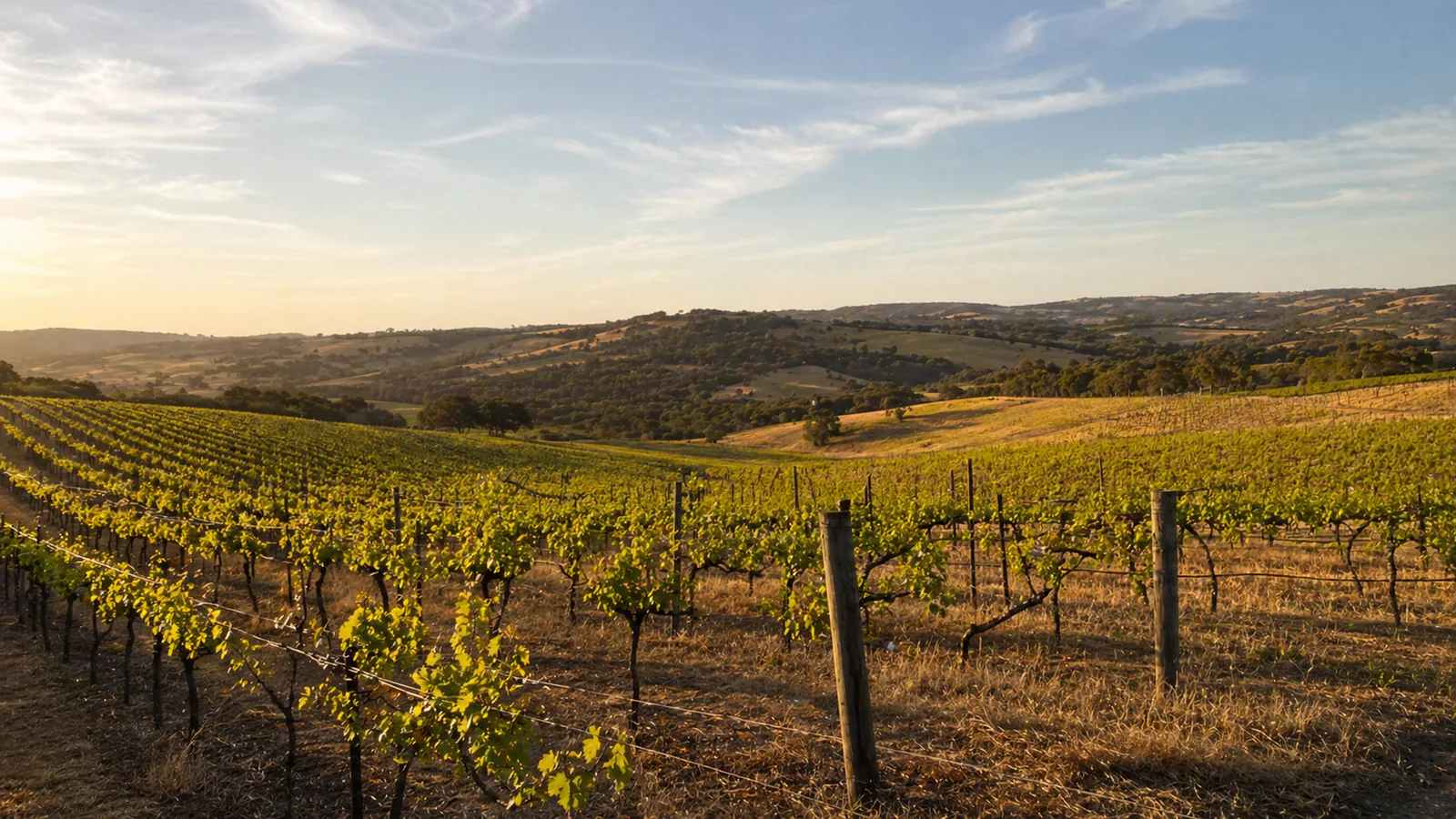
Australia spans more wine climates than almost any other producing country. A $20 Barossa Shiraz is dark fruit, chocolate, and oak. A $25 Clare Valley Riesling is steely, bone-dry, and built to age for 20 years. A Yarra Valley Pinot Noir tastes more like Burgundy than anything else from the Southern Hemisphere. The word ‘Australian wine’ doesn’t tell you what’s in the glass. The region does. This guide maps the major zones, explains what each one produces, and tells you where to start.
By the end of this page you’ll know:
- Why a $30 Barossa Shiraz tastes so different from a $30 French Syrah made from the exact same grape
- That Australia’s best Riesling rivals the finest from Germany, and almost nobody outside Australia has tried it
- Which region to head to based on whether you prefer big, bold reds or something lighter and more food-friendly
- Why Yarra Valley Pinot Noir looks nothing like anything else Australia makes, and why cool-climate Australian wine is having a moment
- The single region that offers the best price-to-quality ratio in Australian wine right now (it’s not the Barossa)
Why Does Australian Wine Have Such a Strong Reputation?
Australia is the fifth-largest wine-producing country in the world. It exports more wine than almost any other country, and for decades that export reputation rested on cheap, reliable, easy-drinking reds and whites. Yellow Tail, Jacob’s Creek, Hardys: affordable, crowd-pleasing, built in industrial volumes. There’s nothing wrong with any of that, but it shaped how a lot of people think about Australian wine, and that picture is about 20 years out of date.
The shift happened in the 2000s, when Australian producers started leaning into what their best vineyards actually do. Old-vine Shiraz from the Barossa. Single-vineyard Chardonnay from Margaret River. Aged Semillon from the Hunter Valley. These are wines that sit comfortably alongside France and Italy at the top of the market.
The key thing that separates Australia from most Old World countries: its GI (Geographical Indications) system is far less prescriptive than France’s AOC. Australian winemakers can plant what they like, blend across regions if they choose, and experiment without bureaucratic sign-off. That freedom is partly why the country’s wine scene evolved so quickly once producers decided quality mattered more than volume.
One more thing worth knowing: Barossa Shiraz vines pre-date phylloxera. The louse that devastated European vineyards in the late 1800s never reached most of South Australia, so Barossa still has ungrafted vines from the 1840s and 1850s. That’s an unbroken genetic lineage that most French regions can’t match. Old vines produce less fruit, but the concentration of flavour in each berry is extraordinary.
What Are Australia’s Most Important Wine Regions?
Australia has dozens of official wine regions, but six do most of the heavy lifting when it comes to quality wine that’s actually available internationally.
Barossa Valley, South Australia
The most recognisable name in Australian wine. The Barossa sits about 60km northeast of Adelaide, in a wide, sun-baked valley that gets very little rain and a lot of heat. Those conditions suit Shiraz perfectly: the grapes get very ripe, the wines are full-bodied, dark-fruited, and rich with notes of blackberry, chocolate, and smoked meat. Some bottles tip toward vanilla and mocha from American oak aging.
The sub-region of Eden Valley sits higher in the hills and runs significantly cooler. Eden Valley Shiraz is leaner and spicier; Eden Valley Riesling is genuinely world-class. If you see “Barossa” on a label it could be from either valley; “Eden Valley” on its own is more specific.
Key facts: starts around $20, sweet spot $35-60, iconic bottles (Penfolds Grange) can run into the hundreds. Best for: people who like Napa Cabernet, Northern Rhone Syrah, or any full-bodied, concentrated red.
McLaren Vale, South Australia
McLaren Vale is about 40 minutes south of Adelaide, where the hills meet the sea. The Mediterranean climate is slightly cooler and more maritime than Barossa. Shiraz here trades some of Barossa’s sheer power for more savoury, earthy complexity, with a distinctive “cocoa-dusty tannin” character that wine writers talk about constantly. It’s also one of the best spots in the country for Grenache and old-vine GSM blends (Grenache, Shiraz, Mourvedre).
McLaren Vale is arguably Australia’s best price-to-quality play right now. You can get outstanding bottles for $25-40 that would cost twice as much in the Barossa. Producers to look for: Yangarra, d’Arenberg, Hugh Hamilton.
Margaret River, Western Australia
Margaret River sits in the far southwest corner of Australia, isolated from the rest of the country’s wine scene by thousands of kilometres of bush. Its climate is strongly maritime, shaped by the Indian Ocean on one side and the Southern Ocean on the other. That means warm days, cool nights, and very consistent conditions year to year.
The result is Australia’s best Cabernet Sauvignon and some of its best Chardonnay. Margaret River Cabernet is structured, elegant, and genuinely Bordeaux-like in its balance. It ages beautifully and tends to sit in the $40-100 range for serious bottles, though entry-level pours start around $20. Key producers: Vasse Felix, Moss Wood, Cape Mentelle, Cullen.
Yarra Valley, Victoria
Just east of Melbourne, the Yarra Valley is Australia’s answer to Burgundy. The climate is genuinely cool, one of the coldest in the country for fine wine production. The wines are lighter, more restrained, and built for food in a way that most Australian reds are not. Pinot Noir here is pale, silky, and cherry-scented with an earthy undertow that has nothing in common with Barossa Shiraz. Chardonnay runs lean and mineral.
The Yarra Valley also produces excellent traditional-method sparkling wine, which makes sense: cool climate, high acid grapes. Prices start around $25 and top bottlings from producers like Oakridge, Coldstream Hills, and Punt Road run $50-80.
Clare Valley and Eden Valley, South Australia
These two neighbouring regions are responsible for Australia’s finest Riesling. Both run cooler than the valley floor, both produce bone-dry, searingly acidic Riesling that’s nothing like the off-dry German versions most people have tried. Young Clare Valley Riesling hits you with lime, green apple, and slate. Give it 8-10 years in a cellar and it turns into something honeyed, petrol-tinged, and profoundly complex.
This is the insider move in Australian wine: a $25 Clare Valley Riesling with 8 years’ age on it is one of the great bargains in the wine world. Producers to seek: Grosset, Jim Barry, Skillogalee.
Hunter Valley, New South Wales
Australia’s oldest wine region, with records dating to the 1820s. The Hunter sits north of Sydney and runs hot and humid during harvest, which sounds like a recipe for bad wine and occasionally is. But the Hunter’s signature grape, Semillon, thrives under those conditions in a completely counterintuitive way.
Young Hunter Valley Semillon is almost aggressively lean: low alcohol (around 10.5%), razor-sharp acidity, barely any flavour. Wait 10-15 years and it transforms. The acids mellow, complex notes of buttered toast, lemon curd, and lanolin develop, and you’re left with something unique to this one patch of earth. Tyrrells and Brokenwood are the names to know. Hunter Shiraz is lighter and earthier than Barossa, built more for food than for the glass on its own.
What’s the Difference Between Shiraz and Syrah?
Same grape. Different name, different style.
In France and most of Europe, the grape is called Syrah. In Australia and most of the New World, it’s Shiraz. The genetic material is identical. What’s different is what climate does to it.
Warm Australian climates ripen Shiraz fully, pushing the fruit toward blackberry, plum, and chocolate, softening the tannins, and lifting the alcohol. The wines are generous, approachable, and designed to be enjoyable without food. Northern Rhone Syrah, by contrast, grows in a cooler, steeper continental climate. The wines are darker and spicier, with more pepper, smoked meat, and graphite, and they typically need food or a few years’ cellaring to open up.
Cool-climate Australian regions complicate this clean picture. Yarra Valley Shiraz, Eden Valley Shiraz, and Adelaide Hills Shiraz all look much more like Northern Rhone Syrah than anything from the Barossa. If someone tells you they don’t like Australian Shiraz because it’s too big and jammy, a cool-climate bottle will change their mind.
What Are Australia’s Most Planted Grape Varieties?
Shiraz is the undisputed king, planted across virtually every Australian wine region. Warm-climate versions are full-bodied and chocolatey; cool-climate versions are spicy and lean.
Cabernet Sauvignon is the second most widely planted red, and Margaret River makes the country’s finest expressions: structured, age-worthy, blackcurrant-driven.
Chardonnay does double duty in Australia. Cheap versions are the bland, heavily oaked wines that damaged the grape’s reputation everywhere in the 1990s. Good versions, especially from Margaret River and Yarra Valley, are elegant, complex, and genuinely exciting.
Merlot is grown widely but rarely produces standout wines in Australia. It tends to turn soft and pruney in warm climates. It’s a blending grape here more than a star.
Pinot Noir is the rising star. Cool-climate regions including Yarra Valley, Mornington Peninsula, and Tasmania are producing Pinot Noir that competes comfortably with mid-tier Burgundy.
Riesling thrives in Clare Valley and Eden Valley. Bone dry, high acid, superb aging potential. Criminally underrated outside Australia.
Sauvignon Blanc is grown across the country but rarely matches Marlborough New Zealand’s aromatic intensity. More restrained, leaner, less blockbuster.
Semillon is uniquely Australian in the Hunter Valley style: low alcohol, high acid when young, transforming into something complex and honeyed with age. McLaren Vale and Barossa Semillon is blended with Sauvignon Blanc for early-drinking whites.
Grenache is having its moment. Old-vine Barossa and McLaren Vale Grenache, often blended into GSM (Grenache, Shiraz, Mourvedre) or bottled on its own, is one of the most exciting things happening in Australian wine right now. Garnet-coloured, silky-textured, with raspberry and dried herb notes. It pairs brilliantly with roast lamb, charcuterie, and anything off the barbecue.
Where Should You Start If You’re New to Australian Wine?
Four bottles, under $100 combined, covering the full range of what Australia does:
1. A Barossa Valley or McLaren Vale Shiraz, $20-30. This is your entry point. Look for something from d’Arenberg, Langmeil, or Shottesbrooke. Pair it with grilled lamb, a beef burger, or hard cheese. You’ll understand immediately why Australian Shiraz became so popular worldwide.
2. A Clare Valley or Eden Valley Riesling, $20-28. Pick something from Jim Barry, Grosset, or Knappstein. Serve it cold with grilled fish, prawns, or just on its own as an aperitif. It should taste like lime juice, green apple, and something almost mineral. If it tastes sweet, that’s not Clare Valley Riesling. It’ll be bone dry.
3. A Margaret River Chardonnay, $25-35. Look for Vasse Felix or Cape Mentelle at this price point. This is restrained, elegant Chardonnay with just enough oak to add texture without tasting like a plank of wood. Try it with roast chicken or pasta with cream sauce.
4. A Yarra Valley or Mornington Peninsula Pinot Noir, $25-35. Coldstream Hills, Yering Station, or Stonier at this price. Pour it slightly cool (around 16°C). It should be pale ruby, light on its feet, and taste of cherry, forest floor, and faint spice. Pair it with salmon, duck, or mushroom dishes.
That four-bottle spread costs you $90-120 and will teach you more about Australian wine than most people learn in a decade of drinking it.
Frequently Asked Questions
Why does Australian wine have a kangaroo on it?
Plenty of Australian wines use kangaroos, koalas, or other native animals as branding because international export buyers respond to those images: they’re immediately identifiable as Australian. It started with mass-market brands in the 1990s and became something of a shorthand for “affordable Australian wine.” Better producers generally avoid it, so a kangaroo on the label is not a quality indicator either way, just a marketing choice.
What’s the difference between Barossa Valley and McLaren Vale Shiraz?
Both are warm-climate South Australian Shiraz, but they taste distinct. Barossa Shiraz tends to be bigger and more concentrated, with deeper dark fruit, more chocolate, and a fuller body. McLaren Vale Shiraz runs slightly cooler and more savoury, with an earthy, dusty-cocoa tannin character and a bit more restraint. If you want the biggest, most opulent glass of red you can find under $40, reach for Barossa. If you want something that goes better with food and has a bit more complexity, McLaren Vale is the pick.
Is Australian Riesling sweet?
Clare Valley and Eden Valley Riesling is bone dry. This surprises a lot of people because German Riesling, which most people have tried, is often off-dry or outright sweet. Australian Riesling is the opposite: very high acid, very dry, with lime and slate flavours rather than honey and peach. If you’ve ever said you don’t like Riesling because it’s too sweet, try a Clare Valley bottle and reconsider.
What does GSM mean on an Australian wine label?
GSM stands for Grenache, Shiraz, Mourvedre: the three Rhone Valley red grapes blended together. It’s a common style in McLaren Vale and the Barossa, producing wines with the richness of Shiraz balanced by the silky texture of Grenache and the earthy depth of Mourvedre. GSM blends tend to be more food-friendly and less heavy than straight Shiraz, and they often over-deliver at the $20-35 price point.
What’s a good Australian wine under $20?
For red, look for McGuigan Bin 9000 Shiraz, Oxford Landing Cabernet Sauvignon, or anything from the Yalumba Y Series range. For white, the Yalumba Y Series Viognier or a Peter Lehmann Riesling will beat most wines at the price. Under $20 is where Australia genuinely excels: the sheer volume of decent wine produced means competition keeps quality high at the entry level.
Are Australian wines too alcoholic?
Warm-climate Australian Shiraz does run high: 14.5% to 15.5% is common. That warmth in the glass is real. But it’s not universal across Australian wine. Yarra Valley Pinot Noir typically sits at 12.5-13.5%. Hunter Valley Semillon is often 10.5-11%. Clare Valley Riesling runs 11.5-12.5%. If you find big Barossa reds too hot, the cool-climate regions give you a completely different experience.
Australia’s size means it never had to be one thing. You can find wines here that look like Bordeaux, taste like Burgundy, and drink like nothing else on earth. The Barossa is the best place to start, but once you’ve got a Clare Valley Riesling in the fridge and an old-vine McLaren Vale Grenache open at dinner, you’ll realise just how much ground there is to cover.
Ready to go deeper on one region? The Barossa Valley guide covers old-vine Shiraz, Eden Valley’s cooler side, and how much to spend at every price point. For the bigger picture on where Australia fits among the world’s great wine countries, the wine regions of the world guide maps it all out.
Keep Reading
Barossa Valley: Australia's Shiraz Capital Explained
What Barossa Valley wine actually is, why old-vine Shiraz costs what it does, Eden Valley's cooler side, and how much to spend. Plain-English guide.
Wine Regions of the World: A Plain-English Guide
Old World vs New World, the major regions in each, how climate shapes style, and where to start drinking. The pillar guide for curious wine drinkers.