Claire Bennett
Wine Editor16 min read
Chile Wine Guide: Carmenere, Regions, and Where to Start
Chilean wine made simple. Maipo, Colchagua, Casablanca, Carmenere, Cab Sauv, Sauvignon Blanc, and exactly where to start for under $25.
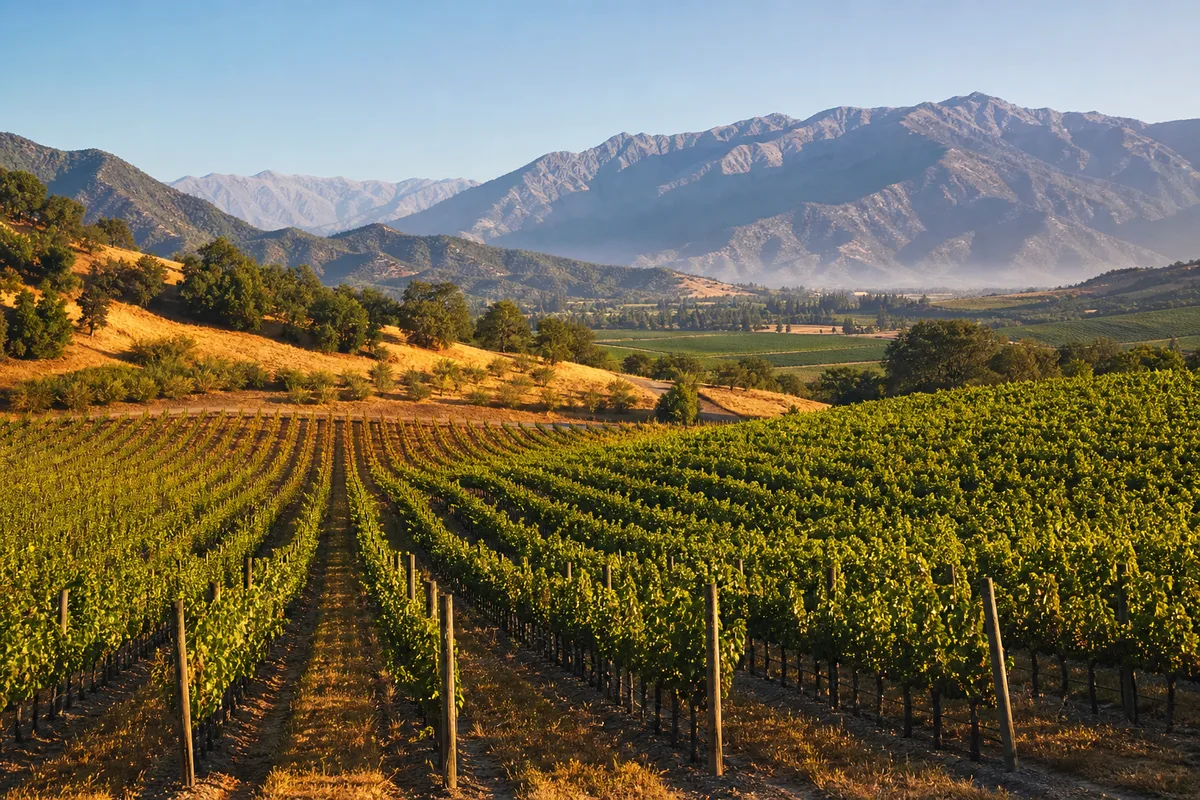
Chile Wine Guide: Carmenere, Regions, and Where to Start
You pick up a bottle labelled Chilean Merlot, pour it, and immediately notice it’s more interesting than any Merlot you’ve had before. There’s a dark fruit core, a hint of green pepper, something almost smoky underneath. You check the back label more carefully and spot a small line: “contains Carmenere.” That’s the moment most people discover that Chile has been quietly producing one of the wine world’s most distinctive grapes for over 150 years, and that most of it was mislabelled until a French scientist untangled the mystery in 1994.
That story alone makes Chile worth paying attention to. But there’s more to it. Chile’s geography creates two completely different wine climates within a few hundred kilometres of each other, which means you can find crisp, mineral Sauvignon Blanc and big, structured Cabernet Sauvignon from the same country, sometimes from the same producer. Add in consistently fair prices and you start to understand why sommeliers keep returning to Chilean shelves when they want to overdeliver on a budget.
This guide maps the whole picture.
By the end of this page you’ll know:
- The grape that disappeared from France for 130 years and was only found because Chilean winemakers noticed something was off about their “Merlot” (the answer changes how you read Chilean wine labels forever)
- Why Chile has never had phylloxera, the vine disease that destroyed virtually every vineyard in Europe in the 1800s, and what that means for the vines you’re drinking today
- How the temperature difference between a coastal Casablanca morning and a Colchagua afternoon creates two wine styles so different you’d barely guess they were from the same country
- The reason a $25 Chilean Cabernet Sauvignon consistently outdrinks $50 bottles from warmer climates, and it has nothing to do with the grape
- Where the real value pocket in Chilean wine sits right now: a price band where $15 to $25 routinely delivers what most regions charge $40 for
Why Does Chile Matter So Much for Wine?
Chile is sandwiched between two of the world’s most extreme geographic features. To the north sits the Atacama Desert, one of the driest places on earth. To the east, the Andes mountain range rises to peaks above 6,000 metres. The Pacific Ocean sits to the west. The result is a natural fortress that has kept Chile agriculturally isolated in ways that have turned out to be profoundly useful for wine.
That isolation means Chile has never had phylloxera. The vine louse devastated European vineyards in the 1860s to 1880s, forcing growers to replant almost every vine in France, Spain, Italy, and Germany onto disease-resistant American rootstocks. Chile escaped entirely. The Andes act as a barrier to soil-borne pests from the east, the desert blocks movement from the north, and the ocean to the west prevents migration that way too. As a result, many Chilean vineyards still grow on their original ungrafted rootstocks, the same genetic material planted when the vines first went into the ground. That genetic continuity is rare, and it produces wines with a depth and complexity that’s genuinely different from vines replanted after phylloxera.
The country is also one of the longest and narrowest on earth. Chile stretches roughly 4,300km from north to south but averages just 177km east to west. That extreme length creates enormous climate variation: from scorching desert conditions in the north to cool, rain-fed Patagonian conditions in the south. Most fine wine production is concentrated in the central regions, between Santiago and Bio-Bio, where Mediterranean-like conditions provide the sunshine and warmth vines need while the Andes and the Pacific create the cooling influences that preserve acidity and freshness.
Chile produces around 12 to 13 million hectolitres annually, ranking it seventh among the world’s wine-producing nations. Most of it is excellent value. The combination of low land costs, year-round sunshine, and reliable harvests means Chilean producers can make commercially sound wine at prices that would be impossible to replicate in Napa or Burgundy.
What Are Chile’s Most Important Wine Regions?
Maipo Valley
The most prestigious Chilean wine region, sitting directly south of Santiago, and the heartland of Chilean Cabernet Sauvignon. The climate is warm and Mediterranean-like: long, dry summers with plenty of sunshine and cool nights thanks to Andean air. Those conditions ripen Cabernet Sauvignon fully while preserving the structure and acidity that make the wines age-worthy.
Two sub-zones matter here. Alto Maipo sits at higher elevation, closer to the Andes, where cooler temperatures produce more structured, mineral-edged Cabernet with firmer tannins and a longer lifespan. Lower Maipo is warmer and more generous: rounder fruit, more immediate pleasure, more approachable in youth.
The benchmark bottles are Almaviva (Chile’s most famous wine, a Bordeaux-style blend made by a joint venture between Concha y Toro and Baron Philippe de Rothschild) and Don Melchor (Concha y Toro’s single-vineyard flagship Cabernet). Both are in the $60 to $120+ range. Solid, genuinely complex Maipo Cabernet starts at $25 to $35 and punches well above that price.
- Signature grape: Cabernet Sauvignon
- Signature style: blackcurrant, cedar, graphite, firm structured tannin, long finish
- Price start point: $25 to $35 for genuinely complex bottles
Colchagua Valley
About 200km south of Santiago, Colchagua is Chile’s answer to a warm, productive inland red-wine valley. Red wine country through and through: Cabernet Sauvignon, Carmenere, Merlot, and Syrah all do well in this sheltered, sun-drenched valley. The wines tend toward full body, generous fruit, and a warmth that makes them immediately satisfying.
Colchagua is the region that put Chilean Carmenere on the global map. Lapostolle’s Clos Apalta is one of Chile’s most celebrated wines, and Montes regularly shows that Colchagua Carmenere can be as polished and complex as anything the region produces. At the everyday level, Colchagua is where you find the $20 to $30 bottles that overdeliver reliably.
- Signature grapes: Carmenere, Cabernet Sauvignon, Syrah
- Signature style: dark fruit, spice, generous body, smooth-textured finish
- Price start point: $20 to $30 for a genuinely good bottle
Casablanca Valley
The cooling breakthrough in Chilean wine. Casablanca sits between the Coastal Range and the Pacific Ocean, close enough to the water that cold marine fog rolls in from the ocean every morning. Those cool, misty mornings slow ripening significantly, preserving the acidity and aromatic intensity that white grapes need to be interesting rather than just ripe.
Casablanca produces Chile’s best Sauvignon Blanc and some of its most expressive Chardonnay. The Sauvignon Blanc here has a lean, precise quality: lemon, green apple, fresh herbs, a mineral finish. Cooler than Marlborough in New Zealand’s ripest years, more aromatic than Bordeaux. The region also makes excellent cool-climate Pinot Noir, with red cherry fruit, earthy notes, and a lightness that’s unusual in Chile.
When Casablanca first emerged in the late 1980s and early 1990s, it changed the conversation about what Chile could produce. Before it, the assumption was that Chilean wine meant reds. Casablanca proved the whites could be world-class.
- Signature grapes: Sauvignon Blanc, Chardonnay, Pinot Noir
- Signature style: crisp, precise, citrus-forward, mineral edge, fresh herbs
- Price start point: $15 to $25
San Antonio and Leyda Valley
Casablanca’s even cooler neighbour, sitting closer to the Pacific and benefiting from stronger maritime influence. Leyda in particular has developed a reputation for Pinot Noir and Sauvignon Blanc with more salinity and structural tension than you typically find in Casablanca. The wines feel leaner, more precise, and sometimes more complex.
The valley is smaller and more boutique than Casablanca. You’ll find fewer labels at mainstream retail, but when you do spot a Leyda Pinot Noir or Sauvignon Blanc from a producer like Viña Leyda or Casa Marín, it’s worth picking up. Prices sit around $20 to $30.
- Signature grapes: Sauvignon Blanc, Pinot Noir
- Signature style: saline, structured, leaner than Casablanca, more tension
- Price start point: $20 to $30
Aconcagua Valley and Aconcagua Costa
The Aconcagua Valley runs inland toward the Andes from the city of Quillota, north of Santiago. The warmer inland sections produce structured Cabernet Sauvignon and some interesting Syrah. The coastal sub-zone, Aconcagua Costa, sits where the valley meets the Pacific and enjoys much cooler conditions. Errazuriz has done the most to develop Aconcagua Costa as a serious sub-appellation, particularly for Pinot Noir, which shows a finesse and elegance that rivals much more expensive bottles from Burgundy.
- Signature grapes: Cabernet Sauvignon (inland), Pinot Noir and Sauvignon Blanc (coastal)
- Price start point: $20 to $35
Bio-Bio and Itata (Southern Chile)
Cooler, wetter, and more traditionally farmed than the central regions. The wine style here is lighter and fresher: aromatic whites from Muscat, old-vine Cinsault and País (the original Spanish mission grape brought to Chile by Jesuit missionaries in the 1500s).
País is having a moment. Ignored for decades as a low-quality bulk grape, it’s now causing genuine excitement among natural wine fans and younger sommeliers who recognise what old-vine, dry-farmed wine from ancient vines can produce. The best Itata País has a pale ruby colour, fresh red fruit, bright acidity, and a wild, earthy character that’s unlike anything else in Chilean wine. Producers like Garage Wine Co., Cacique Maravilla, and A Los Vinateros Bravos are making compelling bottles at $20 to $35.
- Signature grapes: País, Cinsault, Muscat
- Signature style: light, fresh, earthy, wild fruit, natural-wine adjacent
- Price start point: $20 to $35 for the interesting boutique producers
What Is Carmenere and Why Is It Only in Chile?
Carmenere originated in Bordeaux, where it was one of six permitted red grape varieties used in blends alongside Cabernet Sauvignon, Merlot, Cabernet Franc, Petit Verdot, and Malbec. When phylloxera devastated French vineyards in the 1860s and 1880s, growers replanted almost everything using American rootstocks. Carmenere was largely abandoned in the process: it ripened inconsistently, tended to produce poor yields, and growers found it difficult to manage compared to more reliable varieties. By the early twentieth century, it had essentially disappeared from France. The official conclusion was that the grape was commercially extinct.
In Chile, the story had been unfolding differently. Cuttings of Carmenere had arrived in the country before phylloxera struck Europe, carried by the first wave of European settlers establishing vineyards in the mid-1800s. Because Chile never had phylloxera, those vines simply kept growing. Decade after decade, they sat alongside plantings of Merlot, producing similar-looking leaves and similar-looking fruit. The two varieties look almost identical when the grapes are unripe: same leaf shape, same cluster structure, same dark colour before full maturity.
For over a century, an unknown but substantial proportion of what Chile called “Merlot” was actually Carmenere. Chilean producers sold it as Merlot, wrote it on labels as Merlot, and largely didn’t question why some batches tasted slightly different.
In 1994, a French ampelographer named Jean-Michel Boursiquot was visiting Chilean vineyards and noticed something wrong. Examining the vines more closely, he confirmed what some growers had begun to suspect: an enormous proportion of Chile’s “Merlot” was Carmenere, the variety France had declared extinct 130 years earlier. The discovery sent ripples through the Chilean wine industry and prompted years of vineyard audits as producers tried to figure out exactly what they’d been growing.
Today, Carmenere is Chile’s signature grape. The variety is almost exclusively cultivated in Chile; nowhere else has it at any scale. When properly ripened, it produces wines with dark plum and blackberry fruit, a characteristic note of green pepper, paprika, or chocolate, and naturally smooth tannins. The green pepper character comes from pyrazines, the same compounds present in Cabernet Franc and Sauvignon Blanc, and it’s more pronounced when the grapes are picked before they’re fully ripe. The best Carmenere producers understand this: they wait longer to harvest, allowing the pyrazines to reduce and the fruit to come forward.
At $20 to $30, a good Colchagua or Cachapoal Carmenere is one of the best value-for-complexity plays in the wine aisle.
How Does Chilean Geography Create Two Completely Different Wine Styles?
The key axis in Chilean wine is the tension between two cooling forces: the Pacific Ocean to the west and the Andes to the east. Depending on where a vineyard sits relative to those two influences, the wines taste almost nothing alike.
Coastal and cool (Casablanca, Leyda, Aconcagua Costa, Bio-Bio): The Pacific sends cold Humboldt Current water up the Chilean coast, chilling the air and generating morning fog that sits in the valleys. Temperatures stay moderate through summer, ripening is slow, and grapes arrive at harvest with high natural acidity and pronounced aromatics. The wines are leaner: crisp whites with citrus and mineral notes, light to medium-bodied Pinot Noir, fresh Sauvignon Blanc with herbs and sharp fruit. These are the bottles that change the perception of Chilean wine as “only reds.”
Inland and warm (Maipo, Colchagua, Cachapoal): These valleys sit far enough from the coast that the Pacific fog rarely arrives. Long, dry, sunny days push ripeness, producing fuller-bodied reds with darker fruit, more tannin structure, and the kind of concentrated character that Cabernet Sauvignon and Carmenere need to reach their potential. The Andes contribute cooling overnight temperatures that slow ripening just enough to preserve freshness, but these are still warm-climate red-wine valleys.
The Andes also contribute meltwater. Many Chilean vineyards are irrigated using glacier meltwater from the Andes rather than groundwater. That matters partly for vineyard health and partly for phylloxera: the louse travels through soil moisture and root systems, and the combination of dry, sandy soils in parts of Chile and the fresh, clean irrigation water has helped keep the country disease-free.
The practical implication for you as a buyer: if you want something crisp and fresh, look for Casablanca or Leyda on the label. If you want something full-bodied and satisfying, reach for Colchagua or Maipo.
Where Should You Start If You’re New to Chilean Wine?
Four bottles, under $80 combined, covering every style worth knowing.
Casablanca Valley Sauvignon Blanc ($15 to $18). Your entry point for Chilean whites. Look for producers like Concha y Toro’s Casillero del Diablo Casablanca bottling, Cono Sur Bicicleta, or Veramonte’s Casablanca. You’ll get lemon and green apple fruit, a fresh herbal edge, and the kind of clean, precise finish that makes this a natural pair for grilled fish, oysters, or a simple green salad. Drink it cold, drink it young.
Colchagua or Maipo Cabernet Sauvignon ($20 to $25). The Chilean red that shows you what the country does best. Carménère gets more attention, but Cabernet Sauvignon is where Chilean wine has the longest track record and the highest quality floor. Look for Montes Alpha, Concha y Toro Marques de Casa Concha, or Santa Rita Medalla Real. Blackcurrant and cedar, firm but approachable tannin, a clean finish. Pairs with anything red-meat adjacent: steak, lamb, a mushroom-heavy pasta.
Colchagua Carmenere ($18 to $22). The bottle that makes the story make sense. Try Lapostolle’s Cuvee Alexandre Carmenere, Luis Felipe Edwards Carmenere, or Emiliana Organic Carmenere. You’ll taste dark fruit, that distinctive paprika-and-pepper note, smooth tannins, and a richness that’s immediately more interesting than a comparable Merlot. This is the grape that was supposed to be extinct. It’ll surprise you every time.
Casablanca or Leyda Pinot Noir ($20 to $25). The most underrated category in Chilean wine. Cono Sur’s Casablanca Pinot Noir is one of the most reliable over-deliverers in the $20 range. Viña Leyda makes a more structured version closer to $25. Red cherry and earth, fresh acidity, medium weight. Pair it with salmon, roast chicken, or anything with mushrooms.
Frequently Asked Questions
What does Carmenere taste like?
Carmenere has dark plum and blackberry fruit, a characteristic note of green pepper, paprika, or dried herbs, smooth tannins, and a full body. The green pepper note varies a lot depending on how the wine was made: wines from producers who harvest later, when the grapes are fully ripe, taste more of dark chocolate and spice. Wines picked earlier show stronger capsicum or herbal character. At its best, Carmenere sits somewhere between a ripe Merlot and a more structured Cabernet Franc, with its own distinctive savoury edge.
Is Chilean wine better value than Argentine wine?
Both countries produce excellent value, and comparisons depend on what you’re after. Chile is generally the stronger option for fresh whites (Casablanca Sauvignon Blanc has no real Argentine equivalent at the same price) and for structured Cabernet Sauvignon. Argentina leads on Malbec, producing the world’s best examples at every price point. For a side-by-side test, compare a $20 Colchagua Carmenere with a $20 Mendoza Malbec. Both will outperform most $40 bottles from Europe or Napa. Which you prefer will tell you a lot about your palate.
What’s the best Chilean wine region for red wine?
Colchagua and Maipo are the two benchmark red-wine regions. Colchagua is warmer, more generous, and produces the country’s most celebrated Carmenere and some excellent Cabernet Sauvignon. Maipo is more focused, more prestigious at the top end, and the heartland of Chilean Cabernet Sauvignon. If you want the most value-for-money reds, Colchagua is the answer. If you want the wines that Chilean winemakers point to as their finest Cabernet, the answer is Alto Maipo.
Why does Chilean wine sometimes smell like green pepper?
That green pepper, capsicum, or herbaceous note comes from pyrazines, a group of aromatic compounds found naturally in certain red grape varieties. Carmenere and Cabernet Franc both carry higher pyrazine levels than most grapes. The compounds are more pronounced in grapes that haven’t fully ripened, which is why you notice the pepper character more in some bottles than others. Producers who harvest earlier (often to manage yields or because of difficult weather) will make wine with more pronounced green notes. Producers who wait for full ripeness get dark fruit and spice instead. If you find the greenness distracting, look for Carmenere from a warm vintage or a producer known for riper picking decisions, like Clos Apalta or Montes Purple Angel.
What food pairs well with Chilean wine?
Colchagua Carmenere or Maipo Cabernet Sauvignon pairs naturally with red meat: steak, slow-braised lamb, beef short rib. The dark fruit and smooth tannin in Carmenere also works well with anything smoky: grilled meats, barbecue, anything with a char. Casablanca Sauvignon Blanc is one of the most versatile food wines at its price point: oysters, grilled fish, ceviche, goat’s cheese, or a simple chicken salad. Chilean Pinot Noir from Casablanca or Leyda does best with lighter dishes: roast chicken, salmon, duck, mushroom risotto.
Is Chilean wine the same quality as French wine?
At the entry level ($15 to $25), Chilean wine consistently outperforms French wine of the same price. A $20 Colchagua Carmenere or Maipo Cabernet delivers more complexity, more structure, and more character than a $20 Languedoc red. At the top end, the comparison changes. Chile’s best bottles (Almaviva, Don Melchor, Clos Apalta) compete with very good Bordeaux and Rhone wines at $60 to $120+. They don’t yet match the very top tier of premier and grand cru Bordeaux in terms of prestige or price. The honest read: for everyday drinking under $35, Chilean wine is one of the best decisions you can make at the bottle shop.
Chile rewards buyers who pay attention to regions and grapes rather than just the country name. Once you know the difference between Casablanca’s crisp whites and Colchagua’s full-bodied reds, the wine aisle stops looking generic and starts looking like a series of specific choices you can make with confidence.
For the wider picture on how Chile fits into South American wine more broadly, the wine regions of the world guide maps all the major producing countries in one place.